



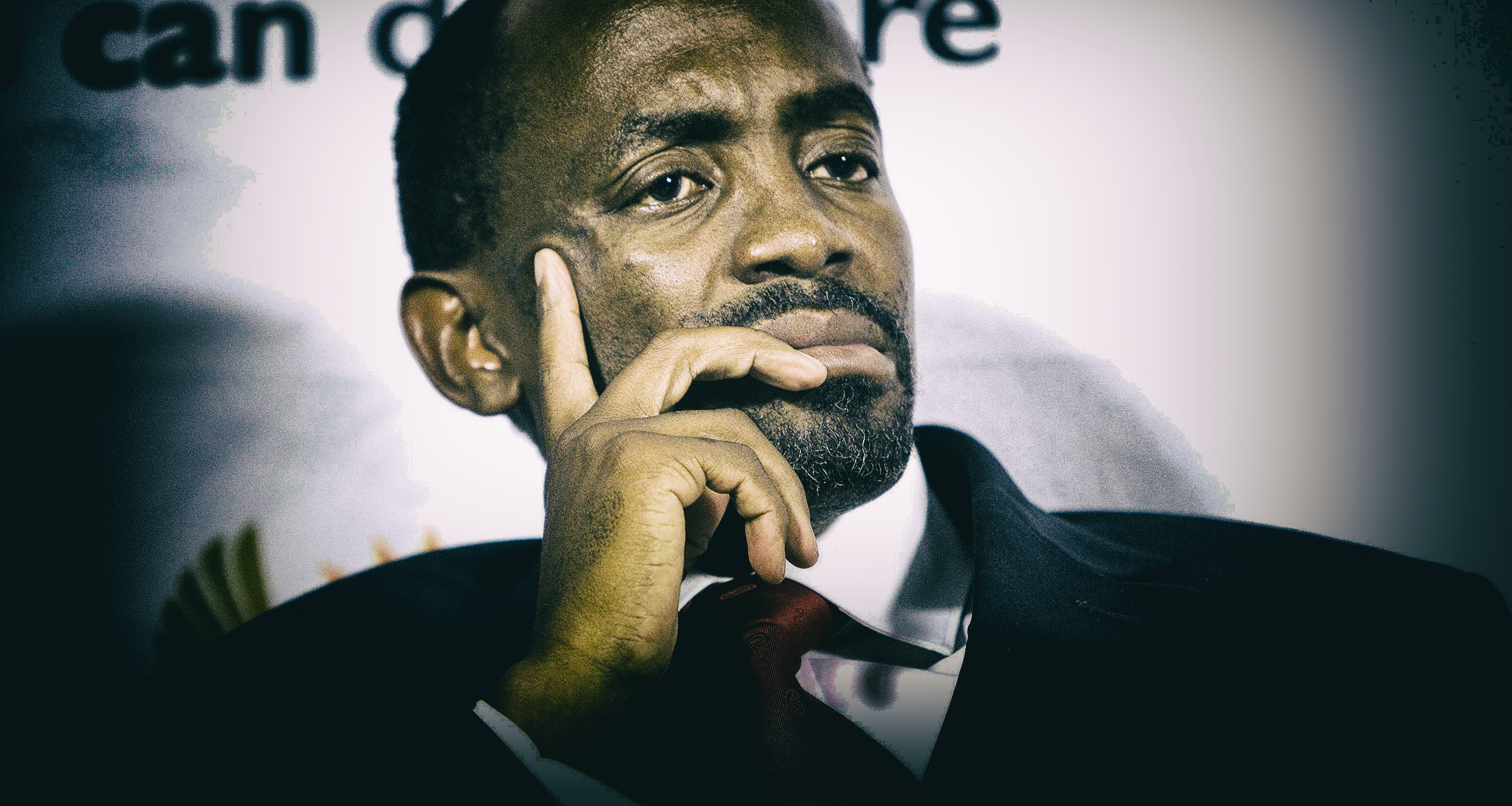
 Former NPA head advocate Menzi Simelane testified at the Khampepe Commission of Inquiry on Tuesday. (Photo: Alet Pretorius / Gallo Images / Foto24)
 Advocate Menzi Simelane, the former head of the National Prosecuting Authority (NPA) whose appointment by President Jacob Zuma in 2009 was deemed irregular by the Constitutional Court in 2012, found himself caught between a legal rock and a revolutionary hard place.
Testifying on Tuesday at the Khampepe Commission of Inquiry into alleged political interference in Truth and Reconciliation Commission prosecutions, Simelane explained how discussions at a forum of directors-general — convened to implement President Thabo Mbeki’s April 2003 pronouncement regarding the “unfinished business” of the TRC — took place in a “politically laced” atmosphere.
“Discussion in that forum on TRC matters was always a political discussion,” Simelane told the inquiry.
/file/dailymaverick/wp-content/uploads/b773f9ee35ec173928047a019ad5e6c2.jpg "Former ANC president Thabo Mbeki congratulates newly elected ANC president Jacob Zuma during a leadership conference in Polokwane in December 2007. (Photo: Greg Marinovich)")
He testified that ANC members of these intergovernmental forums were “first and foremost politicians. Some of them in their own right. Some were MK members who became DGs. That was the function of deployment,” said Simelane.
These members preferred old Struggle hierarchies to their new government leadership roles as civil servants and brought to their new roles the paranoia, suspicion and mistrust stemming from exile.
He said senior members who had been in exile preferred to be addressed as “Commissar, as someone who leads political discussions.”
A “commander”, on the other hand, he said, was regarded as a “strategic leader”. These exiles all knew the then NPA head, advocate Vusi Pikoli, as a former MK member and a director-general in the Department of Justice, which is why his “fellow comrades could not understand that he was not following orders”.
/file/dailymaverick/wp-content/uploads/1db36b480b2fcce1f79fa37232a63890.jpg "Former NPA head Vusi Pikoli. (Photo: Supplied)")
“Those labels found their way into discussions, and people would say, ‘But he is one of us. He understands us and how we think, who we are and why we think what we do’,” Simelane explained.
Simelane was catapulted into the position after his predecessor, Pikoli, was suspended by Mbeki in 2008 when he refused to bend to executive creep in the business of the NPA as well as TRC prosecutions.
Involvement
Simelane said he was not testifying at the inquiry as someone who had “received a notice to appear as a person of interest”, but because, after listening to some of the testimony, he wondered, “Why had they not just asked me?”
He said matters had come to a head when Pikoli refused to terminate the employment of advocate Anton Ackermann, the then head of the Priority Crimes Litigation Unit (PCLU) dealing with TRC matters.
Ackermann has testified to the Khampepe Commission that he had never intended to prosecute senior ANC leaders, including Mbeki, and that the impression that he was hellbent on doing so was incorrect and mendacious.
It was National Police Commissioner Jackie Selebi, a key Mbeki ally, who championed the rumour that Ackermann was poised to arrest ANC leaders. Despite numerous meetings with senior Cabinet members, this allegation served as the primary pretext for interfering with the NPA. Though never a member of MK, Selebi held a high-ranking position within the ANC’s leadership structures during exile.
/file/attachments/orphans/DMJackie-Selebi-MAIN-PHOTO_934275.jpg "Jackie Selebi leaves the Gauteng High Court in Johannesburg, on 2 August 2010, where he was appearing on corruption charges. He was found guilty and sentenced to 15 years’ imprisonment. (Photo: Siphiwe Sibeko / Reuters)</p>
<p>")
Ackermann testified that the date of a memorandum he had written in 2003 was later forged to read “2006” to justify the claim of the imminent arrests. On Tuesday, Simelane said he had never seen the memorandum and was unaware of the forgery allegations.
Ackermann also testified that a report claiming that ANC members were about to be arrested for the 1989 poisoning of the Rev Frank Chikane had been planted by Jan Wagenaar, the legal representative of former apartheid generals.
No independent decisions
Simelane set out that at the time not a single government department could take a decision on its own, and if a director-general or senior member “slacked off” it was “reported upwards”.
“That is how you get recognised. That is where friendships are lost.”
Simelane said he had tried to resolve the obstacles between Pikoli and ANC leaders and former MK members who had wanted Ackermann removed.
“They all said, ‘We don’t want Ackermann.’ As I said, discussions about the TRC were always political. It was not a typical programme discussion”.
Zero cooperation
He told the inquiry that Selebi did not want to second resources to the PCLU, and neither did the National Intelligence Agency or any other government department. Debates, he added, often revolved around people in exile who were suspected of being Askaris (turned liberation movement fighters), and who could be trusted and who could not.
“Those titles, of commissar and commander, I learned were a matter of revolutionary pride. They [senior MK members] would have informal discussions about how they functioned outside South Africa.”
Engagement by these senior MK members with the apartheid government of the time was always done, said Simelane, “with a sense of hurt and anger. You could tell these guys had a specific view about that system, about the people the imagined they were working with on certain levels.”
Their attitude towards Ackermann was “deeply resentful”, he said
“They literally wanted nothing to do with him. There were times I feared for his life. They felt so strongly about him.”
/file/attachments/2990/Gemini_Generated_Image_dx2mz9dx2mz9dx2m1_483498.png "Advocate Anton Ackermann. (Image: Gemini AI)")
The West Wing
During the period of the clash between Pikoli and the Department of Justice and other arms of the executive, Simelane was Pikoli’s deputy and had tried to arrange various meetings to clear up the Ackermann matter. But, said Simelane, Pikoli was clear: he would not be removing Ackermann.
“We had a meeting in the West Wing. It was not a cluster meeting, but there was tension in room 157,” Simelane recalled.
Everything had been put on the table, including complaints that had been received by the PCLU of abuses in the ANC’s Quatro prison camp in Angola and that some individuals had been falsely accused and were seeking redress.
“There was an ‘us and them’ attitude. You are prosecuting our leaders, therefore you are fighting with us when we should be nation-building, when reconciliation is the agenda of the government, and you are asked to buy into it.”
He said the attitude was, “‘However you feel about the past, please cooperate within that bigger project.’ That continues till this day.”
Ackermann has accused Mbeki of being Machiavellian with regard to the TRC, saying that while the former President had promised prosecutions, he had created a secret entity outside of the NPA to deal with cases where amnesty had not been applied for.
Mbeki has denied this.
Judicial independence
Meanwhile, on Monday, 30 March, the Gauteng Division of the High Court dismissed an application by Mbeki and Zuma, supported by President Cyril Ramaphosa, seeking Judge Sisi Khampepe’s removal as chair of the commission of inquiry.
The court found that the applicants had failed to obtain the necessary prior consent required to sue a judge. The presiding judges emphasised Section 47 of the Superior Courts Act, which served as a safeguard for judicial independence, protecting individuals from unwanted litigation arising from their duties. DM