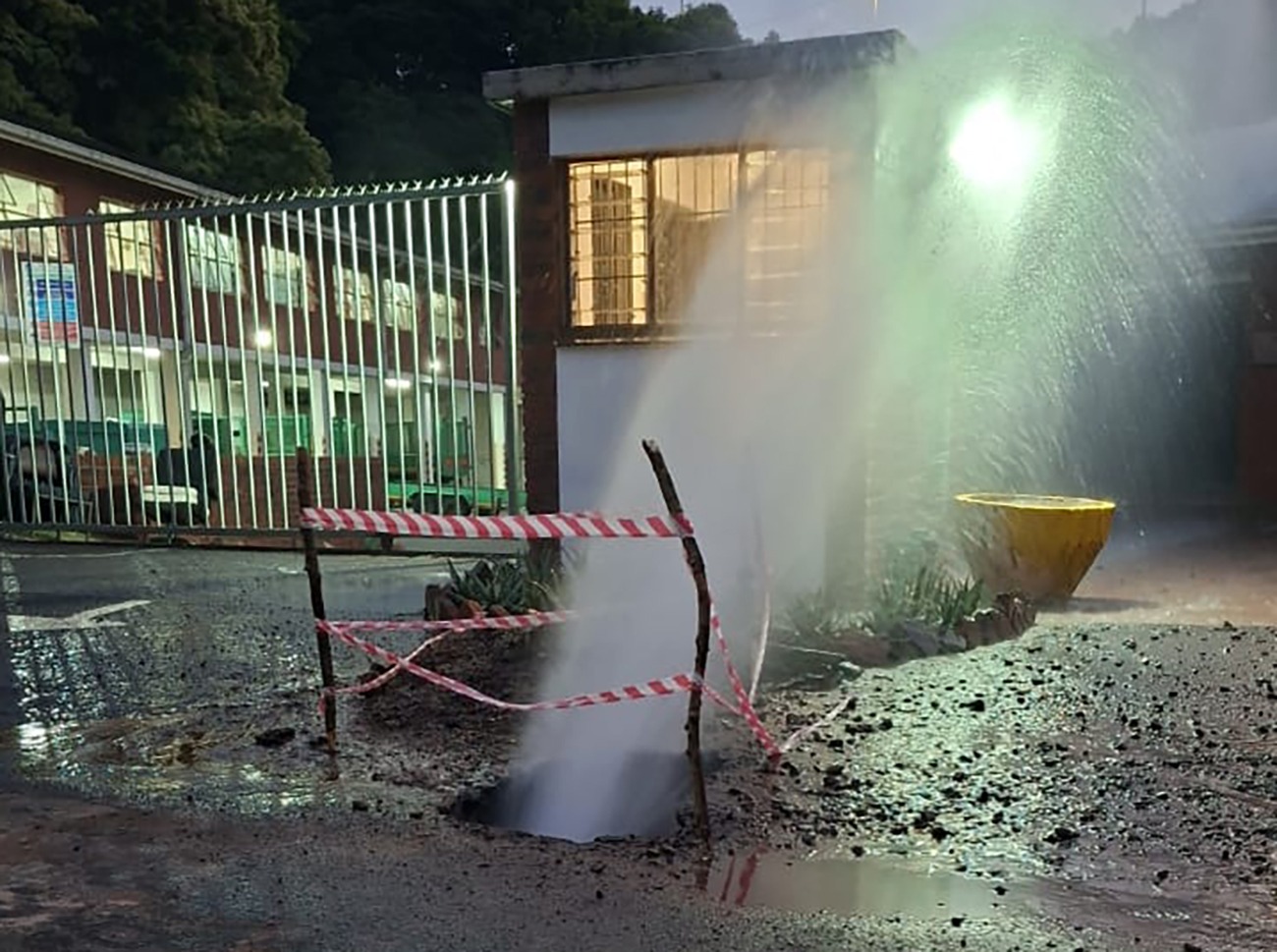
 A fountain of water gushes from a leaking water pipe in Durban North last month. (Photo: Supplied)
 Don’t ask us to build more dams — fix your leaking pipes first. That was the blunt message to municipalities across South Africa from a senior Department of Water and Sanitation (DWS) official on Tuesday, 31 March, when the department released three audit reports on the declining state of South Africa’s water and wastewater treatment plants.
Anet Muir, chief director of water use compliance monitoring and enforcement, said the volume of water leaking from old or damaged pipes in Gauteng (431 million cubic metres per annum) was now almost equivalent to the entire volume of purified tap water supplied to the Western Cape (464 million cubic metres per annum).
More than 35% of purified tap water (296 million cubic metres per annum) is gushing out of leaking pipes in KwaZulu-Natal — just slightly less than the entire volume of purified water supplied to the province of Limpopo every year (297 million cubic metres per annum).
The Blue Drop progress report also revealed which province’s residents were responsible for the most water consumption. Gauteng is leading, consuming 243 litres per capita per day, while the national average is 215.
Although no detailed city or town data on non-revenue water was provided by the department, it is understood that most of the water leaking in KZN comes from Durban’s ageing and neglected water pipe network. Daily Maverick requested a copy of this data from the eThekwini Municipality last week, but city officials have yet to respond.
/file/attachments/orphans/drop2physicalwaterlossesbyprovincesourceDWS_364823.jpg "Examples of the massive water volumes going to waste across South Africa. (Source: DWS)")
“We can’t build more dams. We must fix the holes,” said Muir during a live-streamed event from the Steve Tshwete Municipality banquet hall in Middelburg, Mpumalanga.
Three reports were released by the department:
- An 800-page Green Drop report auditing the performance of nearly 1,000 wastewater (sewage) treatment works, more than 3,000 pump stations and over 73,000km of sewer pipelines across the country.
- A much shorter, 27-page No Drop progress report that assesses tap water losses and water-use efficiency
- A 33-page Blue Drop progress report on the status of the drinking water supply risk in South Africa, which found that most water supply systems are currently classified as safe, but with significant risks emerging in some provinces.
Urgent attention
The Blue Drop risk report fiound that drinking water risks are concentrated in a limited number of weaker-performing provinces, with the Western Cape and Gauteng showing the best performance, while the Northern Cape and Free State required “urgent attention” due to their comparatively high proportion of high- and critical-risk systems.
Water and Sanitation Minister Pemmy Majodina said, “It is important to note that drinking water systems in major metropolitan areas are generally performing well in terms of Blue Drop key performance areas.
“Where municipalities indicate that water supplied meets the requirements of the Sans 241 [national water standards], the public can safely consume water from their taps. Residents should, however, verify with their municipalities that testing and compliance with Sans 241 are being carried out.”
On the question of leaks and water that is not paid for, Majodina said that at the national level, the percentage of non-revenue water was 47.3%.
In simple terms, that means that roughly half the purified tap water in South Africa is going to waste or is not paid for.
/file/attachments/orphans/drop3WhyNonRevenueWaterisaBigDealsourceDWS_929855.jpg "Why non-revenue water is a major problem. (Source: DWS)")
/file/attachments/orphans/drop4NRWlossesbyprovince_774569_541482.jpg "The latest statistics on non-revenue water at a provincial level. (Source DWS)")
“The underlying causes of poor performance in terms of [all three] Drop reports include non-adherence to standard operating procedures for drinking water treatment and wastewater treatment, infrastructure in a poor condition due to lack of maintenance, and municipalities failing to hire qualified staff or prioritise budgets for maintenance and operations,” said Majodina.
“Weak billing and revenue collection, poor municipal leadership and management, and the absence of a legal requirement for municipalities to use water and sanitation revenue for maintenance further exacerbate the problem.”
She noted that the findings of the three Drop reports were corroborated by research from the Department of Cooperative Governance, National Treasury, the Auditor-General, and other institutions, all of which indicated that many municipalities cannot effectively discharge their governance and service delivery mandates.
Criminality and corruption
These challenges were compounded by “organised criminality, corruption, vandalism, attacks on critical water and energy infrastructure, and infrastructure decay.”
The minister suggested that the reports were not only “a mirror reflecting weaknesses” but also “a compass pointing toward what is possible”.
Without competent personnel, disciplined operations, effective governance and consequence management, infrastructure would continue to fail, and communities would continue to suffer.
“Colleagues, municipalities, engineers, and water professionals, this report must be your turning point. Confront it honestly, develop corrective action plans, strengthen operations, fill critical vacancies, restore discipline, and act with urgency. Communities cannot live with broken promises or polluted rivers. To the people of South Africa, you have every right to demand better. Your water, your sanitation, your health, and your dignity are non-negotiable.
“Decline is not destiny, failure is not permanent, and broken systems can be rebuilt. With courage, discipline, competence, and collective resolve, South Africa can turn this tide. Let this be the moment when we refuse to normalise sewage pollution, reject complacency, and choose responsibility, action and service,” said the minister.
Yet, despite this frank acknowledgement of the problems and her bold declarations that government at all levels should be held to account, the country clearly has a long road to travel to fix the rot and give effect to the DWS slogan that “Water is Life and Sanitation is Dignity”.
/file/attachments/orphans/drop6MidmarDaminKZNsourceUmngeniUthutkelaWater_568769.jpg "Midmar Dam is one of the largest reservoirs in KwaZulu-Natal, but purified water supplies are running low due to pipe leakages in Durban and other urban centres. (Photo: Umngeni-Uthukela Water)")
In his presentation on the underlying reasons for the poor performance, the DWS director-general, Dr Sean Phillips, reiterated that standard operating processes for drinking water treatment and wastewater treatment were not being adhered to.
- Municipal infrastructure was in poor condition due to a lack of maintenance;
- Municipalities were not hiring the necessary staff with the correct qualifications;
- There was “non-prioritisation” of budgets for maintenance and operations by municipal councils;
- Billing and revenue collection systems were weak; and
- There was “poor municipal leadership and management”.
“There is no legal requirement for municipalities to use revenues from the sale of water and from sanitation charges to fund the maintenance and operation of water and sanitation infrastructure,” said Phillips.
One particular area of concern was the high staff vacancy rates in municipal water departments.
According to the DWS, there are 26,246 positions in these departments (excluding water treatment staff), of which 7,426 (28%) positions are vacant.
In some provinces, water service authorities had less than 50% of positions filled.
The full report is available on the Department of Water and Sanitation website. DM