




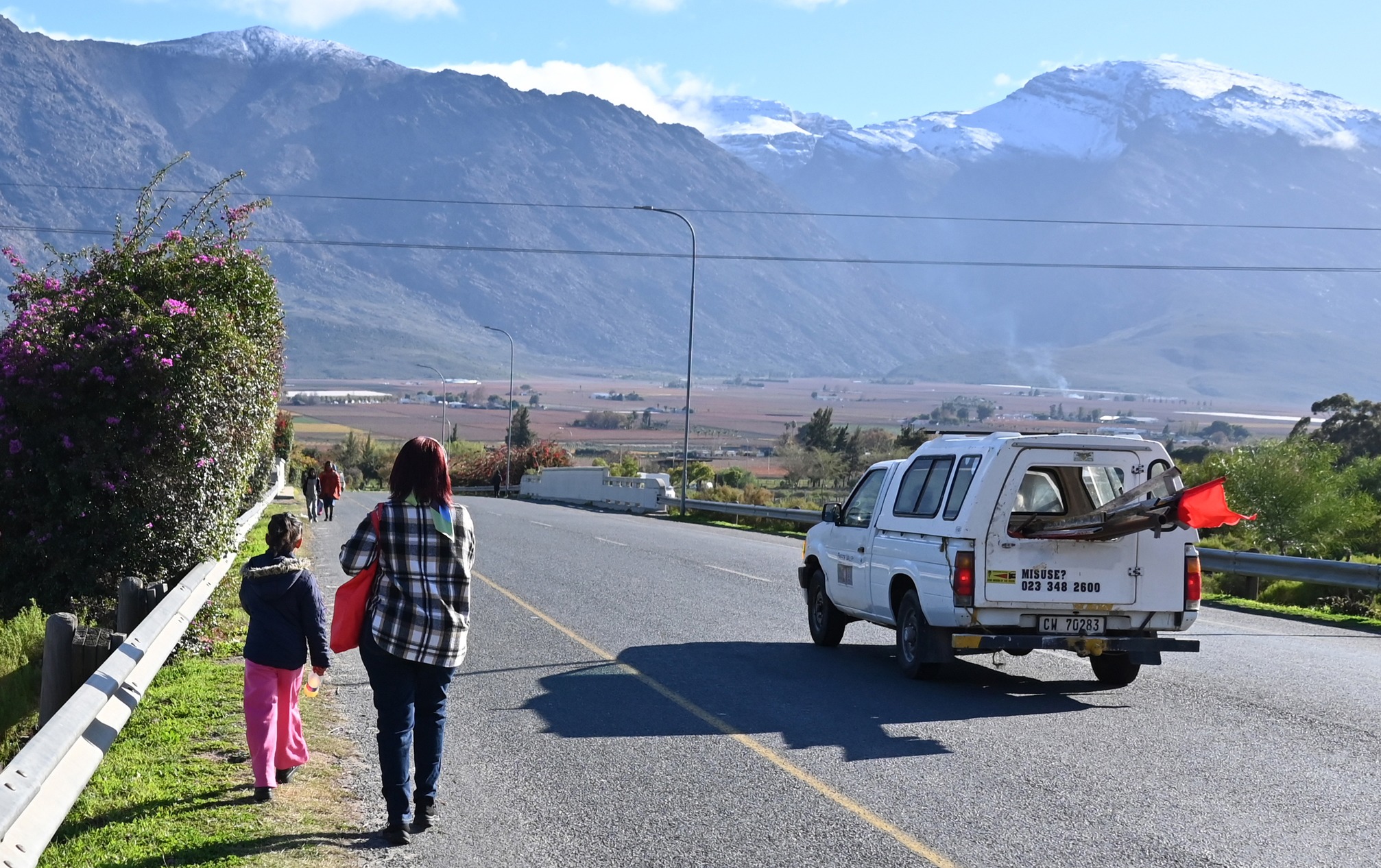
 The vast majority of households in De Doorns subsist on around R2,300 a month, relying on seasonal work at grape farms between October and February. (Photo: Nathi Nqobile)
 Annalise Abrahams* from De Doorns in the Western Cape is a seasonal farm worker.
She wakes up early in the morning, surrounded by mountains that touch the clouds, shacks and small houses, in a place which translates to “the thorns”. She works for around R2,300 every fortnight at a grape farm, when there is work. During the off-season, the workers are “laid off”.
“I was born here, actually. [I] went to school here, matriculated here, and ever since, I’m here. It was my dream to leave De Doorns. It was my dream to go and study further. I really wanted to be a doctor.”
At that time, NSFAS and other funds did not exist to help families that did not have money. She was unable to study to be a doctor. Abrahams came from a single-parent household.
“My mother was also a farmworker. That’s why I decided I’m also going to go work. So I work during schooltime, just to help my mom.”
Despite getting pregnant in high school, she matriculated. About a decade later, Abrahams got married. Unfortunately, a few years later, she was widowed. Now, she supports her children and grandchild singlehandedly.
Minimum wage, maximum work
“It’s not easy work. But it is a very important job, because we learn to plant those trees, we learn to grow, we do everything. At the end of the day, the boers (farmers) get all the profit, and they can’t even pay us a living wage.”
She lives in her mother’s house, which was left to her after she passed.
“Early in the morning, we have to get up. Especially during winter time, the sun is getting out very late, so we are going to work in the dark and when you come home, it’s already dark.”
They work eight hours during the winter and in season, nine hours. It all depends on the needs of the farm, she said. If it’s packing time, the workers put in another hour or two of overtime.
In the valley, they work on export grapes, for both wine and food. They begin with pruning while it is still winter and organise the branches of the vines on to the corresponding wires. The plants then begin to flower. The workers must prune again. As Abrahams said, there’s a lot to do to prepare the vineyard before they even pluck the grapes off the branches and pack them.
/file/attachments/orphans/DeDoorns_6719_343068.jpg "Common pesticides used on grape farms include fungicides, insecticides, herbicides such as glyphosate (Roundup Turbo) and growth regulators such as Dormex. (Photo: Nathi Nqobile)")
Health and safety
“Pesticides are a very important factor for the farms, but it’s very bad for our health and for our condition. Because the pesticides is killing. If someone gets in contact with the pesticides, they’re starting to get a rash on their body, especially for the men that are spraying the pesticides. They don’t have protective clothes. What are those pesticides going to do to them?
“They must have PPE. They must have the right gloves, they must have the right overalls, they must have the right shoes, and they must have the right mask. And after spraying, they must have a place to go and wash themselves, put their clothes away. All those precautions must be put in place for them. But what about people like us, that is working in the vineyards? The sprayer is spraying here, where we are, still working.”
Abrahams said that they had to touch the areas that had been sprayed.
“We do not even get training. After the pesticide is sprayed, you must go into that vineyard,” she explained. “I’m especially referring to Dormex. It’s the most dangerous pesticide we are dealing with.”
For the grapes, it was good, she emphasised, but it was not good for people.
“It doesn’t matter what it does to the workers, as long as that pesticide is getting into the vineyard in time for the blooming and everything — that is their main goal and focus.”
Abrahams says she first brought the pesticide issue to the bosses ages ago. She said that farmers did not listen, and if they brought it up, they were likely to be fired and labelled as a troublemaker. Abrahams said that if you were chased away from a job, people could not simply apply at another farm close by, as the farmers communicated with one another about “troublemakers”.
“We as farmworkers, people did recognise and see us,” Abrahams said about attending the People’s Tribunal on Agrotoxins. “People must be held accountable for the wrong things they do — that’s where I get my power from.
“My mother died, not even getting a chance to get a decent, living wage [as a farmworker]. Going forward, to get that living wage, I’m also not going to get it. I’m putting this struggle forward for my next generation that comes – that there, maybe, a bigger solution or they are going to get that decent living.”
Physical effects of pesticide exposure
Many people and unborn children had died because of the pesticides, she said, whether it was a result of women working the fields or sprayers who did not have the correct PPE.
Dormex is suspected of causing cancer, of damaging fertility and foetuses, and of damaging organs through repeated or prolonged exposure.
Abrahams said that exposed farmworkers often suffered from skin issues, affected eyes and breathing problems.
The adverse health effects from contact with hydrogen cyanamide (Dormex) include severe irritation and ulceration of the eyes, skin and respiratory tract.
She said workers had not been offered a medical explanation for how they developed their health issues.
“Not everybody’s immune system is strong, like the others. For a couple of days, your chest is so sore, your throat is so sore, [from] that pesticide. It’s not good.”
She said that the doctors would book workers off for a day or two, depending on symptoms. There was no communication between local doctors and farmers about what could be causing the symptoms, Abrahams said.
She said that when farmworkers died, she had never seen a farm owner attend a funeral. At most, she’d seen the farm manager.
The life of a farm labourer
/file/attachments/orphans/DeDoorns6647_704161.jpg "A 2017 study, titled De Doorns research report, noted xenophobia and outsider exclusion in the area and found that about 4.2% of the population had no schooling, with a 6% primary school completion rate and a 13.7% high school completion rate. The area had a high rate of malnutrition, with many children relying on school meals. (Photo: Nathi Nqobile)")
Abrahams listed the cost of electricity, food and debts from loan sharks, incurred from trying to make it through the month, as serious financial burdens.
“People in power can give us that money so we can live. They are making huge profits. For now, in this valley, for this season, all his grapes were exported. There was no rain for this packing season. This season, all of the farmers got a 100% profit. What did we get? [A] bonus is not a must. What did we get for a thank you? R500.”
Abraham mentioned the cycle of poverty in rural areas where children left school early to work to help families, and where children also fell into gangsterism and begging because of widespread poverty and lack of options.
Abrahams said that human rights and laws protected the farm owner, not the farm worker.
“I really want to be a farm owner and have my own farm. Treat people the way they must be treated. Pay them the money they must get paid,” Abrahams said.
“If I can be an owner of my own land, then I can grow my own vegetables, eat from my garden, grow organic products, not have to use pesticides, be my own boss, pay for my kids’ school education. I’m not going to stop dreaming.” DM
*Annalise Abrahams’ name and other details have been changed to protect her identity.