




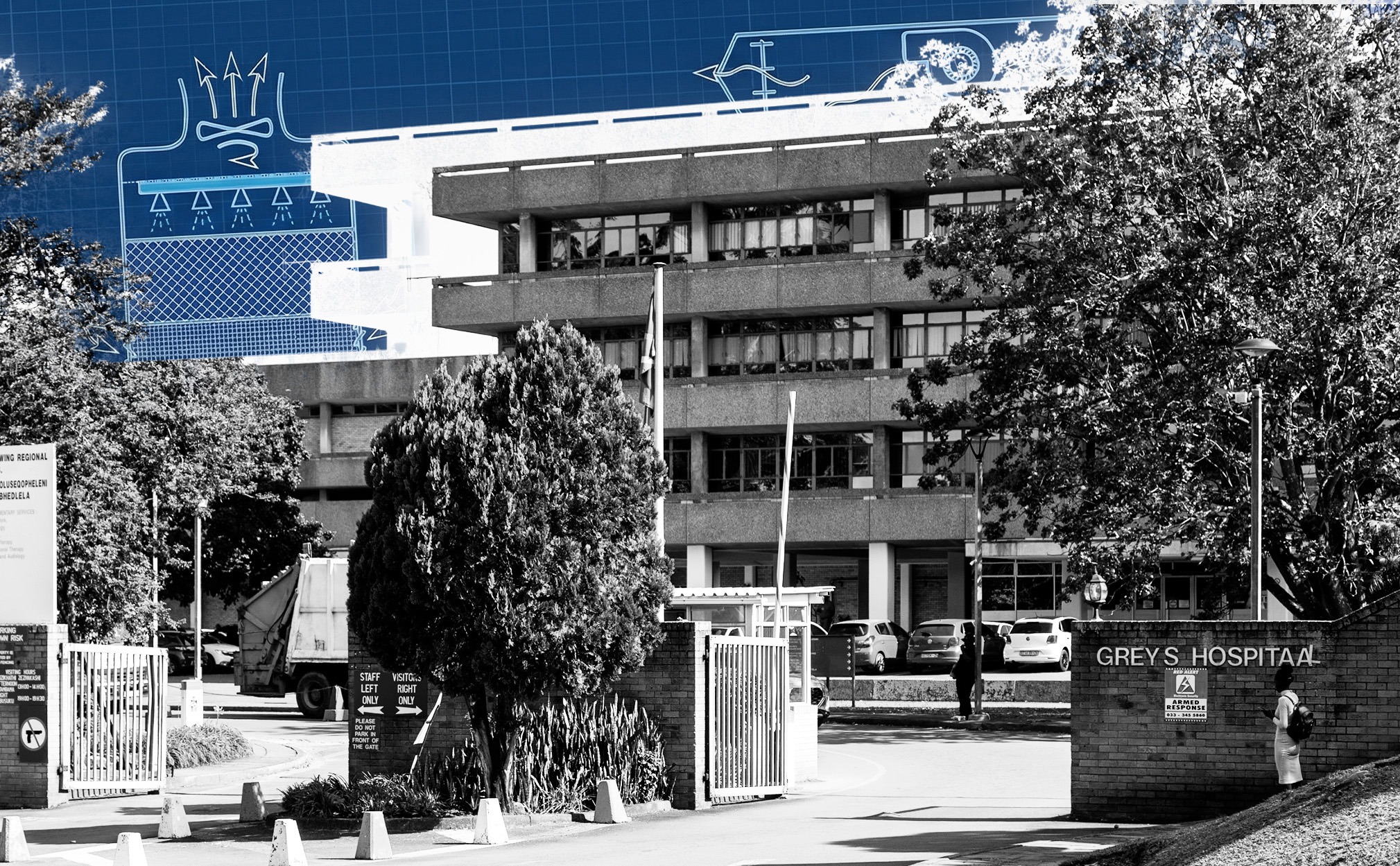
 Illustrative image: Grey’s Hospital. (Photo: Rogan Ward) | Diagram. (Supplied)
 Tuesday, 31 March 2026, was supposed to mark the completion of a new heating, ventilation and air-conditioning (HVAC) system at Grey’s Hospital in Pietermaritzburg that would keep operating theatres cool and sterile.
But the project has not yet begun.
Instead, the hospital’s HVAC system, a 45-year-old industrial plant that should have been replaced two decades ago, continues to operate. It has been failing for years, pushing theatre temperatures beyond safe limits and forcing surgery cancellations.
A replacement project, listed as a strategic priority in 2022, has not reached the construction stage.
The project has been stalled since 2017 by slow consultant appointments, scope changes that forced the replacement build back to the drawing board, and what appears to be a fundamental breakdown in coordination between the two departments responsible, the KwaZulu-Natal departments of health and public works.
/file/attachments/orphans/260320_ARD7488_148348.jpg "The visitors’ entrance at Grey’s Hospital. (Photo: Rogan Ward)")
The machine
An operating theatre’s HVAC system controls temperature, humidity and airflow, keeping airborne contaminants away from open wounds and conditions tolerable for the people working in them.
The system at Grey’s is a large industrial chilled-water plant, installed in the early 1980s. It works in three stages. Chillers are like large electric refrigerators that produce cold water. Air-handling units use that water to cool and dry the air entering the theatres, blowing it across cold-water pipes the way a fan cools air over ice. Cooling towers dump the extracted heat outside. In better times, three chillers ran, with a fourth held in reserve for heatwaves.
The system’s design life was 25 years. On that estimate, it should have been replaced in 2005.
“Over the years, constrained maintenance budgets appear to have contributed to inadequate preventative maintenance,” said the head of the KZN Department of Public Works and Infrastructure, Vish Govender. Maintenance of the system, he noted, is the KZN Department of Health’s responsibility.
A consulting engineer with extensive experience on systems like Grey’s HVAC system put it simply: “It’s like your car. You have to service it.”
An HVAC has a finite life — 15 to 25 years by industry benchmarks — but will last longer if maintained well. “We have replaced systems that operated for 30 to 40 years,” said the engineer, “but it will only last that long if really well-maintained.’
The Grey’s HVAC was not well-maintained. A 2013 hospital report shows maintenance staff warning they were severely understaffed and that provincial control over budgets and supply chains was slowing their work. By the early 2020s, the chillers were “constantly breaking”, according to another report. And in 2022, a contractor warned in correspondence that a cooling tower had critically deteriorated and was at risk of collapse. “It has done its service,” he wrote.
“The age-related deterioration,” said Govender, “explains why problems associated with the system have been occurring since approximately 2011”.
Human costs
Those consequences arrived long before today’s deadline.
Internationally recognised standards set the acceptable range for operating theatre temperatures at 20–24°C, with relative humidity between 20 and 60%. Staff and internal records showed temperatures reaching 28°C in December, and ranging from 24–26°C across most theatres on multiple mornings through March – before surgeons, patients and theatre lights added further heat. Humidity readings in the same period ran from 70% to 84%, well above the upper limit of the internationally recognised standard.
/file/attachments/orphans/GreysHospitalHVACsystemInfographicv2_763215.jpg)
Surgeons operating in the heat have strapped gauze swabs to their foreheads, or had colleagues mop their brows with sanitary pads, to stop sweat dripping into open wounds.
When chillers tripped and theatre slates were reorganised around what could safely be done in the heat, delayed procedures pushed patients to the back of lists already measured in years. One surgeon told us some disciplines were making bookings for 2029 or 2030.
“The patient load already far outweighs the resources,” said another. “Now, with wasted theatre slates, everything gets deferred and snowballs.”
The Witness reported how one patient, referred to Grey’s for a kidney procedure, waited more than a year through successive postponements, her condition worsening. She was still waiting when journalist Chris Ndaliso spoke to her in February. She refused a discharge. “I don’t know what else to do,” she told him.
In January 2026, Grey’s management issued a memo instructing theatre staff how to operate under the heat: when to exercise “heightened vigilance”, when to postpone, and when to cancel. Temperatures up to 26°C were described as within the “acceptable clinical safety margin” — already above the upper limit of the internationally recognised standard. One surgeon read the memo as a directive to keep operating.
/file/attachments/2990/2026-03-30_12-49-30_805463.png "The main operating theatre at Grey’s Hospital. (Photo: KZN Department of Health)")
Grey’s is the only public facility in western KwaZulu-Natal providing tertiary surgical care — urology, paediatric surgery, spinal surgery, gynaecologic oncology, complex obstetrics, and more — to a catchment of roughly 4.5 million people. For those patients, there is nowhere else in the public system to go.
“In private medical care, one can walk out and go look for another option,” a surgeon told us. “Not so in state.”
The delay
The project to replace Grey’s HVAC system began in 2017, when the KZN Department of Health (DoH) appointed the KZN Department of Public Works and Infrastructure (DPWI) as its implementing agent.
The project has been edging forward and backwards ever since.
The DPWI advertised for a consultant in 2018. By 2020, that consultant had produced a conceptual proposal for a new HVAC system across the entire hospital. The DoH rejected it as too expensive, and split the project into two, DPWI head Govender said. Phase 1 would cover the theatre block only. Phase 2, the rest of the hospital, remains unbudgeted and on ice.
The consultant went back to the drawing board and, by 2022, had produced a revised proposal. But, Govender said, the DoH then changed its technology preference, and there was another reset.
What happened next is difficult to establish. A DoH internal document from early 2023 described the project as already in its design development stage — and forecast completion by 31 March 2026 — but Govender told us that a DoH infrastructure committee only approved the project’s advancement to that phase in April 2024. The two accounts cannot be reconciled on the available record.
What followed is equally unclear. The DPWI advertised for a full professional team between August and December 2024. Their appointment was “significantly delayed due to prolonged procurement processes in 2024 and 2025”, said the DPWI, without explaining why. As of this week, said Govender, that team was still finalising the planning work that the April 2024 approval was meant to have cleared, and he anticipates a presentation to the DoH head, Penny Msimango.
/file/attachments/orphans/ED_439700_204320.jpg "Penny Msimango, the head of the KZN Department of Health. (Photo: Gallo Images / Darren Stewart)")
But the DoH told the KZN Health Portfolio Committee, in a report tabled a fortnight ago, that consultants were finalising design development — a stage further than where the DPWI says the project stands.
The two departments responsible for this project are telling different stories. Neither account fully coheres.
Both departments said they were moving urgently. In a February presentation to the portfolio committee, the DoH described bimonthly strategic meetings with the DPWI to address delayed projects, and said it intended to declare the Grey’s HVAC replacement an emergency. There is no public record that such a declaration was ever made. In the same presentation, the DoH told the committee that most capital projects allocated to the DPWI were delayed, that designs were taking up to five years to complete, and that health institutions were “frustrated”.
In a statement published on its Facebook page in February, the DoH said the theatres had “from time to time experienced technical glitches; a normal occurrence in such environments.” The department did not respond to our questions.
What it means
The failure at Grey’s is not, experts say, an isolated operational lapse.
Helen Schneider, a health policy and systems researcher at the University of the Western Cape, said all health systems face resource constraints: “You’re always having to make rationing choices.”
But she drew a sharp line between unavoidable strain and preventable failure. A constrained system, she said, requires “good governance and leadership to make decisions”. Where those decisions are not being made, “where clear gaps in leadership, incompetence and poor administration create unconscionable delays”, those failures must be named and addressed.
A split jurisdiction between health and public works departments for facility infrastructure, she said, diffuses accountability and routinely produces delays.
Alex van den Heever, a health systems expert at the Wits School of Governance, reviewed a summary of our findings.
“It’s symptomatic, I’m afraid,” he said. The failure of equipment essential to healthcare delivery, he argued, is the predictable outcome of weakened accountability, distorted procurement incentives, and chronic management failures combining to normalise system breakdown. This was “an institutional environment in which dysfunction becomes predictable because the conditions that allow it are repeatedly reproduced”.
/file/dailymaverick/wp-content/uploads/2024/02/04-Prof-Alex-van-den-Heever.jpg "Professor Alex van den Heever. (Photo: YouTube)")
DPWI head Govender, in his response to our questions, was precise about what must happen: “Comprehensive maintenance strategies, combined with life-cycle planning and budgeting, are essential for all hospital services and equipment to ensure patient safety, continual service delivery, extended asset lifespan, and cost-effective resource allocation. Infrastructure replacement must be incorporated into long-term life-cycle planning so that replacement can occur timeously.”
That standard, by his own department's account, was not met at Grey's.
In February, KZN Health Portfolio Committee chair Imran Keeka (DA) called on Health MEC Nomagugu Simelane and department head Msimango to provide a “clear, funded and time-bound plan”.
/file/attachments/orphans/Leg-Caucus-14-scaled_932094.jpg "The chairperson of the KZN Health Portfolio Committee, Dr Imran Keeka. (Photo: DA)")
Keeka told Daily Maverick that the DoH had been relying on “patchwork” fixes to the HVAC for want of funding for a full replacement. “Interim measures and procedural memos do not substitute for safe, functional operating theatres,” he said. “The question is no longer whether protocols are being followed, but whether patients are being placed at risk.”
According to surgeons interviewed, patients are already being placed at risk.
In mid-March, the DoH told the committee it had allocated R34.2-million for the HVAC upgrade in the coming financial year. A further R4.1-million had already been spent. How much more the full replacement will cost, and when construction will begin, the DoH has not said. DM
/file/dailymaverick/wp-content/uploads/Scorpio-Logo.jpg)