





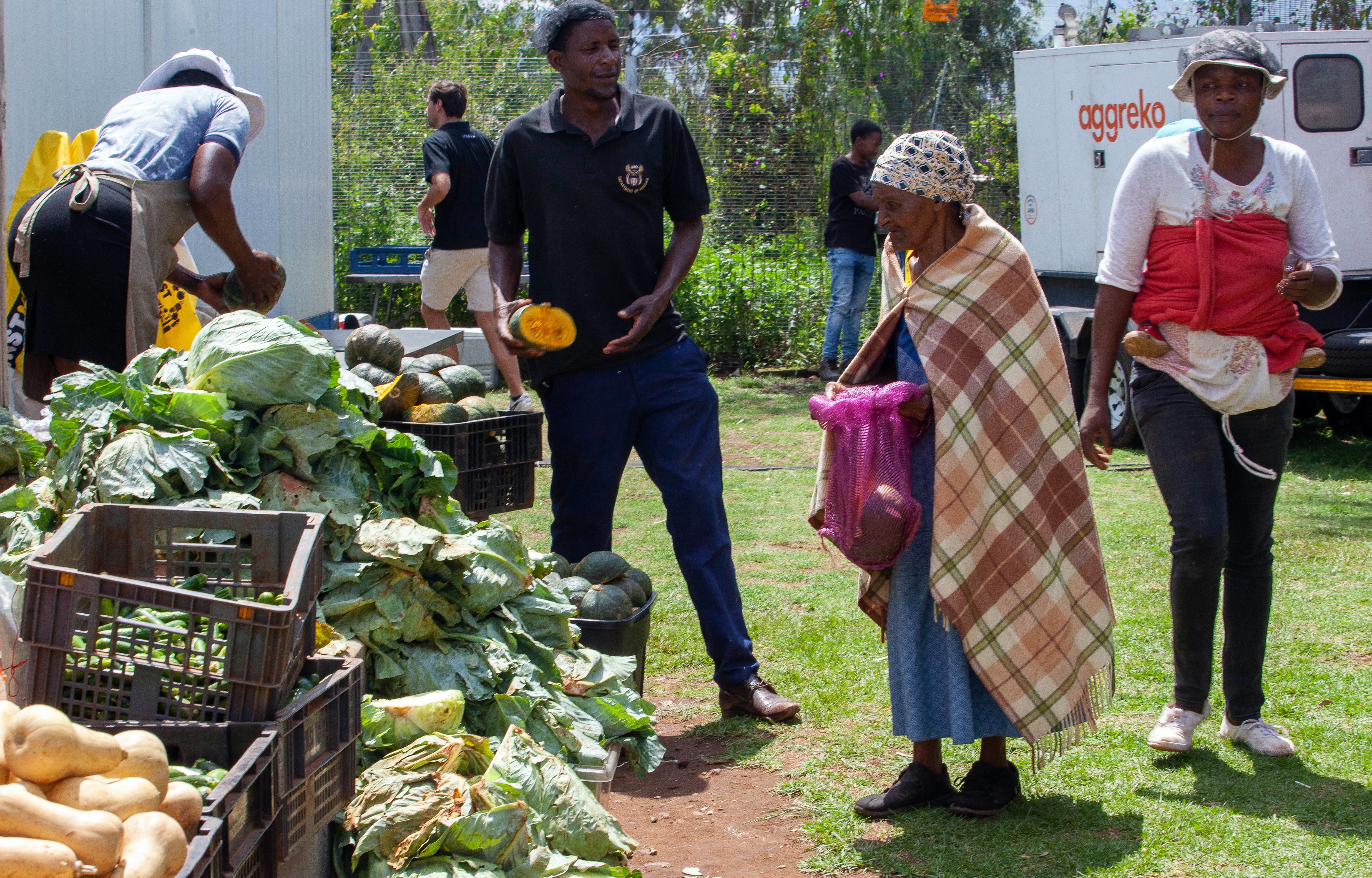
 Jackson Park residents receive food parcels at the launch of the Bread of the Nation initiative at Imagine Church in Johannesburg on 8 March 2023. (Photo: Gallo Images / Papi Morake)
 Every year on 30 March, the United Nations Environment Programme (UNEP) marks the International Day of Zero Waste, an annual call to rethink how we produce, consume and manage our resources. This year’s theme, Zero Waste Starts on Your Plate, is aimed squarely at food waste, a “preventable crisis”, said UNEP executive director Inger Andersen.
But food waste isn’t just last night’s leftovers scraped into the bin. It’s the broader category of food that exists in the human supply chain without being eaten – surplus stock dumped at the back of a supermarket, produce ploughed under because it doesn’t meet export specifications, and manufacturers destroying goods close to expiry dates.
Ahead of the day, the UN Secretary-General’s Advisory Board on Zero Waste announced its inaugural 20 Cities Towards Zero Waste, a recognition of cities demonstrating ambitious approaches to reducing waste and advancing circular economy solutions. The list spans six continents. Four African cities feature: Accra in Ghana, Kisumu in Kenya, Lilongwe in Malawi and Chefchaouen in Morocco. No South African city is included.
South Africa’s particular version of the problem
About 10 million tonnes of “mostly edible food” in South Africa is lost or wasted across the value chain, according to Andy du Plessis, managing director of FoodForward SA. The country “has a big problem”, he said, as one in four people have limited access to food and 63.5% of households are food insecure.
This waste sits at the heart of Sustainable Development Goal target 12.3.1, the global commitment under the UN’s 2030 Agenda to halve per capita food waste at retail and consumer levels. South Africa signed onto this goal and in 2020 launched the South African Food Loss and Waste Initiative, a public-private voluntary agreement committing to that same 2030 target.
Tracking progress towards that target, however, is another matter entirely, and South Africa is falling further behind than many realise, in part because there is no official measurement and tracking of the progress.
South Africa’s only national household food waste estimate, 27kg per capita per year, comes from a 2017 study combining compositional analyses across just three cities. The 2024 UNEP Food Waste Index Report classifies it as medium confidence, noting that local studies in South Africa vary from as low as 8kg to as high as 134kg per capita per year. While UNEP identified six household-level datapoints from different parts of the country, none constitutes a robust national baseline suitable for tracking progress over time.
Notably, Statistics South Africa does not have data available on their Sustainable Development Goals Integrated Indicator Framework.
“Regrettably, this indicator is not captured in the food security statistics we compile,” an official said.
“The reason we do not report on SDG indicator 12.3.1 is because of [the] unavailability of data. We tried since the baseline report (2017) at the beginning of SDG via [the] Sectoral Working Group to identify institution(s) that might have data to respond [to] this indicator,” they said. “Unfortunately, to date we have not found any data.”
According to Clementine O’Connor, UNEP’s Sustainable Food Systems Programme management officer, high levels of food waste are not unique to South Africa, but the country is facing acute waste pressures. Cape Town, for example, generates about 2.1 million tonnes of waste per year and warns that its main landfill could reach capacity by 2027 without major improvements in diversion and circular practices, said O’Connor.
“The South African Food Loss and Waste Initiative […] has found that the average household can save up to R1,200 worth of food each month, by adjusting shopping, cooking and food storage habits to reduce food waste at home,” she said.
Data collection in preparation for the 2027 UNEP Food Waste Index Report is set to begin later this year, according to O’Connor. But without a government-led national baseline study in the interim, South Africa’s progress, or lack thereof, will remain largely invisible.
Dumping or donating, a liability concern
The breakdown of where waste occurs is telling, said Du Plessis, as 49% happens at the processing and manufacturing stage, 19% after harvesting, 18% at the household level, 6% in retail and 8% on farms. The largest single contributor, manufacturing, is not accidental. It is, in large part, a direct consequence of how the law is written.
“All the major manufacturers, we work with all of them, and all of them donate,” Du Plessis told Daily Maverick. “But at the back of their minds, they are concerned about this legality issue around food safety and liability.”
/file/attachments/orphans/ED_438507_201041.jpg "SA Harvest prepares bread at the launch of Bread of the Nation Initiative at Imagine Church in Johannesburg on 8 March 2023. Through this initiative, the by-product of the beer brewing process is used to produce a high-fibre, high-energy bread, with the aim of distributing more than 300,000 loaves over the next three years. (Photo: Gallo Images / Papi Morake)")
Section 61 of the Consumer Protection Act imposes strict liability across the entire food supply chain, regardless of negligence. In plain terms: if donated food causes illness, every actor in the chain – producer, distributor, recipient organisation – can be held liable. The result is that destruction becomes the safer commercial decision.
A 2022 survey by the Harvard Law School Food Law and Policy Clinic, conducted with the Consumer Goods Council of South Africa (CGCSA) and FoodForward SA, found that more than 85% of businesses cited liability concerns as a barrier to donation, and more than 62% said legal protection would lead them to donate more.
Du Plessis told Daily Maverick that donors are already participating but constrained, and that clearer guidelines and a relaxed liability framework would unlock significantly more food.
“Of the 10 million tonnes wasted annually, if we recovered just 50%, that would generate 20 billion meals a year,” he said. “At our cost of 50 cents per meal, that’s about R325-million. To buy that food commercially would cost over R7-trillion.”
SA Harvest, which works directly within commercial supply chains to redirect surplus food, told Daily Maverick that legal liability arises in donor conversations but is rarely the primary obstacle. Uncertainty about processes is more common than outright resistance, said Cassandra Potgieter, head of strategy, marketing and communications at SA Harvest.
Once food safety protocols and redistribution systems are clearly explained, corporate participation tends to follow. In SA Harvest’s experience, food donation can become a routine supply chain practice rather than an exceptional act, but the infrastructure to move food quickly and safely must exist alongside any legal reform, she said.
Voluntary limits
In August 2025, the South African Bureau of Standards (SABS) published a voluntary Food Donation and Redistribution Best Practice Standard. Du Plessis said it is crucial, since it gives manufacturers a document they can take to their legal and food safety divisions to justify increased donations.
The CGCSA, which serves as secretariat for the Food Loss and Waste Initiative, has also developed best practice guidelines for businesses, commissioned policy research with other organisations, and co-signed a petition for a Food Donations Policy. A South African National Standard on food donation management is in the process of being published for public comment, they said. But the CGCSA said that without legislative change, progress remains constrained.
South Africa is committed to halving food waste by 2030 under the Food Loss and Waste Voluntary Agreement launched in 2020, aligned to SDG 12.3. Six years on, the national Food Loss and Waste Strategy has not been finalised.
The CGCSA says the 2030 target remains its aim, with funding secured in 2024, allowing scaled efforts through the end of this year. But it acknowledges that the data collected over the next two years will be what truly indicates whether the target is achievable. DM