




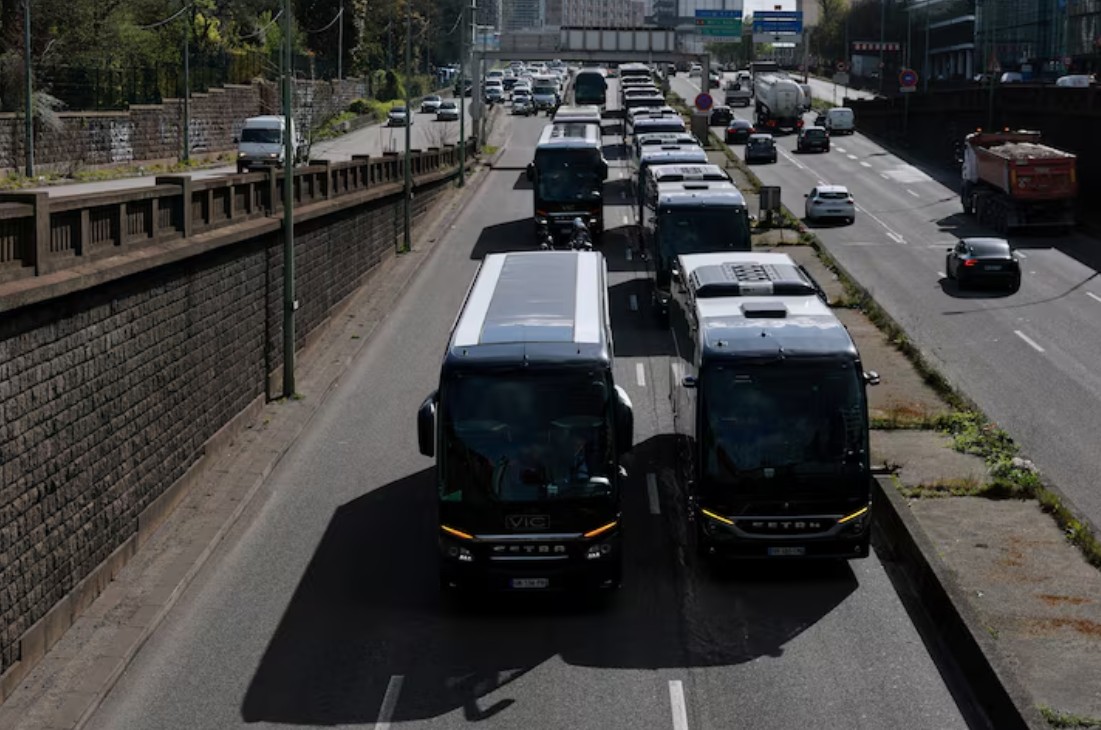
 French bus drivers drive at reduced speed on the Paris ring road during a road transport sector protest against the rise of fuel prices and to demand increased support from the French government on 30 March 2026. (Photo: Reuters / Stephanie Lecocq)
 Finance and energy ministers of the G7 – the United States, Canada, Japan, Britain, France, Germany and Italy – were due to hold a teleconference today to coordinate action. EU energy ministers meet to discuss the issue on Tuesday, 31 March 2026.
Governments face tough choices because the higher energy costs boost inflation and slow growth, but using public finances to cap them strains budgets and distorts market price signals that would normally lead to reduced demand.
Here are some of the announced measures involving G7 countries:
Global
The International Energy Agency agreed to release a record 400 million barrels of oil from strategic stockpiles.
The IEA said all 32 member countries backed the move, the sixth coordinated stockpile release since the agency’s creation in the 1970s.
The US will take a leading role by contributing 172 million barrels. Canada will release 23.6 million barrels.
Germany
Berlin decided not to subsidise prices, but to limit volatility by allowing petrol stations to increase prices only once a day at midday.
They can cut prices at any time. Breaches could be punished with fines of up to €100,000 (almost R2-million).
France
France’s government has opted for support measures strictly targeted at the sectors most in need, marking a sharp contrast with sweeping energy price caps that badly strained public finances after Russia’s 2022 invasion of Ukraine.
It has announced more than €70-million (R1.38-billion) in fuel subsidies for the transport, farming and fishing industries for April, in addition to a €150 (just under R3,000) benefit for 3.8 million low-income households to help pay energy bills.
United Kingdom
Most British households are protected until July from the immediate impact of higher gas prices on heating and electricity costs, due to regulated tariffs, though the government has launched a £53-million (R1.2-billion) package for homes that use heating oil.
Finance Minister Rachel Reeves has indicated that targeted support is under consideration rather than sweeping cost-of-living measures for households.
Prime Minister Keir Starmer has said the government is considering expanding the powers of the competition regulator to tackle price gouging and profiteering following the leap in oil and fuel prices.
Italy
The Italian government has set aside about €417.4-million (R8.24-billion) to cut excise duties on petrol and diesel until 7 April, but prices have changed little and industry lobbies are pushing for more effective steps.
Japan
The Japanese government is using 800-billion yen (R87-billion) of reserve funds to finance subsidies to try to keep gasoline prices at about 170 yen (R18.32) per litre on average. The measure is likely to cost as much as 300-billion yen per month.
Japanese Finance Minister Satsuki Katayama said the government was prepared to take all necessary measures “on all fronts”, but did not comment directly on the possibility Japan might intervene in the crude oil futures market. DM
(Reporting by Giuseppe Fonte in Rome, Alexander Chituc and Jan Strupczewski in Brussels, Leigh Thomas in Paris, Christian Kraemer in Berlin, Alistair Smout in London, Leika Kihara in Tokyo; editing by Barbara Lewis.)