



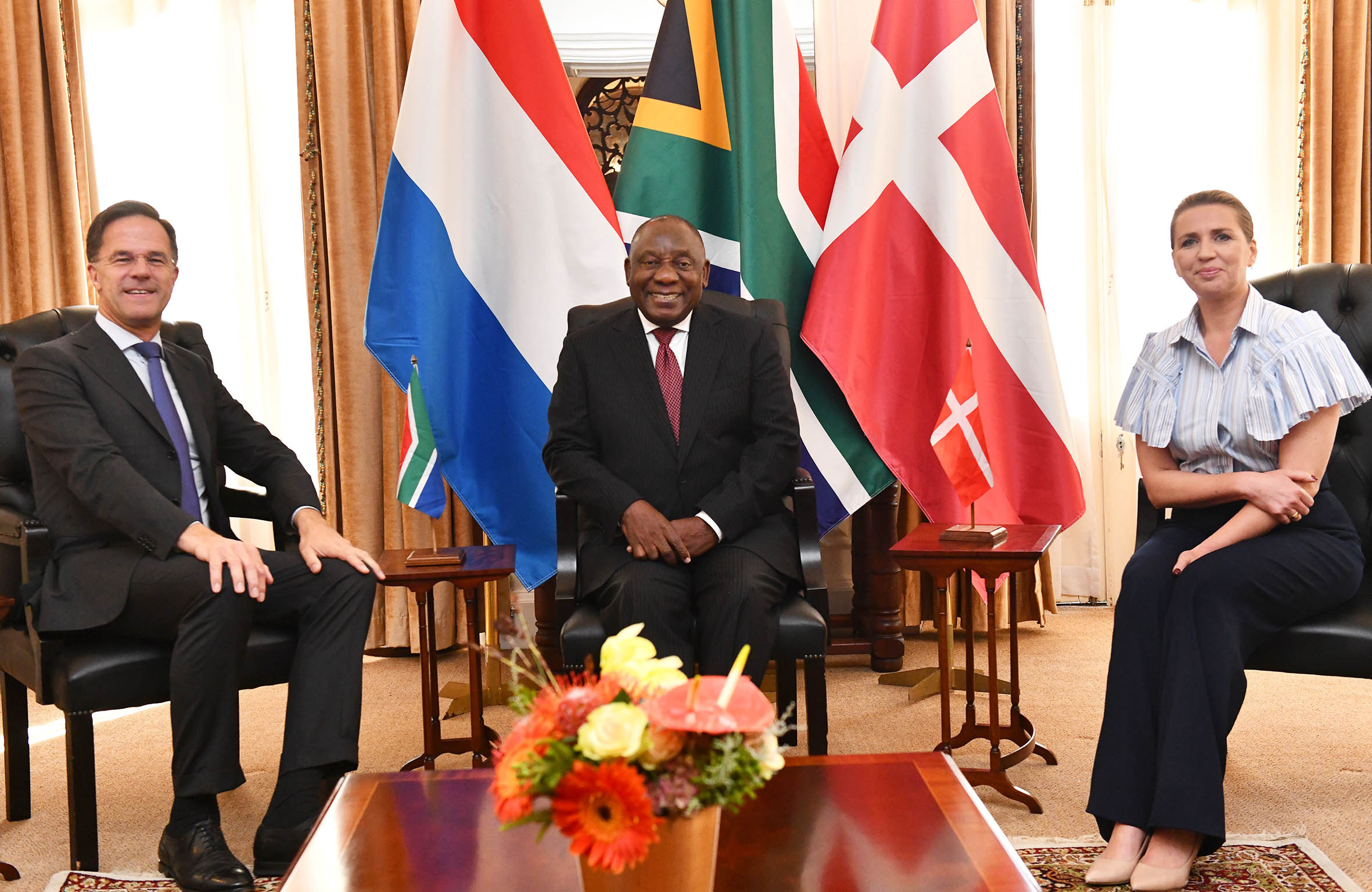
 From left: Prime Minister of the Netherlands Mark Rutte, President Cyril Ramaphosa and Prime Minister of Denmark Mette Frederiksen ahead of official talks during a joint working visit in Pretoria, South Africa on 20 June 2023. (Photo: GCIS)
 /file/dailymaverick/wp-content/uploads/2025/10/label-Op-Ed.jpg "<br>")
The conversation about Europe-Africa relations often centres on familiar themes: trade, development, migration. These are important issues, but they are not separate debates. They are different expressions of a deeper question, one that is becoming increasingly urgent.
Is the partnership between Europe and Africa keeping pace with a rapidly changing world, or is it still anchored in assumptions that no longer hold?
Because the reality is this: the world is not merely evolving, it is becoming more contested, more fragmented and more uncertain than at any time since the end of the Cold War.
We see this in the erosion of consensus within multilateral institutions, in the selective application of international norms, and in the growing willingness of states to act outside established frameworks when those frameworks no longer serve their interests. But perhaps most significantly, we see it in the widening gap between how the international system is designed and how it is experienced.
And when that gap becomes too large, legitimacy does not erode gradually, it breaks.
This matters because legitimacy in global governance does not rest only on rules or institutions. It rests on voice, fairness and outcomes. When these are perceived to be misaligned, even the most carefully constructed systems begin to lose credibility.
Structural transition
This is not a temporary disruption. It is a structural transition. And in moments of structural transition, partnerships are not simply useful, they are tested.
The Europe-Africa partnership is no exception.
For decades, it has been framed in the language of cooperation, development and shared values. But there is also a more difficult truth: at critical moments, this partnership has reflected asymmetry – of voice, of agenda-setting and of outcomes. Not always by intent, but often by design.
If the partnership is to remain credible in the world that is emerging, it must evolve.
It must shift from being, at times, prescriptive to being genuinely reciprocal. From advancing fixed positions to testing them. From outcomes that reflect preference to outcomes that reflect what actually works; for both sides.
Because partnership is not about winning arguments. If one side wins the argument, but the other cannot live with the outcome, the partnership has already begun to fail.
Nowhere is this tension more evident than in trade.
The historical record is clear: no country has transitioned to high-income status without sustained industrialisation and value addition. Yet Africa remains structurally positioned as a supplier of primary commodities. When it seeks to move up the value chain, it encounters increasingly complex standards and compliance regimes.
A system that enables access while constraining development will ultimately lose its legitimacy. This imbalance extends beyond trade into the architecture of global finance itself.
The current international tax system allows significant value to be extracted from developing economies through profit shifting, regulatory arbitrage and jurisdictional competition. The result is not merely inefficiency, it is the erosion of fiscal capacity in countries that most urgently require resources for development.
Binding constraint
For many developing economies, this is not marginal leakage. It is a binding constraint. Reform, therefore, is not simply a technical exercise. It is about how value is understood and governed in the global economy. Unless taxation aligns with where value is created, development will remain structurally underfunded.
A similar structural tension is visible in climate policy. Africa contributes less than 4% of global emissions, yet it faces disproportionate climate vulnerability. At the same time, it holds many of the resources required for the global energy transition.
But climate finance remains largely debt-based. Borrowing costs are higher, and currency volatility increases repayment burdens over time. In practical terms, this means that countries are expected to finance long-term transitions using financial instruments that are short-term, volatile and risk-sensitive.
This creates a fundamental paradox. If participation in the global transition requires taking on risks one did not create, then a simple question arises: Whose transition is it?
What is needed is not just more finance, but different finance, finance that enables development, rather than constrains it. This includes greater use of local currency financing, grant-based support for adaptation and risk-sharing mechanisms that reflect economic reality, rather than idealised models.
Beneath trade and finance lies an even deeper issue: global governance.
The international security environment is becoming more complex and interconnected, but the institutions designed to manage it are under visible strain. The United Nations Security Council, for example, remains central, but increasingly contested.
Its structure reflects a past distribution of power that no longer aligns with contemporary realities. In this context, proposals such as greater regional representation are not radical departures, they are recognitions of how governance is already evolving in practice.
Necessary and achievable
At the same time, reform must be realistic. The veto power, for instance, is unlikely to be abolished. But it can, and should, be regulated. Mechanisms that constrain its use in cases of mass atrocity, enhance transparency and introduce accountability are both necessary and achievable.
Because when power cannot be removed, it must be disciplined.
Taken together, trade, tax, climate finance, institutional reform – these issues point to a broader conclusion. The challenge we face is not the absence of rules. It is the misalignment between rules and reality.
This misalignment is perhaps most visible in the current state of international law. Increasingly, legal norms are reinterpreted, bypassed or selectively applied, often by those with the greatest capacity to uphold them.
This is not without consequence.
International law depends not only on enforcement, but on shared belief in its consistency. When that consistency is questioned, the system does not simply weaken, it begins to fragment.
Recent actions by major powers, including the US, have reinforced a perception, particularly in parts of the Global South, that adherence to international law is contingent, rather than principled. Whether universally accepted or not, that perception matters. Because in international relations, perception shapes legitimacy, and legitimacy shapes compliance.
If rules are seen to bind some but not others, they cease to function as rules. They become instruments of convenience. And at that point, we are no longer managing a rules-based order, we are managing its gradual unravelling.
This brings us back to the central principle that must underpin any meaningful partnership: listening. The challenge is not that perspectives differ. It is whether those differences are genuinely engaged with.
If Europe approaches Africa with a fixed view of how the system should function, and Africa approaches Europe with a fixed view of historical imbalance, dialogue may continue, but progress will not.
Progress requires something more demanding.
No single model of development is universally applicable
It requires recognising that no single model of development is universally applicable. No single interpretation of global norms is universally accepted. And no single actor can shape outcomes in isolation.
That is not a weakness. It is the defining feature of the world we are entering. The real question, then, is not whether Europe and Africa agree. It is whether they are prepared to adapt.
Because the true test of partnership is not alignment in principle. It is flexibility in practice. History does not always announce its turning points. But there are moments when the direction of travel becomes clear.
This may well be such a moment.
The Europe-Africa partnership can continue as it has – structured, functional, but increasingly under strain – or it can evolve into something more balanced, more responsive and more aligned with a multipolar world.
But that evolution will not be driven by declarations. It will be driven by choices.
Choices about whether we listen to respond, or listen to understand. Choices about whether we defend positions, or build solutions. And choices about whether we seek advantage, or sustainability.
Because in the end, partnership is not defined by what we say, it is defined by what we are willing to change. And the world is not waiting. DM
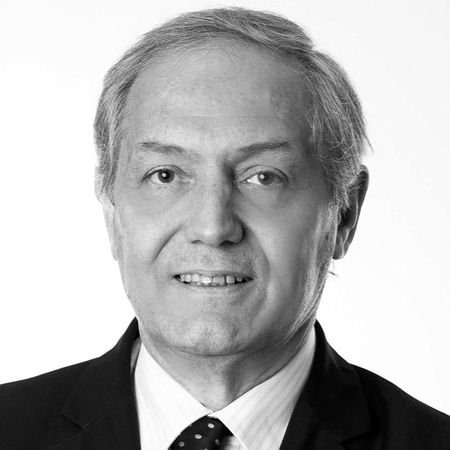
Daryl Swanepoel is the Chief Executive Officer of the Inclusive Society Institute. This article is an extract of his opening remarks at the EU-Africa Consultative Meeting held in Cape Town from 27-29 March 2026. The meeting brought together think-tanks from the networks of the Foundation for European Progressive Studies and the Africa Think-Tank Dialogue.