




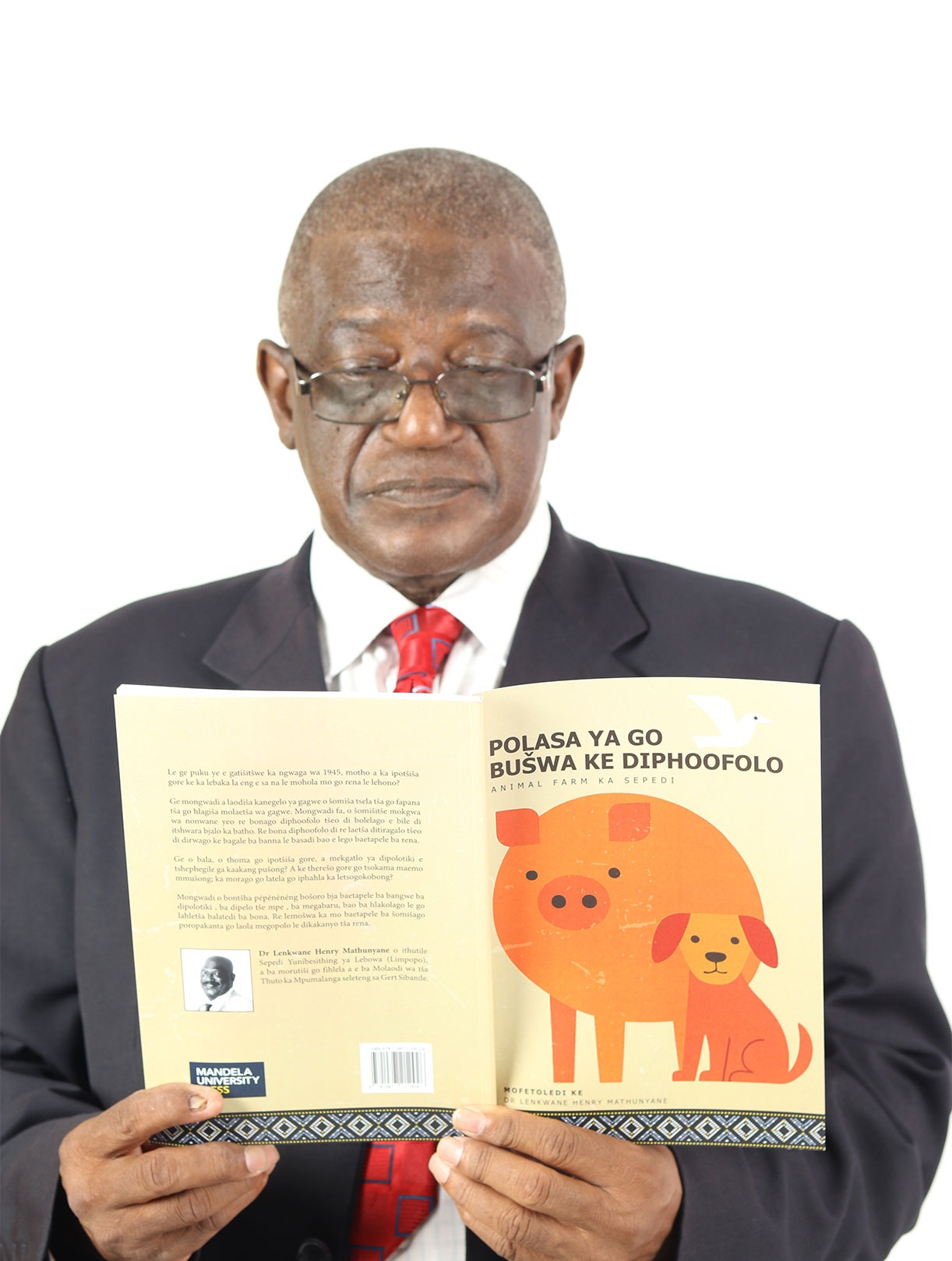
 Dr Lenkwane Henry Mathunyane, with the newly translated Sepedi edition of Animal Farm, launched at Nelson Mandela University’s Multilingualism Indaba in Gqeberha. (Photo: Supplied / Nelson Mandela University)
A new Sepedi translation of Animal Farm – the classic political allegory by English author George Orwell – is set to broaden access to ideas about power, leadership and democracy in South African classrooms.
Translated by veteran educationist Dr Lenkwane Henry Mathunyane and published by the Nelson Mandela University Press, the book highlights how multilingualism can expand access to political discourse, critical thinking and classroom debate — particularly for learners who study in languages other than English.
The translation was officially launched on 26 March during the second Annual Multilingualism Indaba hosted by Nelson Mandela University in Gqeberha, Eastern Cape.
The three-day Indaba, which took place from 25 to 27 March, is themed, Intersections of Knowledge: Language, Multilingualism(s), and Language Policy, and will bring together scholars, students and language practitioners to explore the role of language in knowledge production and education.
At the heart of the programme was the launch of the university’s revised language policy on 27 March, which coincides with International Multilingualism Day.
Inclusive education
Executive Dean of the Faculty of Humanities, Professor Pamela Maseko, says that Nelson Mandela University is “deeply committed to advancing multilingualism as a cornerstone of inclusive and equitable education”, and that the translation of Animal Farm into Sepedi affirms the importance of making classical texts accessible in African languages, where they are “equally relevant and resonant within our own cultural, social and political contexts”.
The work reinforces the intellectual capacity of African languages to carry complex ideas, she says, and aligns with the institution’s broader vision of transforming the linguistic landscape of education in South Africa, speaking directly to the intersections of language, knowledge production and social justice highlighted in the Multilingualism Indaba.
“Dr Mathunyane’s contribution not only enriches our literary resources but also strengthens the role of African languages in shaping informed, critical and engaged citizens.”
While Animal Farm has long been prescribed in South African schools, it has traditionally been taught to English home language learners, leaving many second-language learners engaging with the novel through a linguistic barrier, says Dr Mathunyane.
He believes that translating the text into Sepedi helps place learners on a more equal footing.
/file/attachments/orphans/Nelson-Mandela-Animal-Farm-Cover_459829.jpg "The Sepedi translation of Animal Farm, published by Nelson Mandela University Press, aims to make the classic political allegory more accessible to South African learners. (Photo: Supplied / Nelson Mandela University)")
“Some topics, especially in politics and governance, are only available to learners studying English literature,” he explains. “The contents of this novel will be of great interest to learners when they can discuss them in their mother tongue.”
Language as a gateway to learning
For Dr Mathunyane, the project grew out of decades of experience working in South Africa’s education system.
Holding degrees from the University of Limpopo and the University of South Africa, including a doctorate in the psychology of education, he spent many years guiding learners and young adults in roles ranging from guidance educator to regional director in the Department of Education.
Across these positions, one issue surfaced repeatedly: language barriers in classrooms.
“Assessment reports from schools and subject advisers showed that language can become a barrier to communication and understanding between learners from different language groups,” he says.
“When learners struggle with the language of instruction, their chances of meaningful participation are reduced.”
That experience convinced him that language diversity had to be actively supported through access to literature in multiple languages.
“Children need meaningful and familiar books in more than one language in and around the school.”
Why Animal Farm?
First published in 1945, Animal Farm tells the story of farm animals who overthrow their human owner in the hope of building a fair and equal society. Over time, however, the pigs who assume leadership become as authoritarian as the humans they replaced – a powerful allegory about the corruption of revolutionary ideals.
The novel’s themes remain strikingly relevant, particularly in societies grappling with leadership and accountability.
“What is happening in this novel is exactly what South Africans experience daily,” Dr Mathunyane says.
“When you look at characters like Napoleon and Squealer, you may recognise some of our leaders in them.”
For him, making the story accessible in Sepedi helps ensure that these ideas are not confined to English-language classrooms.
“Political awareness is no longer a taboo subject. This novel allows learners to discuss issues of power, leadership and society openly.”
The translation also serves another purpose: demonstrating that African languages can express complex political ideas.
“It dispels the notion that indigenous African languages cannot be used in advanced academic discourse.”
A translation shaped by collaboration
Choosing Sepedi for the translation was a natural decision for Dr Mathunyane. The language is his mother tongue and was a major subject during his undergraduate studies.
“Sepedi learners will feel proud that a well-known English novel has been translated into their home language,” he says. “It places them on equal footing with their English-speaking counterparts.”
Producing the translation, however, was not a quick process.
It took more than 10 years to complete the manuscript, with careful attention paid to the nuances of satire and political symbolism in the original text.
“English is my third or fourth additional language, so some words were difficult to translate,” he says.
“But with the help of Sepedi educators and subject advisers, we were able to arrive at a standardised version.”
The project eventually found a home with the Nelson Mandela University Press, after Dr Mathunyane submitted a proposal to the publisher in 2024.
The manuscript followed in 2025, and the book was published in January 2026.
Encouraging debate and critical thinking
Although the Sepedi edition is presented as a children’s book, Dr Mathunyane believes it will be particularly valuable for secondary school learners and university students.
Animal Farm has long been prescribed for grades 10 to 12, but primarily for English home language learners.
“Second-language learners also deserve exposure to this book in their own languages,” he says.
Reading the novel in Sepedi could encourage learners to engage more confidently with the story’s political themes.
“They will find it easier and more interesting to participate in discussions and debates in an open and equal atmosphere.”
Dr Mathunyane also believes the book can be used creatively in the classroom.
He suggests that learners could dramatise scenes from the novel, helping them translate abstract ideas, such as social justice and equality, into tangible experiences.
Educators, he adds, could also use the book to encourage multilingual literary societies and debating clubs.
“Students should learn that speaking a different language does not make anyone inferior. Every citizen has the right to participate and contribute in every sphere of life.” DM