




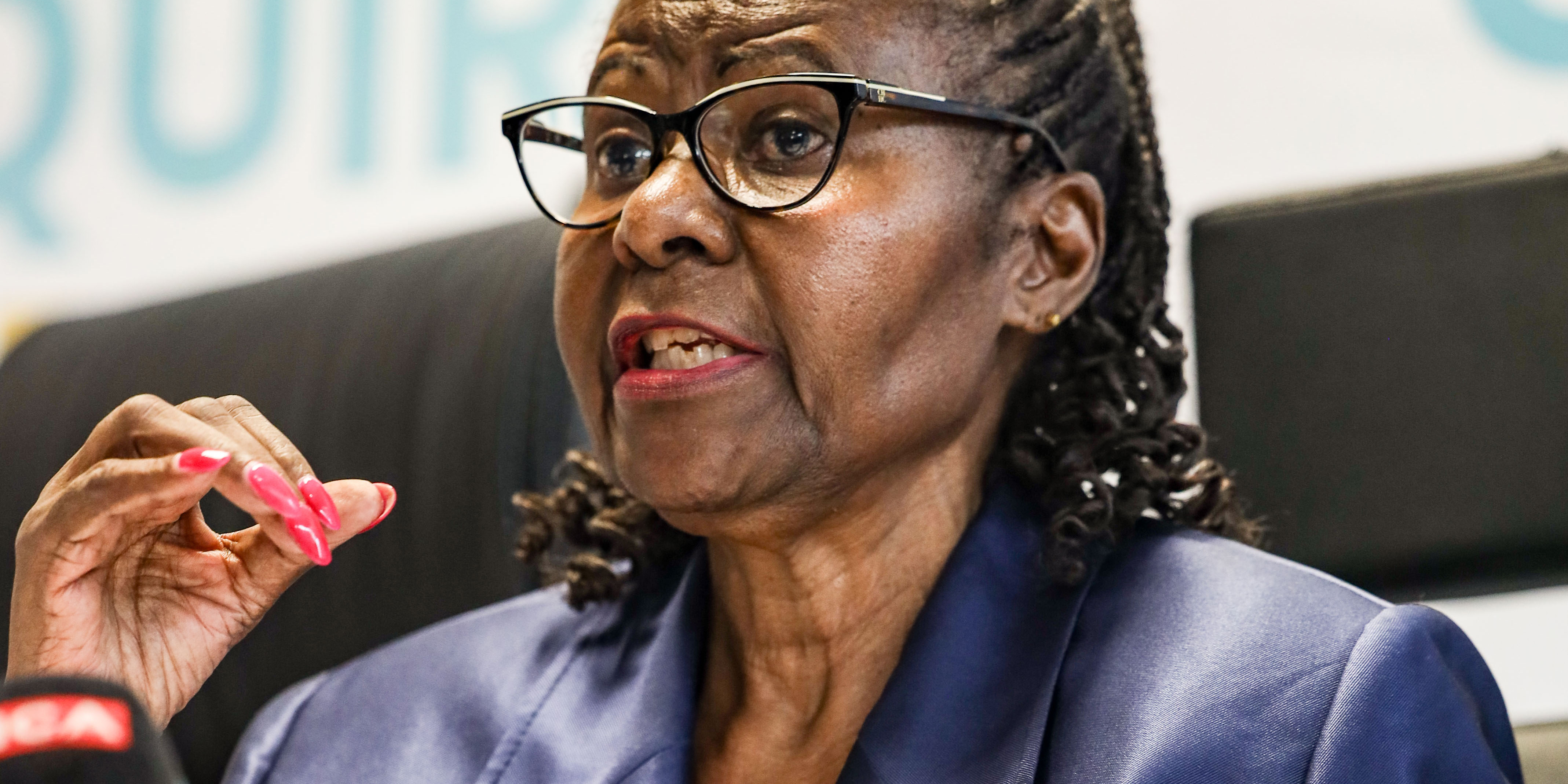
 Retired justice Sisi Khampepe. A joint submission from Open Secrets and Swisa suggests that political actors, including former president Thabo Mbeki, obstructed justice during sensitive investigations like the Arms Deal. (Photo: Gallo Images / OJ Koloti)
 /file/dailymaverick/wp-content/uploads/2025/10/label-Op-Ed.jpg)
Over the past few weeks, and after many delays, South Africans are finally hearing the evidence being led before the Khampepe Commission of Inquiry. The commission is seized with answering a question of fundamental importance: What was the reason for the failure to prosecute cases of apartheid-era murders identified by the Truth and Reconciliation Commission? And, perhaps most importantly, did delays arise because of undue political interference?
These questions go to the heart of our constitutional order and the birth of a democratic SA. Part of our country’s grand transitional deal was that individuals who came forward and confessed their crimes to the Truth and Reconciliation Commission (TRC) would be granted amnesty. But those who did not would be prosecuted, and rightly so, because there can be no justice without accountability. That they may not have been prosecuted because it was not politically convenient to do so – and that steps might have been taken to prevent it – is grotesque and unacceptable.
It is in this context that Open Secrets and Shadow World Investigations South Africa (Sisa) have made a joint submission to the Khampepe Commission this week.
Our submission doesn’t directly address the commission’s terms of reference. Instead, it is intended to provide the commission with additional political context that speaks to the subject of its investigation. Very simply: the commission is tasked with understanding whether political actors, including the executive, might have interfered in sensitive criminal cases.
Overwhelming evidence
Our submission gives the commission information that shows the allegation is, at least, plausible; and it is plausible because there is frankly overwhelming evidence that during the Mbeki administration, senior figures, including then president Thabo Mbeki himself, stuck their nose into the investigation of high-profile criminal scandals and allegations.
We focus on two examples in our submission.
The first is the Strategic Defence Procurement Packages (SDPP), also known more commonly as the “Arms Deal”. Swisa and Open Secrets’ directors have a long history in investigating the Arms Deal and associated corruption. Andrew Feinstein, a director of Swisa, directly experienced how senior ANC figures worked to curtail his investigations into the Arms Deal while he served on the Standing Committee on Public Accounts. Paul Holden and Hennie van Vuuren have written multiple books on the Arms Deal and, importantly, the failure to investigate apartheid-era economic crime.
/file/dailymaverick/wp-content/uploads/2022/12/ANCCONFday2pix026.jpg "Former ANC NEC member Tony Yengeni on 16 December 2022. (Photo: Leila Dougan)")
The Arms Deal was signed in December 1999 and almost immediately attracted attention for a vast array of procurement irregularities and serious allegations of corruption or fraud. That wrongdoing led to two criminal convictions (Schabir Shaik and Tony Yengeni) and forms the basis of the will-it-ever-happen corruption and racketeering trial against Jacob Zuma and Thales.
In 2017, as part of the People’s Tribunal on Economic Crime, Holden and Feinstein provided evidence showing that approximately $263.45-million in suspicious payments flowed to individuals and companies from Arms Deal contractors. That figure was based on court documents, leaked police reports, mutual legal assistance requests, search warrants, and settled plea agreements in the United States.
Yet the full scale of criminal wrongdoing in the Arms Deal has never been properly investigated or prosecuted, despite huge amounts of prime facie evidence. A key reason is because the executive repeatedly interfered with investigations to influence their outcome or to needlessly put up obstacles preventing the National Prosecuting Authority (NPA) and the “Scorpions” from accessing relevant information.
/file/dailymaverick/wp-content/uploads/2025/09/ED_538821.jpg "Former president Thabo Mbeki. (Photo: Gallo Images / Sharon Seretlo)")
We show how, for example, the findings of an investigation into the Arms Deal by the Auditor-General was heavily edited after it had been given to the executive – the very people it was investigating – prior to it being published. Among those who received copies of the draft report was Thabo Mbeki: he had headed the Cabinet sub-committee that oversaw the Arms Deal selection process. Significant evidence of serious procurement irregularities was excised from the draft report, while a general and unconvincing finding was inserted into the final report to clear the government of wrongdoing.
Obstruction
One of the most infuriating cases of obstruction related to damning evidence that had been uncovered by the police in Germany. In 2006, the German Police in Dusseldorf raided the offices of ThyssenKrupp, one of the prime contractors in the Arms Deal. They uncovered document trails about irregular payments to officials and agents connected to the Arms Deal.
Amazingly, their investigation had been triggered because, under German law, it used to be legal to pay “facilitation” payments on deals, and to declare this as a tax write-off under the description “useful expenditures”. ThyssenKrupp had reported “useful expenditures” on the Arms Deal, but for payments made after this insane law had been struck from the German law books.
From 2007 onwards, prosecutors in Germany repeatedly tried to arrange with the Scorpions to share evidence. They submitted a mutual legal assistance request via official channels, which was ultimately never executed by the Ministry of Justice despite entreaties from the NPA. Having waited a year, the German prosecutors formed the view that they could not rely on the Ministry of Justice to provide assistance, and ultimately decided to settle their cases in Germany on lesser offences.
The dilatory and inexcusable failure to respond diligently to requests from Germany thus undermined criminal cases in both Germany and South Africa.
The second case relates to the prosecution of Jackie Selebi. Selebi, the former national police commissioner, was convicted of corruption in 2010 and sentenced to 15 years in prison.
The ructions and scandals around this case dominated news headlines at the time, not least because of the high-profile decision by Mbeki to suspend the National Director of Public Prosecutions, Vusi Pikoli, in 2007, following his decision to secure arrest warrants for Selebi.
/file/attachments/orphans/ED_0033131_964958.jpg "Former national director of public prosecutions Vusi Pikoli. (Photo: Gallo Images / Nardus Engelbrecht)")
‘Clear political interference’
At the centre of this case of interference was a remarkable letter addressed to Pikoli by then minister of justice Brigitte Mabandla in September 2007. It was sent after Pikoli had refused an alleged request from Mbeki for a two-week grace period prior to the issuing of arrest warrants for Selebi, and only a day before Mbeki suspended Pikoli. In the letter, Mabandla told Pikoli that he should “not pursue the route you have taken steps to pursue”, which a later inquiry into Pikoli’s fitness to hold office found amounted to clear political interference.
Both Mbeki and Mabandla have in the past continually denied such political interference.
Importantly, this habit of political interference took place in the context of a broader politicisation of SA’s criminal justice and intelligence clusters. Together, they cast a long shadow over SA’s political life. The instability it created at the NPA played a major role in creating the lax and conducive environment in which State Capture could take hold. The damage done to our democratic institutions is still felt. Justice, in many instances, is now so long delayed it is effectively denied.
Even so, the protagonists of these dramas persist in their schemes. Mbeki and Zuma’s challenges to the Khampepe Commission, including their demands that a judge of Khampepe’s stature recuse herself on the basis of conjecture, obviously raises concerns that they are trying, once again, to delay justice and accountability.
It is for this reason that we have decided not to depose a formal affidavit to the commission as yet, lest it create the scope for another lengthy legal diversion. Instead, we have raised these issues with the commission with the offer that we are happy to work with its evidence leaders to depose a formal witness statement – but only if it helps in the commission’s quest for truth and justice.
Because, in the end, after decades of obstacles, delays and outrage, the most important thing is that the accused answer for their crimes, and their enablers are held to account. DM