




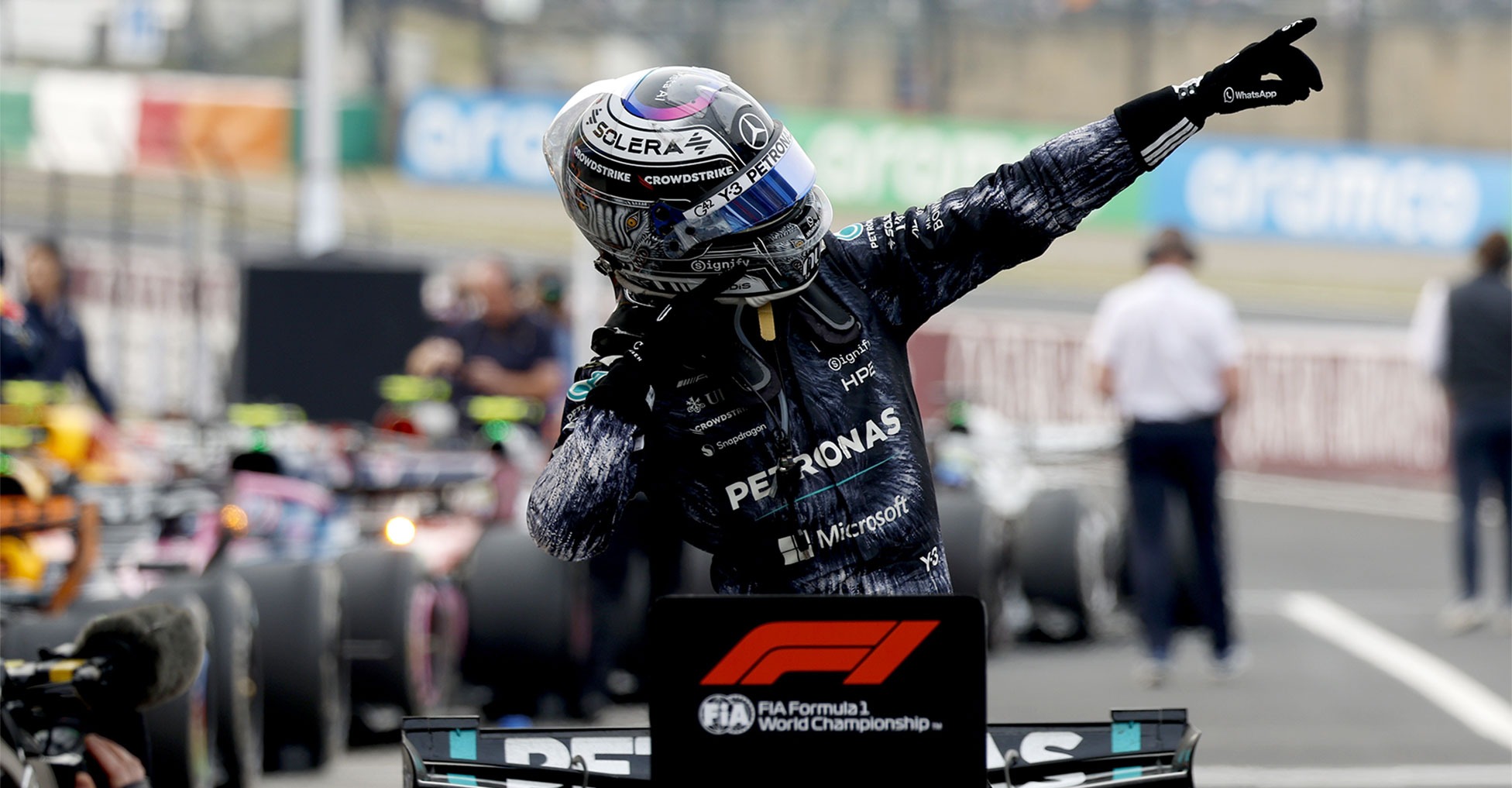
 Mercedes driver Kimi Antonelli of Italy celebrates after winning the Japanese Grand Prix at the Suzuka racetrack on 29 March. (Photo: Franck Robichon / EPA)
 A generational talent is emerging. Mercedes driver Kimi Antonelli claimed his second consecutive Grand Prix win of the season in Japan on 29 March, making him the first teenager to lead the Driver’s Championship in Formula One (F1) history.
The 19-year-old has been smashing records left, right and centre.
In China last weekend, Antonelli became the youngest driver in F1 history to secure pole position, surpassing Sebastian Vettel’s long-standing record from the 2008 Italian Grand Prix.
He followed that up with victory at the Chinese Grand Prix on Sunday, 15 March.
This made the Italian the second-youngest Grand Prix winner in history after Max Verstappen.
It also made him the first Italian to win a Grand Prix in 20 years, since Giancarlo Fisichella’s victory at the 2006 Malaysian Grand Prix — the year Antonelli was born.
“It feels pretty good,” the youngster said after his win in Japan. “Of course, it is still pretty early to think about the championship, but we’re in a good way.”
After a poor start that saw him drop down to sixth, Antonelli fought his way back to the front, with a safety car working in his favour.
/file/attachments/orphans/13870617_432944.jpg "Kimi Antonelli celebrates on the podium after winning the Japanese Grand Prix on 29 March. (Photo: Franck Robichon / EPA)")
“It was a really nice second stint, the pace was just incredible. I felt great in the car and feel very pleased with that,” he said.
Teammate George Russell faltered slightly, dropping from second to fourth.
Nevertheless, the Mercedes dominance is obvious as they extended their championship lead to 135 points, 45 points ahead of second-placed Ferrari.
Elsewhere, McLaren will also be ecstatic, particularly Oscar Piastri, who secured a second-place finish.
Piastri had not even started the previous two races due to reliability issues with his car.
Mercedes’ early dominance is one of the defining themes of the opening three races, alongside the impact of the new engine regulations and a grid still scrambling back to the drawing board.
/file/attachments/orphans/UP1EM3T0HTYFS_307454.jpg "Red Bull’s Max Verstappen during the Japanese Grand Prix. Verstappen finished eighth. (Photo: Issei Kato / Reuters)")
A game of Mario Kart
While the drivers are beginning to get a handle on the new energy deployment system, an overarching debate is the impact of the new power units and engine regulations.
The new power units mark a major shift, with a 50-50 split between electric power and the internal combustion engine.
Under the current regulations, cars are perpetually “energy-starved”, requiring teams and drivers to implement constant, real-time energy management.
However, with the new “boost” and “overtake” modes, cars are running a lot closer for longer than in 2025, encouraging more wheel-to-wheel racing, as intended by the FIA, the sport’s governing body.
In Melbourne, for example, the FIA highlighted that the race featured 120 overtakes — 75 more than in the 2025 Australian Grand Prix.
There is no doubt that when the cars are locked together for several laps, it makes for exciting racing.
“The best racing I’ve ever experienced in F1,” said Ferrari driver Lewis Hamilton after his multi-lap battle in China with teammate Charles Leclerc. “That’s how racing should be. It should be back and forth, back and forth. It shouldn’t be, like, one move is done and then that’s it.”
/file/attachments/orphans/13871055_614934.jpg "Lewis Hamilton in action during the 2026 Japanese Grand Prix, at which the British driver finished sixth. (Photo: Franck Robichon / EPA)")
Meanwhile, four-time world champion Max Verstappen called the new regulations “terrible” and “not fun at all”, comparing the racing to Mario Kart.
“This is not racing. Boosting past, then you run out of battery; the next straight, they boost past you again. For me, it’s just a joke.”
Aston Martin driver Fernando Alonso described it as “the battery world championship”.
Though their views are most likely influenced by their competitive positions, they point to the same complex issue.
Akin to a video game, the “boost” — dubbed a “mushroom boost” by Jenson Button — and “overtake” modes provide bursts of electrical energy to aid passing. But overuse leaves drivers vulnerable, often resulting in immediate counterattacks.
The surge in overtaking at Melbourne was partly due to drivers still learning to manage the system. As understanding improves, that volatility is likely to settle.
/file/attachments/2990/Qualifyingpace_626602.jpg)
Slow qualifying
The concern is that the innovations risk eliminating elements of driver skill. What were once flat-out or skill-demanding corners, like the Degner Curves in Japan, are now much slower, not because the cars lack grip, but because drivers are conserving energy for the straight.
Another concern that drivers have raised, which the FIA will be looking to address in the coming weeks, is the impact the new regulations have on qualifying and how drivers approach it.
F1 is inherently about who can drive their car around a circuit the quickest. However, because the cars need to harvest electrical energy on qualifying laps, it means that despite drivers remaining on full throttle towards the end of the straights, their cars are still underpowered and slower.
“For everybody, going into Q3 is just not the nicest feeling because we want to be at the limit of the car, and whenever you play with those limits, not only do you pay the price of a small snap, but you also pay triple the price in the straight,” said Leclerc.
“This is very frustrating because qualifying is all about us trying to find the limit and play with the limit, and at the moment, whenever you play with the limit you get destroyed in the straights.”
Qualifying is also supposed to punish those who make even the smallest of errors.
Previously, if drivers lifted off the throttle or made a mid-corner correction, they were punished by losing time. In certain scenarios, drivers have discovered that lifting off the throttle can effectively re-index or reset the battery’s deployment curve.
“Once they make a mistake, this actually saves some energy,” said Andrea Stella, McLaren’s team principal. “Therefore, you go faster overall in a sector because the energy you save with the delay in the throttle, because you had a problem, is going to reward you at the end of the straight.”
It is all a bit topsy-turvy, but with time, things will balance out.
/file/attachments/orphans/UP1EM3T0HPDFN_911658.jpg "Ferrari's Charles Leclerc at the 2026 Grand Prix in Japan, where he finished third. (Photo: Issei Kato / Reuters)")
Five-week break
Despite finally putting some decent points on the board, McLaren will be going back to the drawing board now that the Saudi Arabian and Bahrain races in April have been cancelled as a result of the ongoing US/Israel and Iran war.
Teams have five weeks to analyse data and look where they can improve, while the FIA discusses any possible changes.
Also looking to improve will be the Aston Martins, which are facing fundamental issues, such as battery shortage and vibrations in the chassis.
The next Grand Prix is in Miami on 3 May, starting at 10pm South African time. DM