




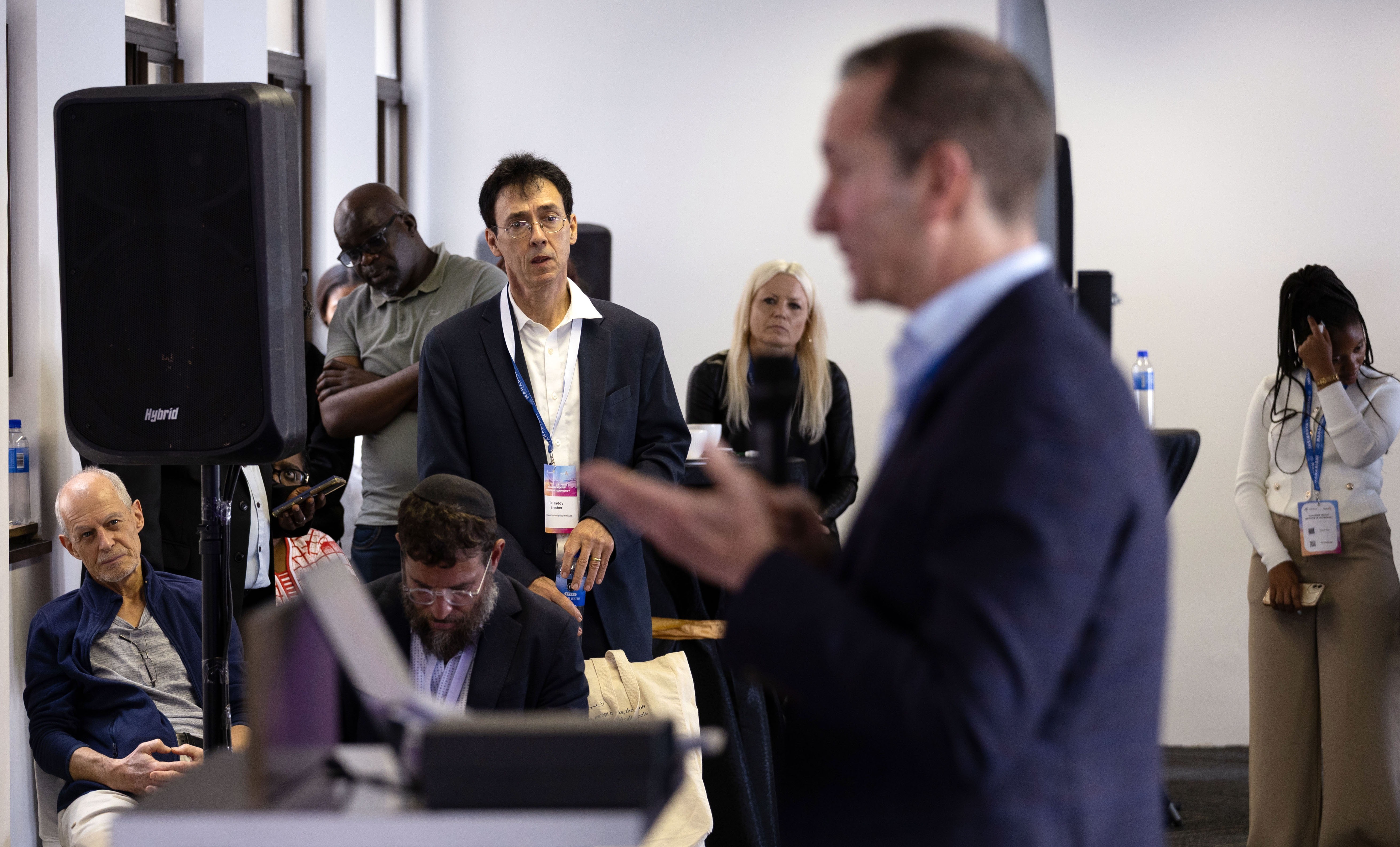
 Dr Taddy Blecher, CEO and co-founder of the Maharishi Invincibility Institute, listens as entrepreneur David Frankel speaks to guests at the opening of the new Maharishi Nextup Institute of Technology in Marshalltown, Johannesburg, on 18 March 2026. (Photo: Our City News / James Oatway)
 For decades, Joburg’s western CBD — once home to the prestigious Johannesburg Stock Exchange, powerful mining houses and major bank headquarters — has been slipping into a symbol of urban decay.
As businesses fled north, the inner city deteriorated into an environment of hijacked buildings, littered streets and rising crime, with many residents and commuters too afraid to enter its once-bustling core. Neighbouring districts like Hillbrow, Yeoville and Berea, once alive with culture and nightlife, had already slipped into the same deep dereliction.
But on the streets around Main, Fox and Ntemi Piliso streets, a new and unlikely story is taking shape.
Here, among once-decaying historic office blocks, thousands of young people now stream in and out of classrooms, computer labs, sports fields and newly restored buildings. This pocket of the inner city is earning a new name – Education Town.
And that vision accelerated dramatically.
A 10-storey tech campus donation
In a major new development in March, South African tech pioneers and philanthropists David and Tracey Frankel have donated a 10-storey, 10,065m² building at 56 Main Street in Marshalltown to the Maharishi Invincibility Institute (MII).
The building will house the newly launched Maharishi NextUp Institute of Technology (MNIT) – a dedicated technology campus aimed at preparing thousands of underserved young people for high-demand digital careers.
The donation significantly expands MII’s “Education Town” footprint and positions the western CBD as a potential tech-talent hub.
“This is more than a building; it is a promise to our youth that they will not be left behind by the AI revolution,” said Dr Taddy Blecher, CEO and co-founder of MII.
“For 20 years, we have proven that if you unlock the genius in a young person, they can compete at the highest levels.”
The new institute will focus on artificial intelligence, robotics and automation, cybersecurity, cloud engineering, data science, digital marketing and design, as well as specialised financial and insurance academies developed with corporate partners facing critical skills shortages.
The model is demand-driven: industry partners will co-design a curriculum aligned to verified scarce skills, with direct pathways into quality employment.
David and Tracey Frankel said they believe Johannesburg can become one of Africa’s leading tech capitals.
“By providing this permanent infrastructure and nurturing the set of cutting-edge programmes coming in here, we are confident we will see youth trained as future tech leaders who will drive forward South Africa’s digital economy,” they said.
From ‘written off’ to reinvention
At the centre of the broader transformation is the Maharishi Invincibility Institute itself, whose multi-building expansion has turned a once-neglected urban cluster into a growing university-style precinct driven by scholarships, job pathways and the restoration of historic properties.
“Part of this area of the CBD was considered ‘written off’,” says Blecher.
He describes the earlier collapse as profound.
“Over 30 years of mining houses leaving along with other major companies, and some of the banks moving to new business districts, the western CBD had its heart ripped out. For years, nobody believed this area could come back,” he said.
But Blecher argues that education clusters often anchor urban regeneration globally.
“Around the world, it’s education that brings cities back to life,” he says. “Look at Penn in Philadelphia, Columbia in Harlem, or Barcelona’s @22 district. When you bring thousands of students into a neighbourhood, everything changes – the streets, the businesses, the safety, the energy.”
The buildings that anchor Education Town
Over two decades, MII has acquired or received several key CBD buildings, many through philanthropic partnerships:
- 9 Ntemi Piliso Street, donated by Anglo American in 2005;
- 45 Main Street, former Anglo headquarters, donated in 2023;
- 58 Marshall Street, donated by the Saville Foundation; and
- 56 Main Street, now housing the MNIT, donated by the Frankels in 2026.
Each building expands both educational capacity and the physical footprint of regeneration.
Blecher says the goal is sustainable work, not simply certification.
“Youth will build the competence and solid grounding to add value and leverage AI to build and transform business through solving business and societal problems.”
MII’s broader model centres on young people with little or no financial means.
“Our students come from places where opportunity doesn’t exist – underserved communities, families living on almost nothing,” Blecher says. “The fact that so many of them are now earning solid salaries, some even becoming CEOs, shows what happens when you level the playing field.”
The programme blends bursaries, a “learn-and-earn” model, psychosocial support and structured job placement.
More than 25,000 graduates have transitioned successfully into the workplace.
“We’ve seen students go from hunger to boardrooms,” he says. (See “SK the Eagle” below)
The precinct also includes the Field of Dreams – the first full-size football field in the CBD in roughly a century – alongside basketball and netball facilities. What once defined Johannesburg – gold, banks, mining houses – is slowly giving way to something different: knowledge, skills, technology and social mobility.
As students move through the newly lit streets of Main, Fox and Ntemi Piliso, cafés reopen. Small businesses re-emerge. The district is cleaner and more populated than it has been in years.
“This isn’t just our project,” Blecher says. “This is Joburg’s comeback story – written by young people who refuse to give up on their city.” DM
Solly ‘SK the Eagle’ Khoza – from Etwatwa to training 600,000 youngsters
When Solly Khoza first walked into CIDA City Campus (now MII) in the late 1990s, he was a township teenager holding a scholarship envelope. The skyscraper on Commissioner Street felt like “a tour of the New York Stock Exchange”.
He recalls Blecher’s early influence: “He had this incredible presence – calm, brilliant, compassionate.”
/file/attachments/orphans/IMG-20260210-WA0063_510279.jpg "Solly Khoza reflects on his humble beginnings and the role the Maharishi Invincibility Institute played in his success. (Picture Supplied)")
While studying, Khoza volunteered in campus management offices and began helping traders draft business plans. That spark grew into the Mentec Foundation, which he founded in 2004 while still a student.
Today Mentec operates in South Africa, Malawi and Zambia and has trained more than 600,000 young people – with a remarkable 95% placement and enterprise-development success rate. It works with corporates like Microsoft, Accenture, Vodacom, Transnet and Absa.
Years after graduating, Khoza travelled with Blecher to the US as part of a Rockefeller Foundation delegation.
“We interacted as two CEOs,” he says. “Dr Blecher had built my foundation.”
“The doers do,” he says. “And Maharishi produces doers.” DM
This story was produced by Our City News, a non-profit newsroom that serves the people of Johannesburg.
/file/attachments/2985/WhatsAppImage2025-11-21at1946001_346702_1cea9e715c05dc0a538fc79753ac3401.jpeg)