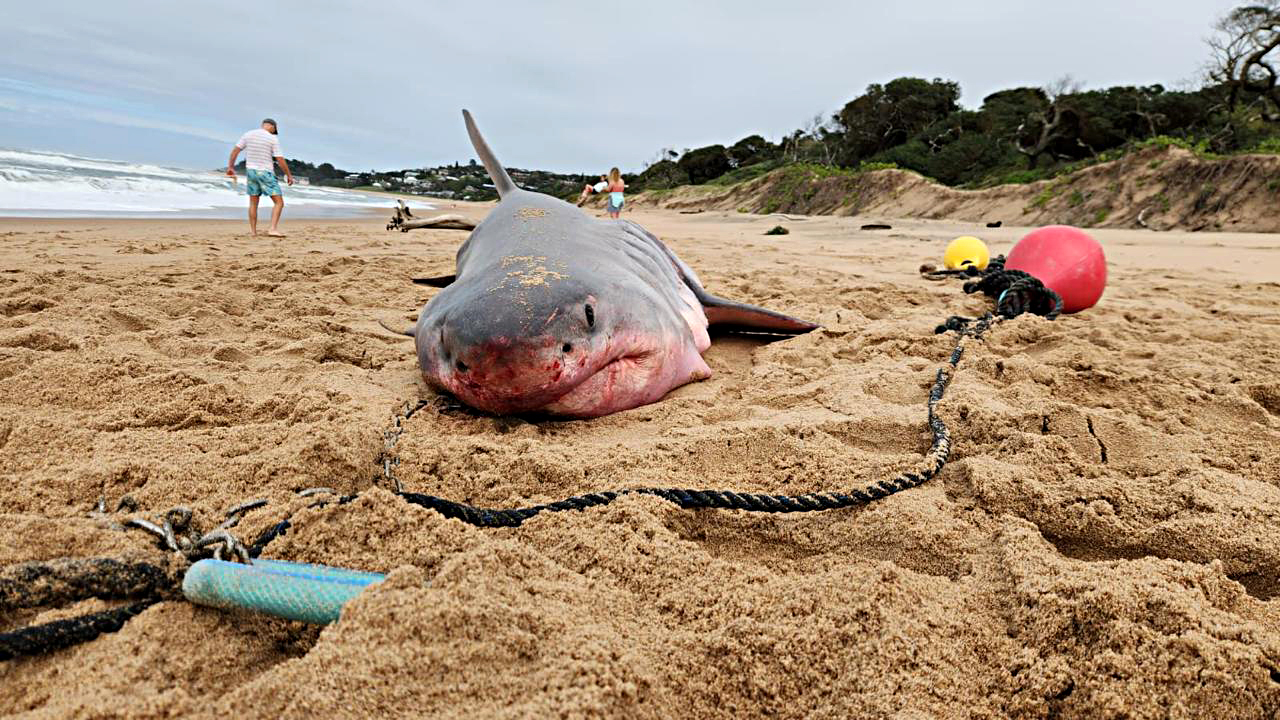
 This white shark carcass washed up on Zinkwazi Beach after being caught in a KwaZulu-Natal Sharks Board drumline. The red buoy (right) suspends the baited hook in the water and is anchored with a rope to a concrete block on the seafloor behind the waves. Strong waves and the shark’s struggles are likely to have caused the ropes to break loose and the shark to strand ashore. (Photo: Josh Pons)
 /file/dailymaverick/wp-content/uploads/2025/10/label-Op-Ed.jpg)
When Club Med opens its R2-billion Beach and Safari Resort at Tinley Manor on South Africa’s KwaZulu-Natal north coast this year, it will do so under the banner of sustainable tourism (see also here).
Less prominently advertised is the controversial shark control system planned for the resort’s beaches.
To protect swimmers, a series of lethal gill nets and drumlines are to be installed and maintained by the KwaZulu-Natal Sharks Board (KZNSB). These devices indiscriminately capture and kill not just sharks, but critically threatened turtle and dolphin species.
Endangered loggerhead and leatherback turtles have been observed nesting in the area. The region is also a primary habitat for the humpback dolphin, one of the most compromised dolphin species in the western Indian Ocean (see here, here and here).
This raises serious questions about the credibility of Club Med’s sustainability claims.
Tourism contributes roughly R10-billion annually to the regional economy and supports about 200,000 jobs. In that context, bather safety is a primary concern. But the efficacy and impact of gill nets and drumlines are coming under increasing scrutiny.
KZNSB, the public body responsible for bather protection in KZN, says there have been no fatal shark attacks at beaches protected by its nets since 1952.
This is true, but independent records show that non-fatal shark incidents have occurred at beaches with KZNSB protection: two at Amanzimtoti (severe bite injuries to the lower body, see here and here), one at Ballito (severe bite wounds) and one at Umtenweni (severe bite wounds to the leg).
For most visitors, the question is simple: is it safe to swim? On beaches where Sharks Board systems are installed, lifeguards will confirm that shark nets are in place and that the beaches are approved for bathing. That statement conjures a picture of an enclosed, protected swimming area. Hotels and tourism agencies do little to dispel this assumption.
Contrary to popular belief, shark nets do not surround enclosed swimming areas.
/file/dailymaverick/wp-content/uploads/2024/11/bull-shark.jpg "This bull shark died on a drumline retrieved by the KwaZulu-Natal Sharks Board and lifted onboard to remove the hook. All dead animals are brought back to the board’s headquarters in Umhlanga where they are sampled. (Photo: Josh Pons)")
Developed more than six decades ago, the Sharks Board’s “shark nets” are in fact a staggered array of gill nets that float between 300m and 500m offshore, parallel to the beach. The nets are typically about 214m long and hang to a depth of about 6m, in water that is between 10m and 14m deep.
Sharks can – and do – swim under or around the nets.
“The nets do not stop shark visits,” says Dr Simon Elwen, a research associate at Stellenbosch University and director of Sea Search Africa. “They merely reduce numbers and thus the odds of interactions, acting like a big fly trap.”
Operational data indicate that when Sharks Board patrol boats clear their nets, about 40% of sharks are found on the inside (shoreward side) of the nets.
The board does not dispute this. “The nets do not act as a barrier; they work by reducing the number of sharks in the vicinity,” says Professor Matt Dicken, acting head of research at KZNSB.
“Killing sharks using a probabilistic approach to improve “bather safety” is nonsensical,” says Elwen,” given the cost to sharks and other threatened or protected species.”
The Sharks Board system is a blunt instrument. It does not discriminate between sharks and harmless species like dolphins, rays and turtles.
In its 2023/24 annual report, KZNSB recorded 430 sharks caught, of which 356 were killed (82.8%). Among 194 harmless animals caught, including turtles and dolphins, 95 were killed (49%) (See the board’s annual report below).
According to Professor Ronel Nel, a sea turtle expert and coastal conservation scientist at Nelson Mandela University, those odds are unsustainable.
“KwaZulu-Natal’s north coast supports one of Africa’s most important nesting sites for loggerhead and leatherback turtles. Green and hawksbill turtles are also found on reefs there throughout the year. Given the extremely low numbers of hawksbills and leatherbacks, every mortality represents a significant loss to the population.”
Such statistics have contributed to growing calls for less environmentally harmful approaches to bather protection. In response, the board has progressively reduced the number of nets and replaced them with drumlines.
A drumline is a baited hook attached to a buoy. When a shark, dolphin or turtle takes the bait, it remains hooked – sometimes for days – until a patrol boat checks the line.
The board argues that these mortality rates and methods are a necessary trade-off. “The nets and drumlines work by reducing the probability of a water user encountering a shark and being attacked,” says Dicken.
/file/attachments/orphans/AadeceasedfemaletigersharkonScottburghBeachKZNwithvisibletraumatothejawconsistentwithinjuriesoftenassociatedwithhooksorsharkcontrolgearJasonVenterTheSharkWiseProject_493359.jpg "A dead female tiger shark on Scottburgh Beach, KwaZulu-Natal, with visible trauma to the jaw, consistent with injuries often associated with hooks or shark control gear. (Photo: Jason Venter / The SharkWise Project)")
Dr Enrico Gennari, a renowned shark expert and director of Oceans Research, disagrees. “We don’t believe there would be a reduction in risk for water users, because the proposed nets and drumlines are being relocated from another area nearby. Decades of research confirm most sharks are highly migratory. Their gear also regularly catches threatened or protected species, including turtles and cetaceans.”
KZNSB’s approach was developed in the early 1960s, when lethal netting was widely regarded as the only effective option.
“The system is archaic and was developed during a period when society had a very different attitude towards ocean life, viewing it purely as a resource and sharks as a pest,” says Elwen. “It is completely at odds with the country's conservation ethos.”
“South Africa was the first country to fully protect white sharks in 1991, and set an example in conservation efforts for this vulnerable and iconic species,” says Cape Town-based marine biologist Kristina Loosen. “And yet in KZN, the Sharks Board is allowed to deploy shark nets and drumlines.”
Elwen explained that sharks are now widely recognised as playing a vital role as apex predators, regulating marine food networks. When sharks disappear, the effects ripple through the food chain. Prey species can multiply unchecked, other populations decline and the overall resilience of the ecosystem weakens.
A 2021 global study found that oceanic shark and ray abundance had declined by 71% since 1970.
Sea turtles and dolphins are harmless to humans, but because the Sharks Board system cannot distinguish between sharks and other sea animals, these highly endangered species will be sacrificed in an area of vital importance for their survival.
“Six of the world’s seven turtle species are now classified as threatened with extinction,” says Nel. “KwaZulu-Natal’s north coast is one of Africa’s most significant nesting regions for loggerhead and leatherback turtles, both listed as threatened on the IUCN Red List.”
The Indian Ocean humpback dolphin (Sousa plumbea) is one of the most range-restricted and vulnerable cetaceans globally. Their estimated population on the KZN Coast is down to about 100 to 500 individuals, fragmented into smaller sub-populations. What makes these dolphins especially vulnerable is that they occupy exactly the same nearshore zone where the shark nets and drumlines would be deployed.
Outdated, non-selective control measures like drumlines and shark nets risk undermining fragile recoveries built over decades. The Sharks Board’s own figures show that turtles and dolphins are among the animals caught in their gear.
“Bathers are far more likely to die on the roads or from drowning,” Elwen says. “If KZN were serious about bather safety, they’d invest in swimming lessons, more lifeguards and perhaps more tidal pools.”
Across its marketing and sustainability communications, Club Med uses phrases such as “respect for natural ecosystems”, “integration with local biodiversity”, “low-impact tourism” and “harmony with nature” (see here, here, here and here).
Critics argue that the proposed use of lethal gear undermines the resort’s environmental positioning in one of the most ecologically vulnerable marine areas on the east African coastline.
Other parts of South Africa have moved in a different direction. In the Western Cape, shark viewing is an important income generator. Cage diving with great white sharks contributed about R550-million to the province’s GDP. Shark tourism in the Western Cape supports hundreds of local jobs, including boat skippers, dive operators and hospitality staff.
“KZNSB is the only fishery in South Africa permitted to target and catch an unlimited number of prohibited species, as listed in the Marine Living Resources Act,” says Oceans Research’s Gennari. “The Sharks Board’s lethal control programme is now over 70 years old. More sustainable, non-lethal alternatives to this outdated approach now exist. These include drone patrols, shark spotters, individual and area-related electrical deterrents, SMART drumlines and the SharkSafe Barrier.”
KZNSB has in fact designed its own non-lethal system, the Shark Repellent Cable, an electrified underwater barrier. Yet, after more than a decade of development, it has yet to be rolled out operationally.
Another is the SharkSafe Barrier, developed by a team of marine biologists at the University of Stellenbosch.
The design – essentially a “forest” of vertical plastic pipes with powerful magnets – works by mimicking a kelp forest, and the magnets disrupt sharks’ electroreceptors. The system is designed to repel sharks without causing physical harm, and its developers say it poses no risk to other species.
Conventional shark nets consist of large spans of mesh (typically about 214m long and 6m deep) suspended from the surface, making them vulnerable in rough sea conditions.
Because the SharkSafe Barrier consists of free-floating vertical pipes anchored to the seabed, each element moves with wave action rather than resisting it, making it better able to withstand high-energy coastal environments.
“KZNSB is constantly investigating newly developed non-lethal alternatives,” Dicken says. “Unfortunately, there is currently no existing technology on the market that would be suitable for the high-energy KZN coastline.”
Dr Sara Andreotti, co-developer of SharkSafe, disputes that claim: “We have successfully tested our system in high-energy conditions for years.”
She adds that SharkSafe is a proven system already in operation at various beach sites internationally.
“SharkSafe has made repeated offers to collaborate with KZNSB to conduct monitored trial installations in KZN waters,” Andreotti says. “To date, none of them have been accepted.”
This exchange highlights a deeper issue: vested interests. The KZNSB currently conducts about 59 boat launches per week to service nets and drumlines. In 2023/24 it reported total revenue of R122-million). Roughly two-thirds of that comes from the KZN provincial government (see annual report above).
The other third comes from local municipalities. Known as “shark safety levies” or “meshing fees”, this money is funded through ratepayers and tourism-linked budgets for the installation and maintenance of nets and drumlines off their shores. These require regular servicing by Sharks Board boats and crews.
Non-lethal systems operate differently: once installed, they require substantially less ongoing maintenance.
That difference carries obvious operational consequences. A non-lethal system would likely require fewer vessels and maintenance personnel, which would affect Sharks Board revenues and operational structure.
/file/dailymaverick/wp-content/uploads/2024/11/Baited-hook.jpg "A baited hook used by the KwaZulu-Natal Sharks Board to attract large sharks. This method is meant to primarily target sharks and allow for the potential release of live sharks. The annual average number of white sharks released alive each year is 14%. The remaining sharks will fight this trap until they tire and can no longer run water over their gills, causing them to drown. (Photo: Supplied)")
Critics including marine scientists and conservation groups say that reality helps explain the Sharks Board’s reluctance to test or deploy non-lethal systems.
The Sharks Board maintains its decisions are guided solely by swimmer safety.
Lethal removal was once the only option. It no longer is. Given that these alternatives now exist, this raises questions about the sincerity of the Sharks Board’s commitment to non-lethal measures.
Why, after more than a decade of tinkering, have they not prioritised and released their electric undersea cable solution? And when presented with a proven, operational alternative that does not require electric current, why the refusal to even test it in their own waters?
“We recognise that phasing out shark nets and drumlines requires time, consultation and due consideration of public safety, community livelihoods and conservation goals,” Gennari says. “But as a public institution, the Sharks Board has a statutory duty of care to the environment and the responsible management of marine resources. It cannot claim minimal impact and high success at the same time. This is an oxymoron. These practices are no longer acceptable in today’s ecological era. They go against the core ethos of South Africa’s constitution.”
Gennari argues that responsible, sustainable protection of the environment supports economic development and job creation.
KZNSB boats and crews could be repurposed for drone piloting, shark spotting and guided educational tours. These benefits endure. Killing endangered animals is a one-way street. Extinct species have no appeal for tourists.
Bather safety is essential. It can be achieved either by killing sharks or by repelling them without harm.
Once that choice exists, the end result is no longer a question of means. It is a question of morality.
Club Med was contacted for comment before publication. No response had been received by the time of publication. DM
Gordon Greaves and Manuela Kusenberg are an investigative team of journalists and filmmakers based in Starnberg, Germany. Their work focuses on environmental stories in Africa for local and European media outlets, with particular interests in lion conservation and the marine environment. Drawing on backgrounds in documentary storytelling and field reporting, they develop stories that combine rigorous research with strong visual narratives.