




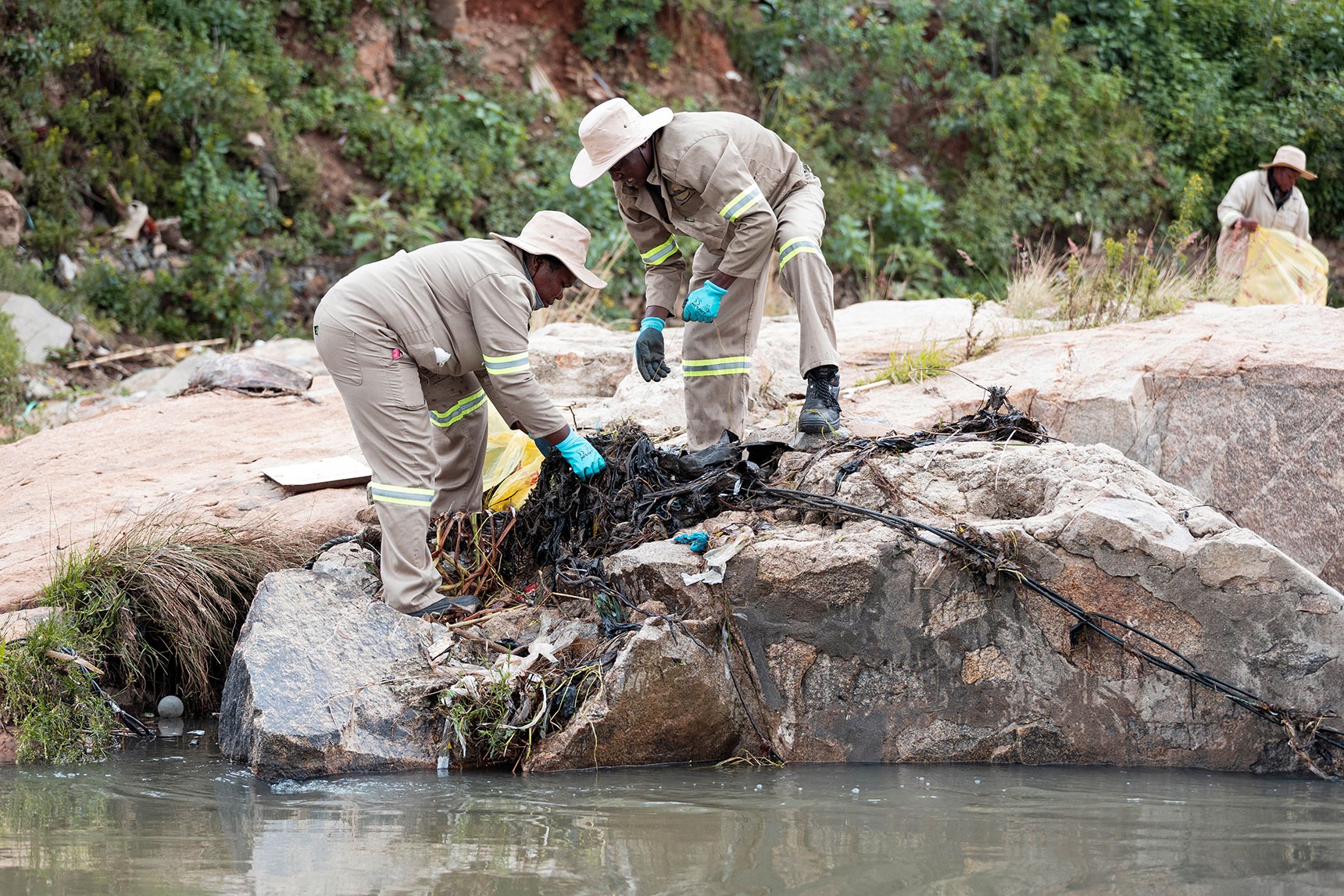
 The Alexandra Water Warriors pick up trash from the Jukskei River in Alexandra, Johannesburg. March 18, 2026. (Photo: OUR CITY NEWS / James Oatway)
 Along the banks of the Jukskei River, a quiet transformation is under way. What was once a polluted waterway choked with waste is slowly becoming a space of restoration, creativity and community pride, driven by the Suncasa programme and the Alexandra Water Warriors.
The initiative forms part of the broader Suncasa (Scaling Urban Nature-Based Solutions for Climate Adaptation in Sub-Saharan Africa) project, which is working to restore key parts of the river system across Johannesburg.
According to programme manager Chanel Pather, the project stretches far beyond Alexandra.
/file/attachments/orphans/Alex_water_warriors_03a_574683.jpg "Chanel Pather, Suncasa Programme Manager, in Alexandra, Johannesburg on 18 March 2026. (Photo: Our City News / James Oatway)")
“Alexandra is not our only site. We start in Lorentzville, where Victoria Yards is, where the Jukskei comes out from under Ellis Park Stadium all the way into Alexandra, and we run all the way to Paulshof. This whole stretch is about six kilometres or so,” she said.
Speaking to Our City News, Pather said that across this stretch of river, different partners were tackling environmental challenges using nature-based solutions. One of the key interventions being the removal of alien invasive plants along the riverbanks. Suncasa is a project backed by the International Institute for Sustainable Development and World Resources Institute, working with local partners.
Invasive plants
“Our partners, Water for the Future, are doing what we call alien invasive plant removal. Invasive plants suck up a lot more water from the riverbank, which destabilises it and causes more debris to fall into the river, destroying biodiversity,” Pather said.
To counter this, the project is also focused on rehabilitation.
“We reintroduce indigenous seeds into the bank to fortify it and allow for better flow of water down the river,” she said.
In Alexandra, however, the work takes on a more community-driven form. Here, the Alexandra Water Warriors have long been active, cleaning a three-kilometre stretch of the river and removing debris on a daily basis.
/file/attachments/orphans/Alex_water_warriors_05a_639234.jpg "Ntombi Maponya and Nonhlanhla Sukazi are two of the Alexandra Water Warriors. (Photo: Our City News / James Oatway)")
/file/attachments/orphans/Alex_water_warriors_09a_954931.jpg "A Hadeda that was carved out of a tree pulled out of the Jukskei River by the Alexandra Water Warriors in Alexandra. (Photo: Our City News / James Oatway)")
/file/attachments/orphans/EDITORS_CHOICE_Alex_water_warriors_21a_935700.jpg "The Alexandra Water Warriors pick up trash from the Jukskei River in Alexandra, Johannesburg. March 18, 2026. (Photo: OUR CITY NEWS / James Oatway)")
Noting the impact this project has had in an area where waste management and service delivery challenges often result in rubbish ending up in the water, Pather said the programme was not just about cleaning, but also about reimagining how communities interacted with the river.
“When we first came to Alex, we saw the first litter trap, and no offence, it was not very pretty. But we saw this whole space and thought, how do we create a space for communities to really engage and enjoy,” she said.
That thinking led to the idea of transforming litter traps into public art installations that double as environmental infrastructure. Discarded materials such as tyres, tree trunks, cables and bricks collected from the river are now being repurposed into functional litter traps and striking artworks. These structures help filter waste while also telling a story of renewal.
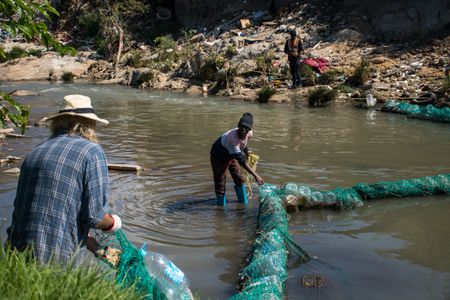
For Semadi Manganye, co-founder of Alexandra Water Warriors, the approach goes beyond clean-up efforts.
“With the cleaning of our environment, we saw how we can turn our trash into cash. We are converting waste into art, everything you see here has been collected from the river,” Manganye said.
Boosting tourism
The initiative is also opening up opportunities for local artists and boosting tourism in the township.
Manganye said: “There is a big gap when it comes to exposure for artists in the township. This was the perfect opportunity to get locals involved and create a green, walkable corridor that can attract both local and international tourists.”
At the same time, education remains central to the project’s long-term success.
“There is a big part of education and awareness that we have to bring to the community; we are working with primary and high schools, teaching learners why we’ve installed these systems and why they need to help sustain them,” Manganye said.
This community-focused approach is already showing results. Pather said there had been a noticeable improvement in the amount of waste entering the river.
The impact extends beyond waste reduction. Cleaner riverbanks and improved flow were also helping to reduce flooding risks in vulnerable areas like Alexandra.
The success of the project, Manganye said, lay in its collaborative model, which was bringing together grassroots organisations, the government and private sector partners. DM
This story was produced by Our City News, a non-profit newsroom that serves the people of Johannesburg.
/file/attachments/2990/2025-11-20_23-05-13_190568_351214_235077_473080_143880.png)