




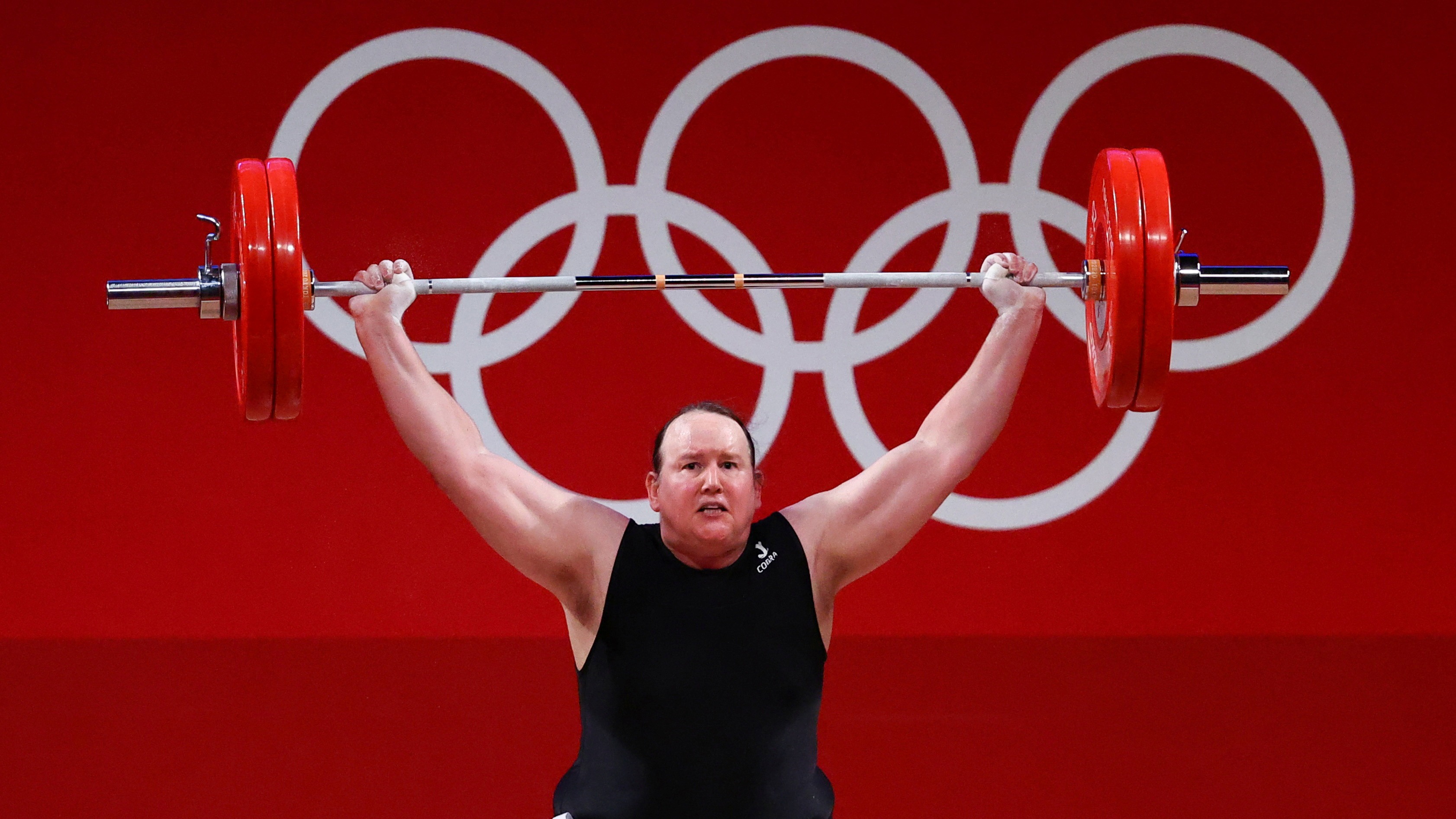
 Laurel Hubbard of New Zealand was the first transgender woman to participate in the Olympic Games. She took part in weightlifting at the Tokyo 2020 Games. (Photo: Reuters / Edgard Garrido)
Fairness, safety and integrity. Those are three themes which the International Olympic Committee (IOC) prioritised when it came to the conclusion that from 2028 Olympic Games onwards, transgender women will not be allowed to compete against athletes who were born as women.
This is a move away from the narrative the IOC was championing as recently as the 2020 Olympics in Tokyo. There the message was centred around inclusivity. The Olympic Games custodian essentially said that a woman is a woman, regardless of whether they were born that way or have transitioned.
Laurel Hubbard example
Hence New Zealand’s Laurel Hubbard made history as she became the first transgender athlete in history to compete in the Olympics.
Despite the scrutiny around her purported advantage, at the Tokyo-hosted 2020 Games, Hubbard failed to record a result after three unsuccessful attempts in the +87kg weightlifting final. Nevertheless, critics argued that another athlete from New Zealand had missed out on being an Olympian because of her presence.
In 2026, the global Olympic body has shifted from that mindset to saying the women’s category at the Olympics is solely reserved for biological women.
According to the research that the IOC has done over the past year or so, this is someone who was born with XX chromosomes (as opposed to the male XY chromosomes) and does not carry the SRY gene. SRY stands for “sex-determining region Y” gene. It is involved in male-typical sex development.
“The International Olympic Committee has published a policy on the protection of the female category. I understand that this is a very sensitive topic, and as a former athlete I passionately believe in the rights of all Olympians to take part in fair competition,” said IOC president Kirsty Coventry.
“The policy we have announced is based on science and it has been led by medical experts, with the best interests of athletes at its heart. The scientific evidence is very clear. Male chromosomes give performance advantage in sports that rely on strength, power or endurance,” Coventry said.
“At the Olympic Games, even the smallest margins can be the difference between victory and defeat. So, it’s absolutely clear that it would not be fair for biological males to compete in the female category. In addition, in some sports it would simply not be safe,” the former swimmer stated.
/file/attachments/2990/UP1EM2K10WWUY_952483.jpg "IOC President Kirsty Coventry. (REUTERS/Fabrizio Bensch)")
Clear competitive advantage
According to the IOC there is a 10 to 12% male performance advantage in most running and swimming events, as well as an advantage of more than 20% for biological males in most throwing and jumping events. The IOC further added that its scientific research showed that male advantage can be greater than 100% in events that involve explosive power. It cited sports such as rugby and combat sports as examples.
“Every athlete must be treated with dignity and respect. So, athletes will only need to be screened once in their lifetime. There must be clear education around the process, with counselling available alongside expert medical advice,” said Coventry.
“The IOC recognises the importance of widespread participation in grassroots and recreational sports programmes, as well as the impact that sport has on society. However, the Olympic Games have a focus on elite sports. And in elite sports we must ensure the fairness, safety and integrity of all competitions within the Games.”
The IOC also explained that it favours the SRY gene test because it’s a definitive starting point and it is fixed; unlike the uncertainty that comes with hormones. Unlike other methods, the IOC says this option is non-intrusive as it merely requires a sample such as saliva or blood.
“You have to understand that you can’t just go and win women’s sports because you’re male. That assumption does a huge disservice to the quality of women athletes. They are really good. The women who win women’s marathons are exceptional athletes, women cyclists who win the Tour de France would beat 99.9% of men,” sports scientist Ross Tucker said on the Real Science of Sport podcast.
“What was happening before was that relatively mediocre males were entering women’s sports. And they weren’t necessarily winning. [American swimmer] Lia Thomas changed that. Laurel Hubbard was the first catalyst in terms of the Olympics,” Tucker said.
“These were good males in sport, who then dominated in women’s competitions. They showcased, in a series of individual cases, what was going to happen if the women’s sporting boundary was not defended.
“It was increasingly becoming apparent that male advantage was not being removed by the suppression of testosterone,” Tucker stated. “The result was that the retention of male advantage was inevitable. Then we got to boxing. The reason boxing made this thing so clear for people is because it is a violent combat sport.”
DSD athletes’ future?
The IOC pointed out that the SRY test is merely a start to determining eligibility. If an athlete tests positive for the gene, further tests will follow. This distinction is particularly pertinent for Differences in Sex Development (DSD) athletes such as South Africa’s Caster Semenya, as they are likely to test positive for the SRY gene.
On the back of this announcement, human rights groups around the world expressed their displeasure. Earlier in the year, with the announcement imminent, the United Nations (UN) slammed the IOC’s decision.
“Under international human rights law, any differential treatment must pursue a legitimate aim and be objective, reasonable and proportionate,” the UN said.
“Where regulation is rooted in stereotypes or generalised assumptions rather than robust and sport-specific substantiated evidence, it risks violating principles of equality and non-discrimination, undermining dignity, privacy and bodily integrity, and deterring individuals from exercising their right to participate in cultural life on an equal basis with others. International human rights law provides clear guidance in this regard. Discrimination on grounds of sex and gender is prohibited,” it added.
It was always poised to be a tough balancing act for the IOC. Include transgender women and displease biological women. The international Olympic body has taken the opposite decision, which will leave many transgender women questioning their space in sports, particularly if they have dreams of reaching the elite level. DM
Comments
Scroll down to load comments...