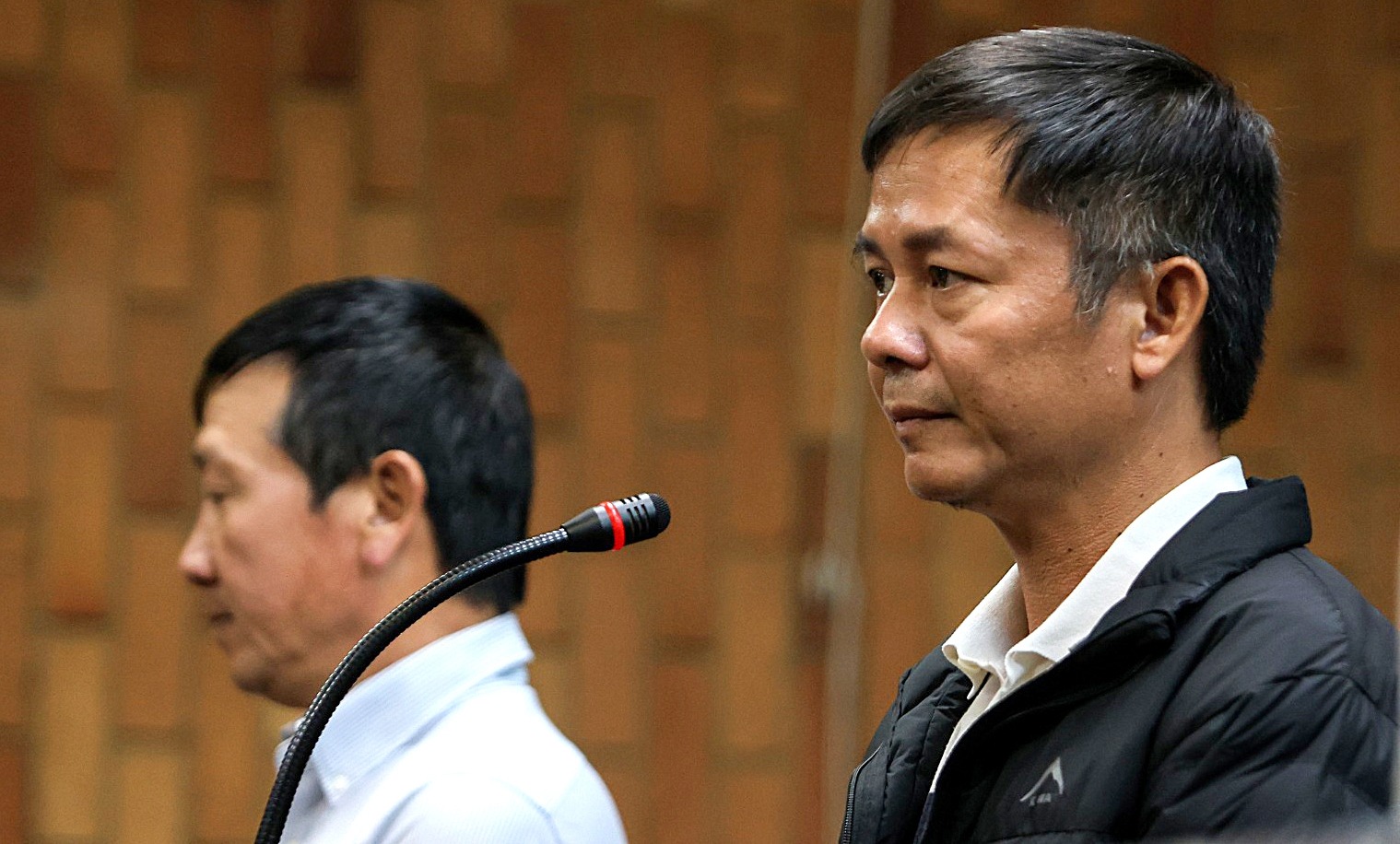
 Accused international rhino horn trafficking kingpin Chu Dang Khoa (right) and his alleged associate and enforcer, Huy Bao Tran, at their bail application last Friday. (Photo: Felix Dlangamandla)
 Investigations and reports by the wildlife trade monitoring network TRAFFIC and other conservation bodies have revealed disturbing evidence of organised crime in South Africa, including the frequent involvement of transnational Vietnamese syndicates in wildlife trafficking.
As of early 2026, investigations show that these networks have shifted from small-scale trafficking to smuggling large volumes of wildlife products, including rhino horns and lion bones.
In one such case, two Vietnamese nationals recently ended up in the dank holding cells of South Africa’s justice system, facing charges that could unravel not just a criminal syndicate but an entire web of transnational corruption, wildlife devastation and diplomatic impunity.
And in a development that is certain to spark a public outcry and anger conservationists and NGOs, Chu Dang Khoa and Huy Bao Tran have been granted bail of R200,000 each in the Kempton Park Magistrates’ Court. They were ordered to hand in their passports to the investigating officer, may not apply for any other travel documents, and must report to the Lyttelton Police Station once a week, according to the National Prosecuting Authority.
The case was remanded until 8 June 2026.
Chris Mercer, a wildlife advocate and author, said the magistrate “is clearly not informed of the wealth, scale and reach of these international crime syndicates and the devastating damage they have wreaked on Africa’s iconic wildlife, plus the impact this decision/judgment will have on the public’s confidence in the criminal justice system”.
He added: “R200,000 is pocket change for these syndicates. They operate in dollars.”
The ‘kingpin’ and his enforcer
One of the accused is Vietnam’s alleged rhino horn kingpin, Khoa (44), aka Michael Chu, who is described as a “diamond tycoon” and scion of a wealthy family involved in the oil and petroleum business. Allegedly a high-level actor in the illicit wildlife trade, he is reportedly a hands-on organiser, director and financier of syndicates that traffic rare, endangered wildlife.
Sitting beside him in the dock was Tran (52), also known as Ben Tran, allegedly Chu’s go-to man on the ground, director of African operations and main enforcer.
They were arrested in late February and early March by the Hawks, not only for orchestrating one of the most sinister rhino horn trafficking operations in recent memory, but also for staging an armed robbery that backfired spectacularly while attempting to mask the “disappearance” of 98 rhino horns from the authorities.
/file/attachments/orphans/HUY-BA4_479595.jpg "Huy Bao Tran, aka Ben Tran, seated in the cockpit of an international flight that carried wildlife DKC Trading Company shipped from South Africa to Vinh Pearl Safari Park located at Phu Quoc island. (Photo: Facebook / Ben Tran)")
/file/attachments/orphans/Bloch-Ben-Tran_600079.jpg "Voi Lodge and DKC Trading owner Chu Dang Khoa, aka Michael Chu, the ‘Diamond tycoon’, is linked to the international wildlife trafficking networks in South Africa, Vietnam and South East Asia. (Photo: Facebook)")
However, the alleged heist was poorly conceived and badly timed. Investigators called it “a clown show”.
Twenty of the “missing” horns that were shipped by the syndicate from OR Tambo International Airport in Johannesburg, together with 150kg of suspected tiger bone carcasses, skulls and claws, were seized by the authorities on 8 November at Singapore’s Changi International Airport, 30 days before the syndicate submitted the false robbery report.
Three weeks later, a second shipment of 17 horns and 26kg of predator body parts that originated in South Africa and consigned to Vientiane, Laos, was also discovered and detained at Changi.
The contraband was secretly rerouted back to the senders via a controlled delivery to Johannesburg, where members of the Hawks’ Endangered Species Section and Border Management Authority nabbed Nigerians Tunji Olanrewaju Koyi (35) and Koyode Adukunle Ongundele (43), now accused 1 and 2. The illicit cargo was recovered in the process, and has since been held as evidence.
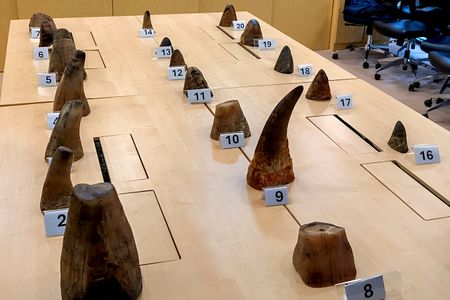
The “Vietnam Rhino Horn Swindle”, as conservationists have dubbed it, was no longer hidden. What began as an audacious, transnational organised crime smuggling racket to launder rhino horns in the hidden, back-alley rooms of Hanoi and tourist-filled casinos of Laos, has unravelled into the biggest wildlife trafficking bust in years. This wasn’t just poaching, it was organised crime on an industrial scale.
More explosively, it has dragged South Africa’s Department of Home Affairs into the spotlight for systemic corruption and exposed Vietnam’s shadowy passport and visa machine as a facilitator for global syndicates.
This is not Chu’s first rodeo with South Africa’s criminal justice system.
According to a recently published book, iziNdlovu: The story of South Africa’s Greatest Rhino Poaching Case by wildlife investigator Div De Villiers and journalist Adrienne Carlisle, “in December 2006, Chu was found with four rhino horns on his property in Newton Park, Port Elizabeth. He had no permits for two of the horns. He was subsequently charged and found guilty of illegal possession. He was sentenced to a fine of R40,000 or 12 months’ imprisonment and deportation from South Africa. It appears his deportation was never effected”.
/file/attachments/orphans/AwomannamedMarybelievedtobeMichaelChusnewwifeseenattendingcourtphotoDM_508113.jpeg "A woman named Mary, believed to be Michael Chu's new wife, seen attending court. (Photo: Felix Dlangamandla)")
A further clue to Chu’s shenanigans is the new passport issued to him by the Vietnamese embassy in Pretoria in 2007, allegedly while on bail on separate immigration charges in the Port Elizabeth matter.
A reliable source who did not wish to be named said it is normal procedure for the police to hold a foreign suspect’s passport until the trial has been concluded.
“Chu and a defence witness allegedly failed to come to court on the scheduled court date,” he said.
So, how did a deported foreign national build an empire on South African soil? The answer lies in a toxic cocktail of Vietnamese “pseudo” rhino hunters and mules, embassy facilitation and the corruption inside the Department of Home Affairs and the Border Management Authority that the Special Investigating Unit laid bare in a bombshell briefing on 23 February 2026 – a day before Huy Bao Tran’s arrest, when he was nabbed at Cape Town International Airport making a mad dash for a flight to Singapore with his wife and children.
The briefing, by acting SIU head Leonard Lekgetho, followed an investigation into Home Affairs authorised by President Cyril Ramaphosa under Proclamation 154 of 2024.
Magaboke Mohlatlole, South Gauteng spokesman for the National Prosecuting Authority, told Daily Maverick that Tran is alleged to have travelled in and out of South Africa using different identities and passport numbers.
“The State further alleges that Tran has previous convictions for similar offences. In his affidavit, he claims to be a businessman and a permanent resident with business interests in Cape Town. However, the State contends that he poses a flight risk due to his access to international travel and history of similar offences.
“Chu Dang Khoa has been added to the matter as the owner of the game farm. He claims that he is in South Africa on a medical visa and was not in the country at the time of the alleged offences. The State disputes this version. Investigations are ongoing and more charges may be added,” Mohlatlole said.
Home Affairs and the Border Management Authority did not respond to questions.
‘Dodgy’ documents
According to an investigator who asked to remain anonymous, the passport machine at the Vietnamese Embassy in Pretoria has been working overtime for years, providing dodgy documents as cover to shady operators.
The Vietnamese Embassy told Daily Maverick it “objects to the vague remarks, expressions, or assumptions regarding its issuance of passports to Vietnamese citizens”.
“The embassy has no comment on matters about which we lack information. Any other matters concerning Vietnamese citizens in South Africa that relate to law enforcement should be communicated to the relevant South African authorities.”
Lekgetho said at the briefing: “The SIU uncovered a disturbing reality: South Africa’s immigration system has been treated as a marketplace, where permits and visas were sold to the highest bidder.
/file/attachments/orphans/AfrozentigercarcassdisoveredduringtheHAWKSraidonVoiLodgein2019courtesySAPS_304776.jpg "A frozen tiger carcass disovered during the Hawks raid on Voi Lodge in 2019. (Photo: Courtesy SAPS)")
“Officials entrusted with safeguarding the integrity of the Department of Home Affairs instead turned their positions into profit-making schemes, while external actors exploited influence, fabricated documentation and manipulated systemic weaknesses to secure fraudulent residence permits.
“The investigation reveals that the country’s borders were not protected by law but auctioned off through corruption. South Africa was being sold one permit at a time.”
According to Julian Rademeyer, investigative journalist and author of Killing for Profit, Chu was also convicted in 2011, for illegal possession of five rhino horns, fined R40,000 and formally deported.
Yet, there he was in 2026, apparently living the high-life behind the gated walls of Pretoria’s lavish golf estates, the registered owner of a game lodge with about 80 captive tigers and at least 98 known stockpiled rhino horns, while allegedly funnelling the horns to the illegal markets along Vietnam’s Mekong River.
Vietnam’s side of the swindle is equally murky – and equally damning.
Hanoi has positioned itself as a rising economic power, yet its passport and consular apparatus has repeatedly been accused of enabling the very trafficking networks it publicly condemns.
Demand for rhino horn in Vietnam’s bustling hubs including Hanoi, Ho Chi Minh City and Laos, where horn is ground into powder for bogus medicinal tonics and aphrodisiacs, or gifted as tokens to bestow status, fuels the slaughter. South Africa has lost thousands of rhinos since the early 2000s – white rhino numbers have crashed from more than 20,000 to “critically endangered”. Every horn that reaches Asia represents bribes paid, visas bought and passports stamped. Chu’s DKC Trading empire allegedly bridged that gap: lodge owner by day, kingpin by night.
Hunt for records
The Department of Fisheries, Forestry and the Environment (DFFE) says it has no idea of the national picture or the number of Vietnamese rhino trophy hunters who have hunted and exported CITES-listed rhino horns as hunting trophies.
The DFFE is supposed to keep a repository and a database of hunting activities by foreign nationals, including but not limited to the export of CITES-listed hunting trophies such as rhino horns and elephant ivory.
/file/attachments/orphans/ChusnewwifebelievedtobenamedMaryandTranswifeJennyattendedthebailapplicationlastFridayatKemptonParkmagistratescourt_326097.jpeg "Chu’s new wife (left), believed to be named Mary, and Tran’s wife Jenny, at the bail application last Friday in the Kempton Park Magistrates’ Court. (Photo: Felix Dlangamandla)")
Replying to a Daily Maverick request for an accurate number of rhino hunters from Vietnam who have exported rhino horns with “legal” permits, the department said: “The information requested falls under provincial competence. In terms of provincial conservation legislation, provinces regulate hunting and keep the related records. The request should be directed to the relevant provinces.”
According to South Africa’s hunting regulations, a foreign hunter may only hunt one rhino per year, and the exported trophy must remain the property of the hunter and cannot be sold or traded commercially.
However, a hunting report shown to Daily Maverick lists Chu Dang Khoa as the legally permitted Vietnamese national who, in 2006, hunted two rhinos in Zululand four months apart. The outfitter and professional hunter were the same person on both occasions. “Second hunt this year” was noted in the comments section of the report.
One outfitter told the writer that he received a call from a person in Pretoria asking him to book and outfit a hunt.
The next thing he knew, a car with diplomatic licence plates arrived at the hunting venue with bags of cash. The hunting party said they didn’t want to deal through the banks.
Another outfitter and professional hunter who applied for rhino hunting permits for at least 22 Vietnamese nationals in KwaZulu-Natal between 2007 and 2010, told Daily Maverick that the individual who asked him to guide the Vietnamese nationals on these hunts was not licensed in the province.
“Some of those hunters could not even hold a rifle properly. I even had two guys who arrived wearing Italian suits and Italian shoes,” he said.
/file/attachments/orphans/CannedtigerhuntingatVoiGameLodgenopermitrequiredFamilymemberandformergamefarmmanagermanagerChuVanThanhakaBeckham_398336.jpg "Canned tiger hunting at Voi Game Lodge, no permit required. Family member and former game farm manager manager Chu Van Thanh aka Beckham. (Photo: Facebook)")
The rot goes deeper when you trace the money. Chu’s family wealth, allegedly funnelled through DKC Trading’s import-export front, DKC Furniture, bought Voi Game Lodge in 2010.
Soon the place was stocked with rhinos and tigers, and an assortment of game that became target practice for the hordes of visiting family members, friends, Vietnamese tourist groups and the embassy officials who drove them there from Pretoria.
Right next door to Voi Game Lodge was Shingalana, a sprawling game-breeding and hunting operation owned by Kobus Jacobs. Their eldest son, Frikkie, is a professional hunter and outfitter, and importantly for Chu’s horn operation, Kobus Jacobs had unlimited access to rhinos sold on auction by SANParks and Ezemvelo KZN Wildlife. Pseudo hunting was in full swing, and the foreign currency was flowing freely.
Data gleaned from the auctions shows the Jacobs family were regular buyers at the annual auctions. Kobus and Rina Jacobs were once seen bidding for rhinos at the Sibaya Casino where Ezemvelo hosted its annual game sales.
Rhino hunting lists reveal that North West Nature Conservation officials were handing out rhino hunting permits to Vietnamese applicants hand over fist, allowing them to export the horn trophies without even knowing whether the permit applicant, or the professional hunter, had actually shot the animal.
/file/attachments/orphans/DeonSwartformerdirectoratNorthWestDepartmentofEnvironmentConservationwhoresignedunderacloudandwentontosellhisconsultingservicesandpermitexpertiset_886731.jpg "Deon Swart, former director at North West Department of Environment & Conservation who resigned under a cloud and went on to sell his consulting services and permit expertise. (Image: Facebook)")
Voi Lodge acted as a launchpad for the Vietnamese pseudo hunters in North West. More than 40 rhinos were bought and delivered to Shingalana for put-and-take pseudo hunts by visiting Vietnamese nationals.
Devious machinations
“Pseudo hunts” are a fraudulent scheme in which organised crime syndicates exploit legal hunting permit systems to source rhino horn for the black market. It involves using non-genuine “hunters” to obtain horns under the guise of legal trophy hunting.
Data gleaned from microchip numbers indicated that some rhinos were shot and killed within two weeks of being delivered, some within days.
Horns were removed from the dead animals, mounted on crude shields and exported with CITES permits to addresses in Vietnam that were often fictitious. Most disappeared into the fraudulent ether that permeates South East Asia’s illegal wildlife marketplace.
Tran is also listed as the Vietnamese national who shot two rhinos in North West. Chu’s cousin, Chu Gu Lit’s name appears on many rhino hunting permits in various provinces. In 2012, he was sentenced to five years’ imprisonment after he and a friend were arrested in possession of 10 horns for which they had no legal permits.
/file/attachments/orphans/ChuDangKhoaandChuGuLittoastingeachotherfacebook_181311.jpg "Chu Dang Khoa (left) and Chu Gu Lit toast each other. (Photo: Facebook)")
/file/attachments/orphans/ChuDangKhoarightandcousinChuGuLitatthe2019grand-openingofDKCsoilandpetroleumteminalGuLitdidtimeinprisonforillegalrhinohornpossessioncourtesy_403966.jpg "Chu Dang Khoa (right) and cousin Chu Gu Lit at the 2019 grand opening of DKC’s oil and petroleum teminal. Gu Lit did time in prison for illegal rhino horn possession. (Photo: lecourrier.vn)")
Former department director Deon Swart, who resigned under a dark cloud at about that time, became a private permit consultant to farm owners and traders in the wildlife breeding and trophy hunting industry.
His wife, Bettie, headed up the department’s office for the Kenneth Kaunda District, under which Voi and Shingalana fell.
Swart’s knowledge of the permit system and his wife helped them build a lucrative relationship with DKC Trading, which owned Voi Game Lodge.
In 2016, Swart visited Vietnam to consult on behalf of DKC Trading, which was trying to score a contract to export 100 rhinos to the Vinpearl Safari Park.
When the DFFE refused their export application, DKC transported 14 of their own rhinos from the quarantine facility back to Voi Lodge. Five rhinos imported from the Free State remained behind. On Christmas Eve 2016, the five rhinos were shot and their horns brutally hacked off. The case was never solved.
Hanoi scandal
Chu Dang Khoa’s mother, Chu Thi Thanh, is the chair of the Thien Minh Duc Group Joint Stock Company, a Vietnamese entity involved in shipping, oil storage and fuel trading, transport, construction and hospitality.
In 2025, the company and its affiliate, DKC Petroleum, a major oil and gasoline distribution chain, were embroiled in a huge embezzlement scandal that shocked even the powerful and politically connected elite in Hanoi.
/file/attachments/orphans/DressedtoKill-VoiGameLodgeregularsDavidThaiandMickyHoangphotofacebook_614696.jpg "Dressed to Kill: Voi Game Lodge regulars David Thai (left) and Micky Hoang. (Photo: Facebook)")
Chu Thi Thanh was arrested in early 2025 on fake invoice and asset theft charges, and her passport was frozen.
By this time Chu Dang Khoa had already left for Africa, with a woman named Mary, believed to be his new wife.
As the Kempton Park Magistrates’ Court prepares for a full trial, the diplomatic temperature is rising.
Vietnam insists it is cooperating while protecting its citizens’ rights. South Africa, reeling from the SIU exposé, cannot afford to appear soft on transnational crime and border security.
/file/attachments/orphans/PhotofromSingaporePoliceForce1_828801.jpg "The foul odour emanating from the cargo revealed the skeletal remains of lions and tigers bones and skulls, destined for the consumer trade in Laos and Vietnam where the bones are ground into powder cake, or soaked in vats of wine and sold as a cure-all tonic.
<br>(Photo: Singapore Police Force)")
(Photo: Singapore Police Force)
International partners are watching: The CITES secretariat, Interpol and Western donors have signalled that continued wildlife trafficking could affect aid and trade talks.
“There is going to be a lot of interest in how this investigation and prosecution proceed, given the scale and history of Chu’s activity and network,” said Taylor Tench, a senior wildlife policy analyst at the Environmental Investigation Agency US.
“Hopefully the prosecution will proceed smoothly while avoiding the frustrating delays that have plagued previous prosecutions of high-level actors engaged in the illegal wildlife trade in South Africa.
“In addition to the wildlife trafficking charges, we encourage South Africa to pursue financial investigations, seize assets and go after proceeds of crime in order to effectively dismantle the criminal network.” DM