



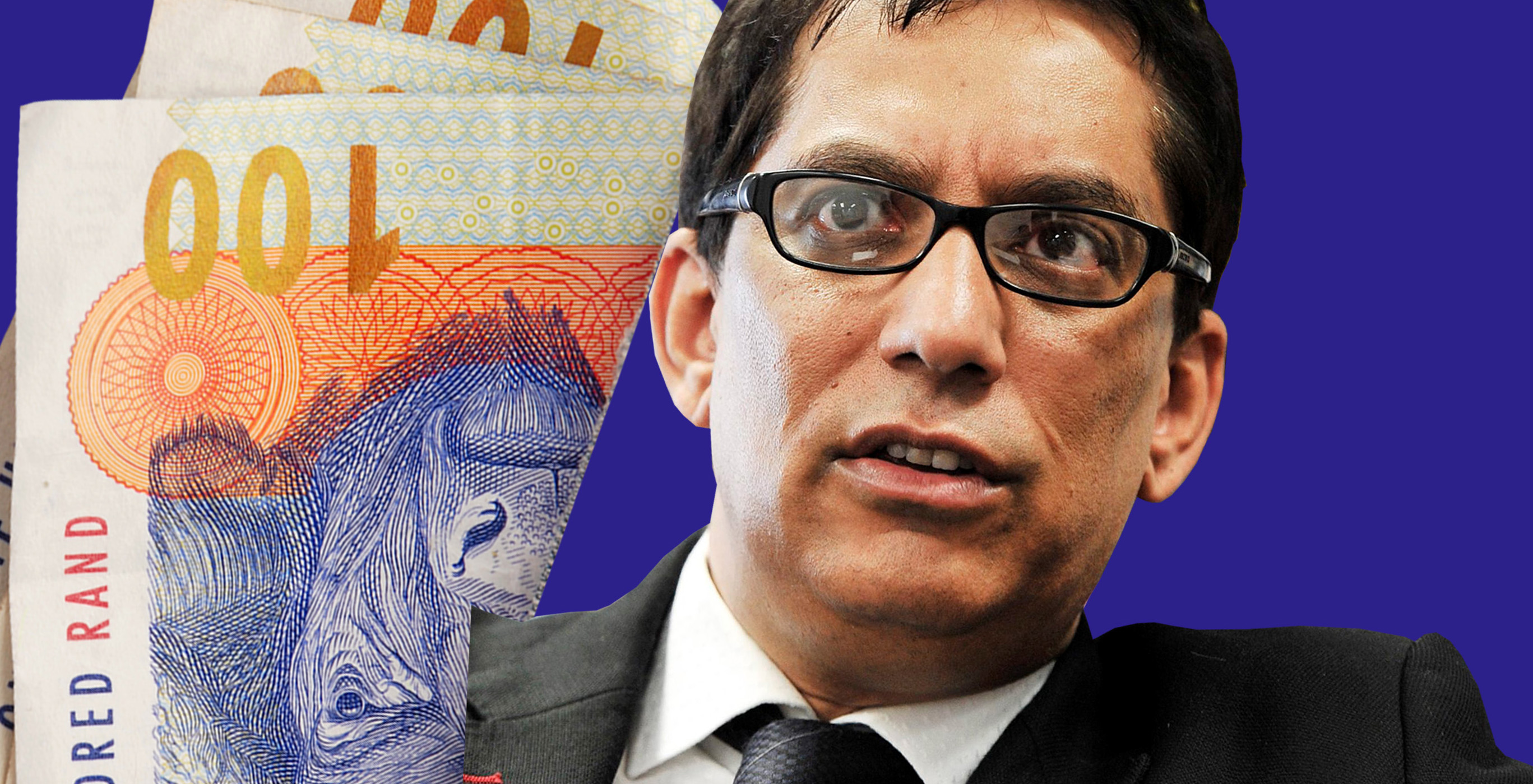
 Illustrative image | Iqbal Survé, chairman of Sekunjalo Investment Holdings. (Photo: Gallo Images / Foto24 / Lerato Maduna)
 Iqbal Survé’s Sekunjalo Independent Media (SIM) has been ordered by the Supreme Court of Appeal to pay the Southern African Clothing and Textile Workers’ Union (Sactwu) at least R458.6-million stemming from a R150-million loan agreement the company entered into with the union in 2013.
In the judgment delivered on Thursday, the court found that a key subordination agreement between the two was never properly authorised — clearing the way for Sactwu to pursue repayment.
At the same time, the court reaffirmed the in duplum rule, underscoring that interest cannot spiral indefinitely, even when it is rolled into the loan.
Self-proclaimed philanthropist Survé entered into the loan agreement with the union in 2013 to buy Independent Media from its Irish owners.
This ruling is the latest in a quagmire of financial issues and controversy surrounding entities linked to Survé. First, the banks have refused to deal with several companies linked to him. Then there is the controversial Public Investment Corporation (PIC) settlement and the delisting of African Equity Empowerment Investments (AEEI). And don’t forget the lawsuits that two of Survé’s companies instituted against the government and Cyril Ramaphosa.
Commenting on the ruling in an article on IOL, Independent Media chairman Lucien Jacobs said: “Independent Media notes the judgment delivered by the Supreme Court of Appeal (SCA) in relation to the dispute involving the Independent Media Consortium and the Southern African Clothing and Textile Workers’ Union (Sactwu).”
“It is important to clarify that this matter does not involve Independent Media as an operating business, nor Sekunjalo Investment Holdings,” said Jacobs.
According to Jacobs, the case instead relates to the Independent Media Consortium (IMC), a special purpose vehicle established to invest in Independent Media, which owns the Cape Times, The Star and Isolezwe, among others.
The union's André Kriel was not immediately available for comment.
The background
In 2013, the investment arm of Sactwu, Sactwu Investment Group (SIG), lent R150-million to Sekunjalo Independent Media. The agreement was that interest would accrue on the loan amount due quarterly over the seven-year term of the loan (with the understanding that the loan would be repaid by 2020). If Sekunjalo Independent Media did not have funds to pay any accrued interest, then the interest would be capitalised (added to the original loan amount).
In 2017, SIG faced challenges from a capital perspective, and its dividend income proved insufficient to make the necessary investments in the clothing industry to preserve clothing businesses and prevent job losses.
By 2017, no interest on the loan to SIM had been repaid, and this had been added to the original loan amount.
At this point, SIG decided it wanted to exit the loan agreement.
But Survé proposed that Sekunjalo Investment Holdings would take over the shares and loans payable to SIG.
According to the court documents, Survé arranged that the equity would be settled by the issue of shares in Sagarmatha (a subsidiary of Sekunjalo Investment Holdings) before Sagarmatha's imminent listing on the JSE. The background notes in the judgment state that he further allegedly informed SIG that Sagarmatha had attracted to its advisory board and as shareholders, some technology billionaires from the US, the Netherlands, China, Singapore and India.
The idea was to settle the debt using shares in Sagarmatha.
On 22 November 2017, SIG’s board of directors passed a written resolution authorising the agreement.
On 1 December 2017, André Kriel, an SIG director, signed a subordination agreement, which basically meant SIG would wait for SIM to be financially healthy before demanding payment.
In April 2018, the Sagarmatha listing failed and consequently, SIG’s loan was never transferred to Sagarmatha.
The SCA judgment
According to the SCA judgment, Survé tried to come up with ways of repaying the loan to SIG after the listing failed. The judgment notes that “at some point, he undertook to pay R120-million and to transfer shares valued at R30-million to SIG”. However, that promise never materialised. SIG subsequently sued for repayment of the loan, and SIM defended the action, primarily relying on the subordination agreement.
The matter then went to the high court, where SIG tried to dispute Kriel’s authority to sign the subordination agreement. It argued that the subordination agreement had been entered into based on three things they had been told, namely:
- that the subordination agreement would only be used if it was needed for the Sagarmatha listing — specifically, if the auditors or the JSE required SIG to step back (delay its claim) so the listing could go ahead;
- that SIM’s auditors, Grant Thornton, wanted the subordination agreement signed so that, in the run-up to the Sagarmatha listing, SIM’s creditors could not demand payment or try to liquidate SIM; and
- that the subordination agreement would automatically fall away and cease having any effect one week after the date Sagarmatha was supposed to list on the JSE.
Put another way, SIG said it signed because it believed the agreement was just a temporary safety net for the planned listing, not a long-term block on getting its money back. It also argued that once unpaid interest was rolled into the loan, the usual cap on interest should no longer apply (the in duplum rule states that interest can only grow up to the same amount as the original loan).
The Supreme Court of Appeal needed to decide whether Kriel had the authority to sign the subordination agreement, because if not, the agreement would be null and void.
The second big question was whether the in duplum rule applied.
In her ruling, Judge Thandi Norman said: “The agreement was structured in such a way that SIM could, at its election, delay payment of interest. The presence of this feature in the agreement distinguishes this contract from those where the creditor (SIG) has allowed the unpaid interest to accrue and reach the unpaid capital amount.”
She went on to explain that “The debtor enjoyed non-payment of interest on the R150-million for seven years. It failed to pay when it was called upon to do so. Litigation commenced on 15 April 2019, and the appeal was brought and heard by this Court some six years later, on 18 February 2026. This is not an ordinary debtor that has purchased a motor vehicle or a house that is bonded with a financial institution. This is a debtor who had the benefit of a huge loan with the freedom to exercise an election not to pay interest and let it accrue.”
The Supreme Court of Appeal capped interest in principle, but the parties had already agreed to a much higher settlement figure — about R458.6-million, plus ongoing interest — which now governs what must be paid.
Daily Maverick contacted Survé for comment, and he replied: “I can’t talk to you right now, I’m at the Cape Town International Jazz Festival. Please call me tomorrow.” He followed it up with a text message, advising us to call Lucien Jacobs (quoted at the beginning of the article) in the morning.
The article will be updated when Survé responds. DM