



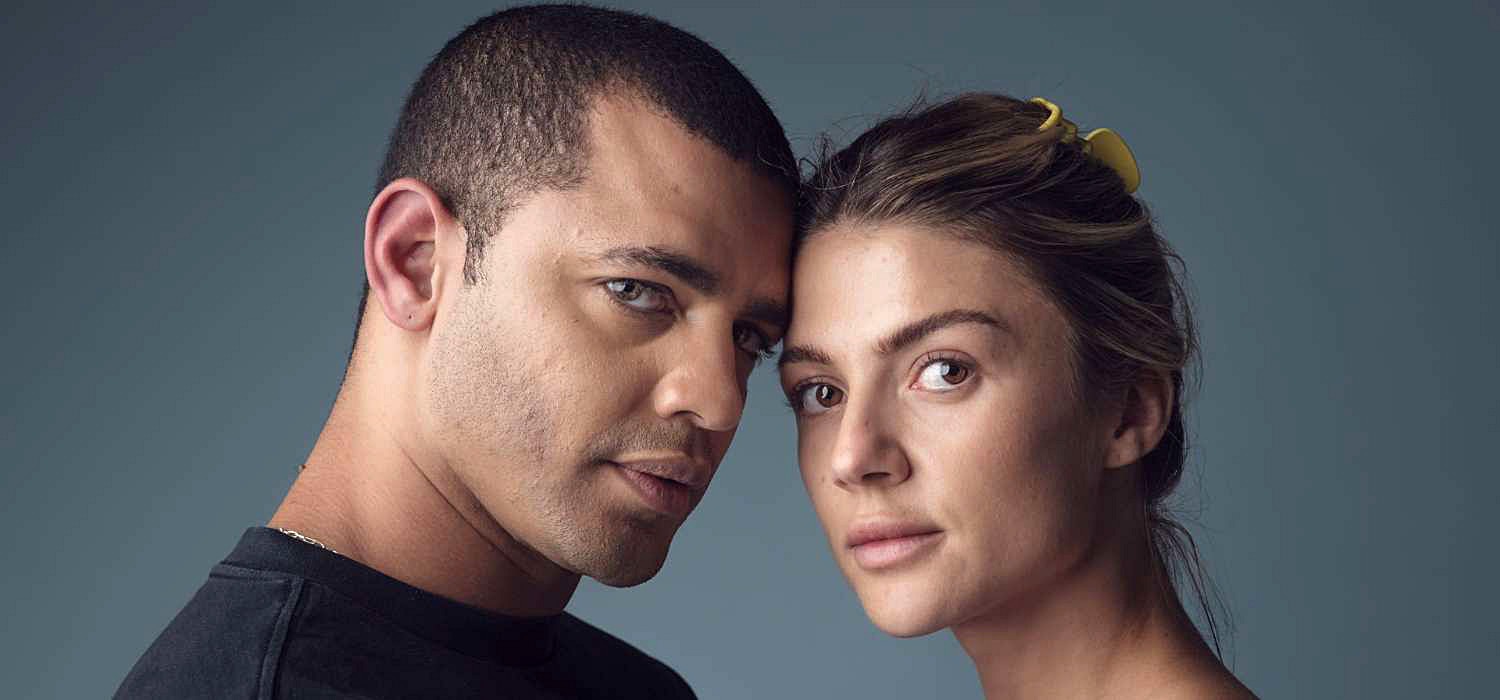
 Mienke Ehlers and Dean John Smith for Lemoene, lemoene, lemoene, lemoene, lemoene. (Photo: Gys Loubser)
 In the small, barren back room of a church hall in Milnerton, walls peeling with rising damp, the overhead lights harsh, I watched actors Mienke Ehlers and Dean John Smith run out of words.
It was 10 days before their debut at KKNK on 28 March and they were rehearsing a new Afrikaans translation and adaptation of Sam Steiner’s 2015 play, Lemons Lemons Lemons Lemons Lemons. The missing words weren’t flubs or forgetfulness, but built into the script, which illuminates a Black Mirror-type thought experiment in which our words are quite literally taken away from us.
It’s a play that’s deceptively simple and feels worryingly prescient in an age when authoritarian political control is no longer merely creeping into the mainstream but is, in many parts of the so-called democratic world, actively stripping away basic rights and freedoms.
Steiner’s original play emerged from the British fringe circuit and eventually landed on the West End; it was while reading the text as a student that theatre-maker Kanya Viljoen’s curiosity was aroused.
“I remember being super confused until the idea behind the play finally landed and I understood what was happening,” she says. “I loved the play and so banked it for future use.”
It stuck with her until, almost a decade later, she found herself yearning for a creative project while focusing on the academic challenges of the PhD that she’s been working on in Germany since 2023.
And so she opted to spin Steiner’s work into Lemoene, lemoene, lemoene, lemoene, lemoene (literally, Oranges, oranges, oranges, oranges, oranges). It’s not only a translation into Afrikaans, but brings the story of a young couple living through the rise to power of a populist regime into a local milieu while also reimagining the character dynamics.
Don’t be fooled by the title: it’s not about lemons. Nor oranges. “The title is really a reference to a kind of ‘word vomit’ that happens in the play,” Viljoen says.
Words – whether vomited or more judiciously spoken – are really the main concern of the play, their power in ordering human relationships thrown into stark relief, especially as they begin to run out.
/file/attachments/orphans/MienkeEhlersandDeanJohnSmithforLemoenelemoenelemoenelemoenelemoene_GysLoubser_949172.jpeg "Mienke Ehlers and Dean John Smith for Lemoene, lemoene, lemoene, lemoene, lemoene. (Photo: Gys Loubser)")
Breezily minimalist, the prop-free two-hander is touchingly observed and tenderly performed. It is also disconcerting. By some stroke of clever timing, it manages to meet the moment, touches on something urgent and pervasive in the zeitgeist, some ever-present anxiety simmering just below the surface of everyday life.
It feels like a reminder that, at any moment, our most basic rights and freedoms, even those we take to be God-given, might be taken away. Who might take them? An authoritarian government voted into power by a well-meaning but ruinously shortsighted majority.
Not that Lemoene is necessarily a political play. It’s more about human relationships, a kind of romantic comedy for a socially perplexing time.
It’s a play that co-opts big ideas in the service of getting at that most fragile and precious thing: the tiny forces that bind us to the ones we love. And it’s about how what we choose to say ultimately structures the reality we find ourselves in.
That’s how I pieced together the puzzle that this play ultimately is.
It’s cleverly open-ended, though, designed to prompt and provoke as many alternative interpretations as there are people watching. It refuses to fall into the trap of making every ounce of meaning explicit. Which means that it’s a story that happens as much in the imagination of the viewer as it does in front of their eyes on stage.
The play also feels like a warning.
Not that we might, after the next election or the next, be subjected to sudden and unprecedented changes in how we are permitted to exist, but that we are perhaps already in a spiral of handing our autonomy over to unpredictable forces. While the central conceit in the play is – hopefully – preposterous, one has only to glance across the Atlantic to see a democracy thrown into disarray thanks to a misalignment between voters’ expectations and the real-world outcome of political power.
Never mind the manifold ways in which we are, voluntarily, allowing our phones, our social media addictions and our little AI companions to transform the very nature of how we behave and how we interact.
These are just some of the alarm bells Viljoen is conscious of in a world she believes seems hell-bent on stripping away our humanity, causing us in various ways to forget who and what we are.
“Honestly, I feel like the world we’re moving towards is one that constantly is trying to remove us from ourselves,” Viljoen told me before we watched a full run of her play.
/file/attachments/orphans/DavidViviersandAnoechaKrugerinRaak_ChristineOfferman_945427.jpeg "David Viviers and Anoecha Kruger in Raak. (Photo: Christine Offerman)")
Viljoen believes that a big part of the function of the work she creates is to remind us what it is that makes us human. She also believes that the need to create this sort of work is increasingly urgent in a world that “from all standpoints – political, economical, social – seems designed to make us forget that we’re human”.
Today’s world, she says, “is about efficiency, it’s about phones, it’s about quick answers, it’s about sitting behind tech, it’s all about not being human”.
She sees art as a kind of antidote.
Making theatre is, for her, about bringing people into a room together. Because, she says, “humanity is simply coexisting and connecting”.
“All we’ve got is each other,” she says. “We only exist because there is someone witnessing us exist.”
And so she’s guided in her work by “an impulse to keep trying to remind us what it is that makes us us”.
Viljoen’s humanist impulses are rooted in a deep and abiding empathy. She recalls, as a child, being moved – to great sadness, even tears – when she saw someone, homeless or bereft, on the side of the road. As a student at UCT during the #FeesMustFall campaign, she felt the tension and hurt on campus so viscerally that it made her physically ill.
“I’m quite open,” she says. “It’s a great gift to be able to feel with people, and I think that’s really where the impulse to create comes from.”
She’s also motivated by the hope that theatre sparks conversation, encourages audiences to think and talk about issues. “There are many things happening, things that do not get discussed but that we need to keep talking about.”
For her, theatre is also a place to get to know the “other”.
“Once you see someone, hear someone, get to know someone, you start to understand them a bit better. Really listening to what [characters] have to say can maybe eventually change your interactions with real people you cross paths with. Something in your brain shifts a bit, because you’ve seen and heard a bit more about their lives.
“So, maybe the next time you walk past a queer person or a person of colour, someone who is different to you, your interaction with them might be different. That comes from the simple action of just paying attention to what characters are saying. Just sitting and listening and realising that everyone’s coming with their own ‘stuff’.”
At the same time, she believes theatre shows us who we are.
“I think the gift of theatre is that it’s an opportunity to see or hear little bits of ourselves.”
Viljoen grew up in Somerset West, in what she calls “a very Afrikaans family”, the oldest of four children raised with a healthy combination of play and discipline. Her mother is a music teacher who insisted that all her children play an instrument, and her book-loving father actively encouraged reading. Also encouraged was thinking properly about things and – as long as it was respectfully said – expressing opinions.
As a girl, Viljoen did ballet, but whereas dancing’s focus was on form and technique, the moment she got a taste of theatre – reciting a poem on stage at age seven – it set her free. She knew then that it was the thing for her.
“It was so, so liberating,” she says. “It was the first thing I did that wasn’t hard.”
She still finds liberation in making theatre, although “doing it now as a profession, with audiences and sales and budgets, brings a different dynamic”.
“I think I’m a better director when I don’t have to consider that the play must sell X number of tickets. So, while I still find it very liberating, there are times when I struggle with it a bit more, knowing we need bums on seats.”
Certainly, she has been unafraid to rock the boat, and to create work that pushes against expectation and potentially rattles audiences.
“One of my first plays was called Raak. I wrote it about a young couple and it was about Afrikaner culture and the oppression of the expectations around it.
“I was dead set on taking Raka [a seminal Afrikaans narrative poem by NP van Wyk Louw, first published in 1941] and reimagining it. Something about that show landed for me in terms of how I wanted to make theatre: it was a bit meta, a bit liminal, a bit like a dreamscape. I was very nervous taking it to Afrikaans festivals in places like Potchefstroom and Bloem. I worried that people wouldn’t sit with it because I was quite critical about, for example, hunting culture.”
She was pleasantly surprised, though, by the degree to which people engaged with it, evidence that audiences should not be underestimated, and are sometimes willing to have their status quo questioned and be provoked.
Viljoen is also known for colouring outside the lines of traditionally defined theatre, of stretching the form and experimenting. Something she considers a creative highlight was a performance art piece called Die skrif is aan die muur (“the writing’s on the wall”).
/file/attachments/orphans/KanyaViljoeninDieSkrifisAandieMuur_GysLoubser_534009.jpeg "Kanya Viljoen in Die Skrif is aan die muur. (Photo: Courtesy of Kanya Viljoen)")
“I installed public bathrooms with writing and poetry. And the whole point was to invite an audience to keep writing [on the walls], writing their thoughts about South Africa. It was one of the hardest things I’ve done because while it was happening I sat in a toilet cubicle and continuously ate white pap.
“It was quite durational. I would sit for five hours at a stretch doing this. It was about allowing people to say what they have to say while I was simply being a witness. I was essentially making and holding space for things to happen.
“It was an interesting experiment, interesting to discover how angry people and hurt people are. And if you give them the opportunity, they will express it.”
Viljoen doesn’t work exclusively with live performance. Over the weekend before I watched her new play being rehearsed, she’d shot a short film. She enjoys working within different mediums, finding the right form for whatever issue she’s tackling.
“It’s a case of trusting that the right medium will find the right story and vice versa,” she says.
She also enjoys adapting to the requirements of the different mediums she works in. “As a film director you’re constantly directing the audience’s gaze towards lots of tiny details. Theatre is, by the very nature of the distance between the audience and the performance, something quite different – you can’t zoom in on stage. I really enjoy being able to play between the two mediums.”
As for the decision to adapt and direct Lemoene for festival audiences in 2026: “I think this is an interesting play to revisit. Particularly now, when we’re literally sitting with the rise of the global right – in mindset and politics. It’s not that far-fetched to think that we’ll live in a world where what you say and how you say it will be monitored. It’s not far-fetched at all.” DM
Lemoene, lemoene, lemoene, lemoene, lemoene can be seen at the Klein Karoo Nasionale Kunstefees on 28 and 29 March and on 2, 3 and 4 April. It will also be performed in Cape Town at Suidoosterfees (29 April to 3 May).