




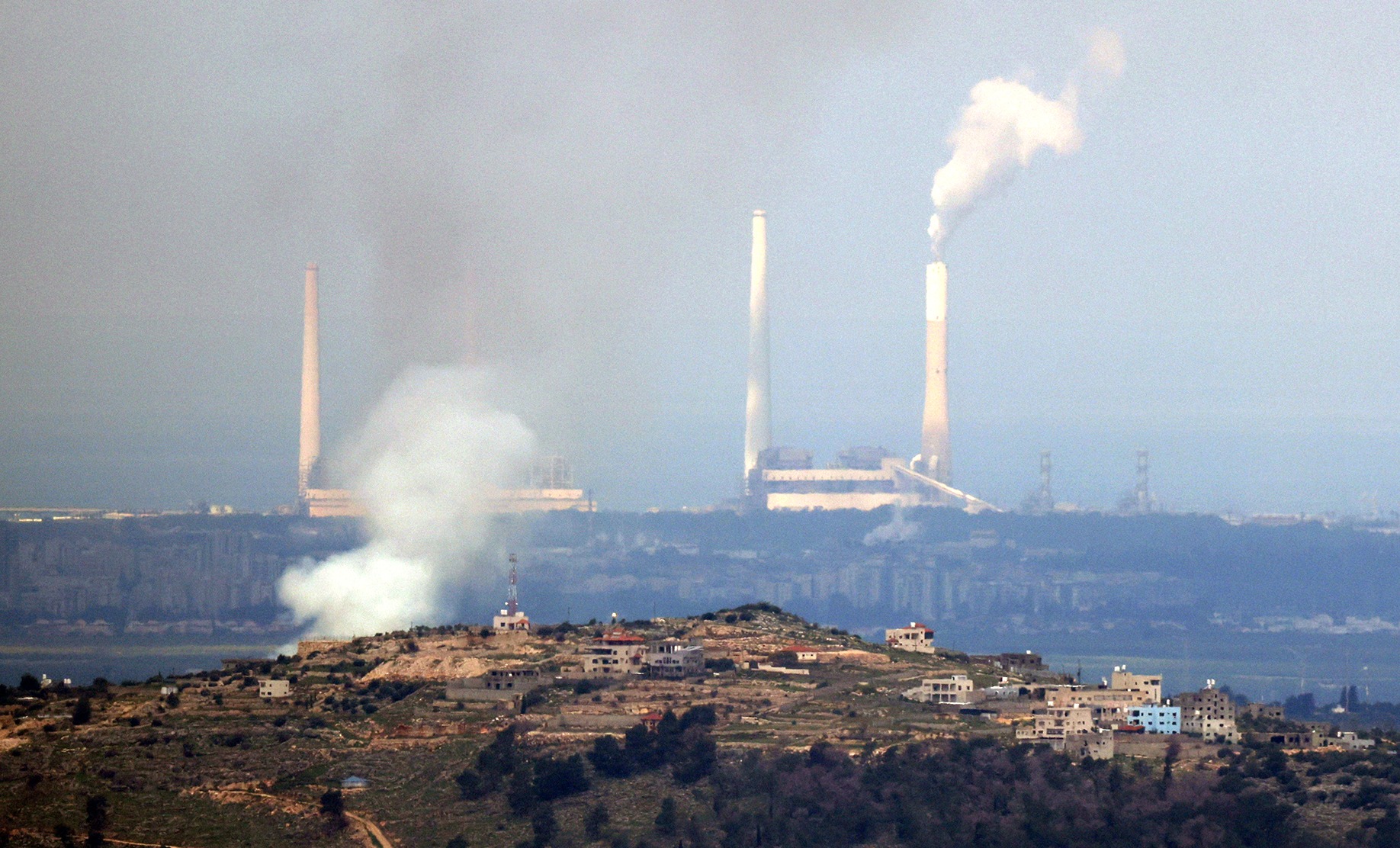
 Smoke billows after a projectile hit in an area between the West Bank and the Israeli city of Hadera, on 26 March 2026. The Israeli military reported that it had detected multiple waves of ballistic missiles launched from Iran toward Israel throughout the morning. (Photo: EPA / Alaa Badarneh)
 The South African Reserve Bank (Sarb) warned on Thursday that monetary policy would be tightened later this year if the Iran war became a prolonged conflict, but held its key repo rate steady at 6.75% for now, leaving the prime rate unchanged at 10.25%.
“For this meeting, we looked at two alternatives ... The first scenario assumes that the conflict lasts another two months or so, with oil prices averaging nearly $100 per barrel for this period and the rand about 5% weaker against the dollar. The second, more extreme scenario has the war lasting over a year, with oil prices staying above $100 per barrel and the rand 10% weaker,” the Sarb’s Monetary Policy Committee (MPC) said in its statement.
“In both scenarios, inflation is higher, exceeding 4% in the first version and 5% in the second. Both call for higher interest rates this year, with one hike in the first scenario and several more in the other. Inflation then slows as oil prices start easing and the policy response takes effect.”
In short, the unfolding Middle East conflict and the disruption to global fuel supplies it has wrought have completely changed the economic landscape. Before the US and Israel launched attacks on Iran on 28 February, the outlook was for rate cuts this year, enabled by a benign inflation outlook.
That sunny scenario has now been consigned to the dustbin of history.
Consumer price inflation (CPI) in February was 3% on an annual basis, bang in line with the Sarb’s new inflation target. This features a tolerance band of one percentage point on either side in case of shocks.
“The ongoing Middle East conflict is a clear instance of a supply shock, which raises prices while weakening demand. The standard response to a supply shock is to look through first-round effects, which are unavoidable and cannot be stopped by interest rate changes,” the statement said.
Second-round effects
This helps explain why the Sarb did not make a pre-emptive rate hike. But it pointedly said it needed to be alert to second-round effects, which are difficult to assess.
Its scenario planning points in a transparent manner how and why it will craft monetary policy over the next few months, with the duration of the Iran conflict being key. In both scenarios, inflation exceeds the “tolerance band” around the 3% inflation target.
The upshot is that the odds are now tilted for the next move to be a hike rather than a cut. “... in our view the risk of the next move being a hike has increased. Geopolitics, and the fallout from the current conflict, takes centre stage right now,” said Razia Khan, chief Africa economist for Standard Chartered Bank.
The Sarb said its economic growth forecasts were “largely unchanged” for now, and for 2026, it remains 1.4%. But it sees “downside risks” to the outlook and one suspects that its growth projections will be whittled down, with the scale of the downgrade hinging largely on the duration of the conflict. As Khan noted, it is now centre stage. Everything else is just a sideshow.
What the MPC statement on Thursday underscored is that South Africans must brace themselves for an acceleration in inflation, a possible slowing of economic growth and a potential rising of interest rates.
This heralds pain for all income groups, and the poor majority, as usual, will be hit the hardest in an economy still scarred by glaring income disparities and sky-high levels of unemployment.
This is a consequence of the ill-conceived war that was unleashed on 28 February by the US and Israel, and ultimately by the US presidential election in 2024. The aftershocks on the economic Richter scale will be severe and lasting. DM