




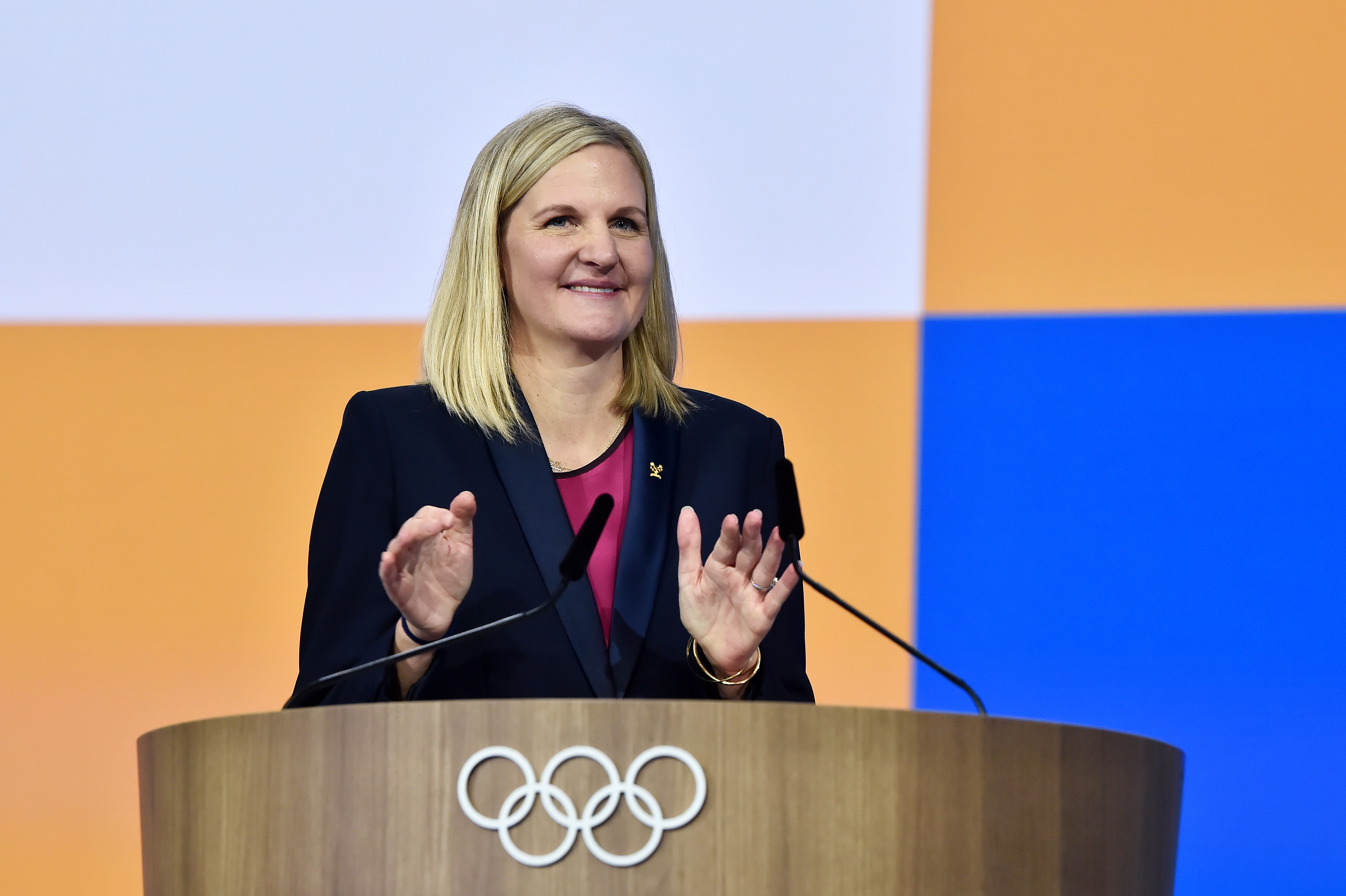
 IOC president Kirsty Coventry has overseen the ring-fencing of the female category in Olympic sports. (Photo: Milos Bicanski / Getty Images)
Only biological female athletes, whose gender has been determined by a one-time gene-screening test, will now be eligible to take part in women’s events at the Olympic Games, the International Olympic Committee (IOC) said on Thursday.
The new rules essentially stop transgender athletes from competing in female category events at the Olympics. They had previously been eligible to compete at the Games once cleared by their federations.
Following an 18-month consultation phase, the IOC unveiled its policy for the Olympic Games, Youth Olympics and Games qualifiers.
It is widely expected to be adopted by international sports federations and become a universal rule for competitors in the female category of elite sports, after years of fragmented regulation that led to major controversies.
/file/dailymaverick/wp-content/uploads/2021/10/GettyImages-1331940860.jpg "Transgender athlete Laurel Hubbard represented New Zealand in the women's 87kg+ weightlifting category at the Tokyo 2020 Games. (Photo: Chris Graythen / Getty Images)")
All athletes wanting to qualify or take part in female category events from the LA2028 Olympics onwards will have to undergo an SRY gene test to determine their eligibility.
“Based on scientific evidence, the IOC considers that the presence of the SRY gene is fixed throughout life and represents highly accurate evidence that an athlete has experienced male sex development,” said the IOC.
The screening will be conducted via saliva, cheek swab or blood sample and is unintrusive compared to other methods, said the IOC, and will be done only once in the athlete’s career. SRY stands for sex-determining region Y gene.
The Olympic body had long declined to apply any universal rule regarding transgender participation in the Olympics, and in 2021 instructed international federations to formulate their own guidelines.
New IOC President Kirsty Coventry did a U-turn immediately after taking over in June last year, saying her organisation would take the lead for a uniform approach.
“At the Olympic Games, even the smallest margins can be the difference between victory and defeat,” said Coventry. “So, it is absolutely clear that it would not be fair for biological males to compete in the female category. In addition, in some sports it would simply not be safe.
“I really believe this policy is foundationally based in science and led by medical experts,” she told a press conference. “We know that this topic is sensitive.
“Safety on the field of play and fairness. One of the things we like to see in sport is fair and equal treatment of everyone on that field of play. Those are the two personal reasons I felt very strongly about this.”
The new rules have no retroactive power and no impact on grassroots or amateur sports.
/file/dailymaverick/wp-content/uploads/2025/03/GettyImages-2165918515.jpg "Transgender athletes will be barred from female category events at future Olympics. Here, the US's Sydney McLaughlin-Levrone is in action in the women's 400m hurdles final in Paris 2024. (Photo: Michael Steele/Getty Images)")
Rare exceptions
There are exceptions, the IOC said, for rare cases of sex development.
“With the rare exception of athletes with a diagnosis of Complete Androgen Insensitivity Syndrome (CAIS) or other rare differences/disorders in sex development (DSDs) who do not benefit from the anabolic and/or performance-enhancing effects of testosterone, no athlete with an SRY-positive screen is eligible for competition in the female category at an IOC event,” said the IOC.
Athletes with an SRY-positive screen would continue to be included in all other classifications for which they qualify.
“For example, they are eligible for any male category, including in a designated male slot within any mixed category, and any open category,” said the IOC.
The Paris 2024 Olympics were hit by a major gender row involving two boxers competing in the female categories, who both won gold in their weight classes. A year earlier, they had been banned from the world championships by their international federation over a gender eligibility test.
Federation rules
Some federations, including athletics, swimming and rugby union, had already drawn up their own rules, barring athletes who have gone through male puberty from competing in the women’s class. Many smaller federations, however, had yet to finalise their own regulations on the matter.
World Athletics is among sporting organisations that have already adopted gender testing, introducing a one-off SRY gene test obtained by a cheek swab for all female athletes ahead of last year’s World Championships in Tokyo.
/file/dailymaverick/wp-content/uploads/2025/03/GettyImages-2166313507.jpg "World Athletics President Sebastian Coe. (Photo: George Mattock / Getty Images)")
Even before the IOC policy announcement, however, human rights and sports advocacy groups voiced their opposition to any gender testing.
“Sports is where excellence, respect and inclusion meet,” said Kimberly Frost, world co-secretary-general of ILGA, a federation of LGBTQ+ rights groups, following the IOC announcement.
“But, instead, the IOC decided to create more scrutiny on the body of any woman who would have just wanted to play the game she loves — from the Olympics, trickling down to every playground. How is this protection?”
Only a handful of openly transgender athletes have taken part in the Games. New Zealand’s Laurel Hubbard became the first to compete in a different gender category to that assigned at birth when the weightlifter took part in the Tokyo Olympics in 2021.
US President Donald Trump last year banned transgender athletes from competing in the female category in school, college and pro events in the United States, as Los Angeles prepares to host the 2028 Summer Olympics.
Trump, who signed the “Keeping Men Out of Women’s Sports” order in February 2025, has said he would not allow transgender athletes to compete at the LA Games. DM
Comments
Scroll down to load comments...