




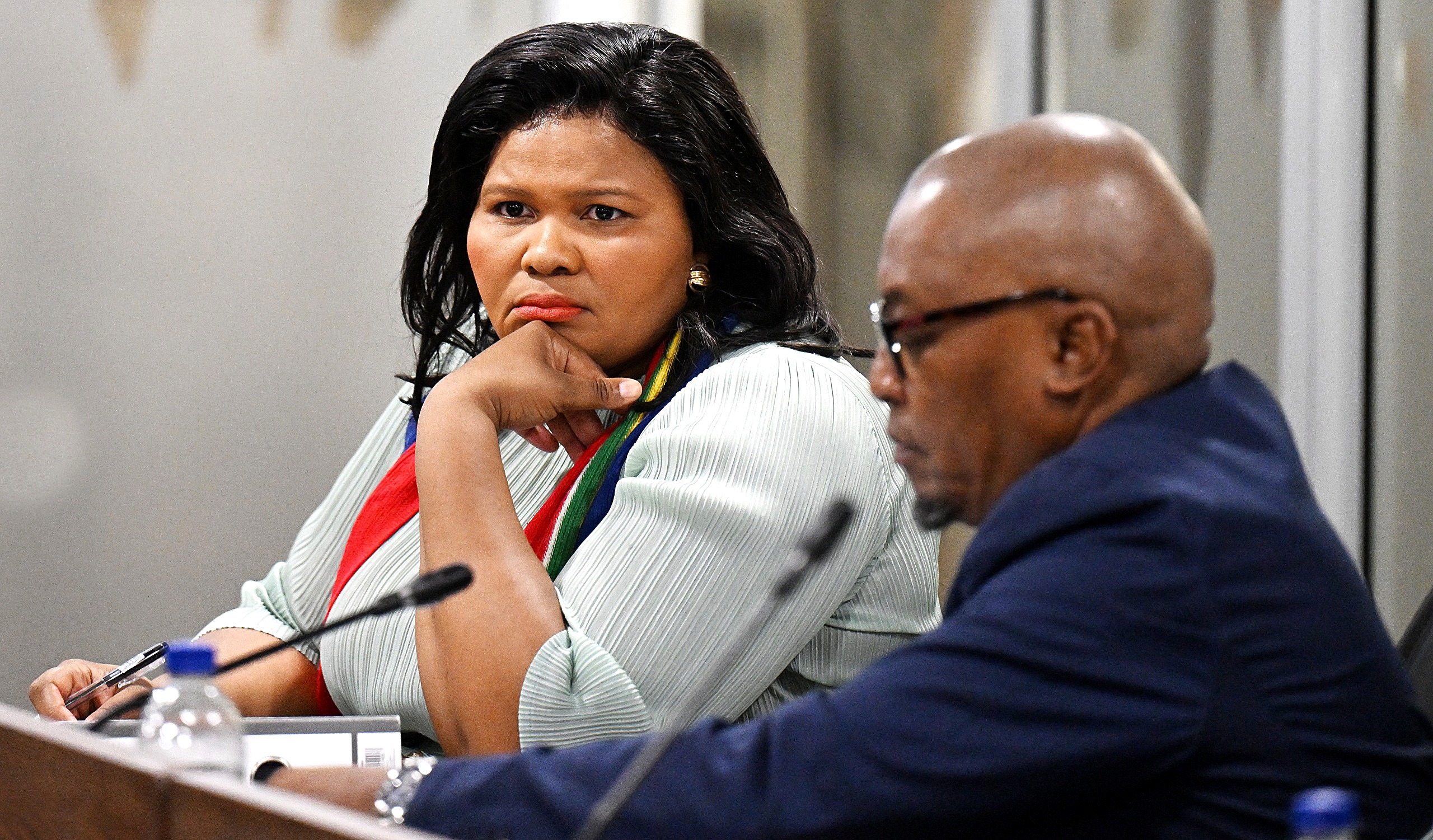
 Nelson Mandela Bay mayor Babalwa Lobishe and several senior City leaders met in Cape Town this week with Parliament’s portfolio committee on cooperative governance and traditional affairs. (Photo: Phando Jikelo / RSA Parliament)
 Nelson Mandela Bay’s appearance before Parliament’s portfolio committee on cooperative governance and traditional affairs this week did more than expose a controversial R25-million transformer deal — it laid bare a deeper pattern of weak governance, poor financial management and a persistent accountability failure at the highest levels of government.
Over two days of often bruising exchanges, MPs painted a damning picture of a municipality not short on plans or funding, but consistently struggling to execute, comply and account for its failures.
The delegation included mayor Babalwa Lobishe, acting city manager Lonwabo Ngoqo, CFO Jackson Ngcelwane and deputy mayor Gary van Niekerk.
Below are five key takeaways and comments from a disillusioned civic coalition.
The controversial transformer lease
On Wednesday, mayor Lobishe admitted to the committee that a R25-million lease of a municipal transformer to private company Coega Steels was irregular.
The transformer is a critical piece of infrastructure intended for emergencies in the metro, and MPs said leasing the equipment without council approval put the metro at risk.
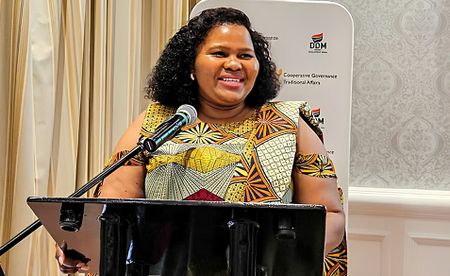
The MK party’s Jeffrey Mtolo accused Lobishe of unlawfully authorising the lease, saying it violated the Municipal Finance Management Act (MFMA). “If there is to be a lease, there must be a council resolution. This matter should have gone to council,” Mtolo said.
“You cannot give an instruction regarding the leasing or disposal of council property. That authority lies with the council. You broke the law. You violated the prescripts of the MFMA,” he said.
ANC MP Dikeledi Direko also questioned Lobishe’s authority, noting that without a council resolution, the contract could be deemed irregular. “If there was a council resolution granting her the authority to sign, she can justify the memo. However, if no such powers were delegated, it means the contract entered into can be regarded as irregular,” Direko said.
Lobishe conceded that no mayor had the authority to approve the transfer of municipal assets without following the required consultation process.
This was despite Lobishe going on record, and on video, earlier this year, saying she would only apologise “for saving 600 jobs,” referring to workers at Coega Steels who would have faced layoffs if the transformer had not been leased and the company could not operate at full capacity.
Committee chair Zweli Mkhize highlighted City documents showing Ngcelwane had warned the then acting city manager Ted Pillay that the transformer lease to Coega Steels required council approval. This did not happen.
Lobishe admitted that the matter should indeed have been served before the council and that a resolution had been required.
When Mkhize asked Lobishe whether she considered her actions regular or irregular, she responded: “It is irregular, but we intended to rectify it in council.”
Mkhize pressed further: “So you agree with members that your actions were irregular? That is the issue being raised.” Lobishe replied: “By law, it is irregular.”
/file/attachments/orphans/WhatsAppImage2026-03-24at115511_881588.jpeg "Bay mayor Babalwa Lobishe and acting city manager Lonwabo Ngoqo faced tough questioning in Cape Town this week during a session before Parliament’s portfolio committee on cooperative governance. (Photo: Phando Jikelo / RSA Parliament)")
A stark warning on underspending
Moving on from the transformer issue, Mkhize turned his attention to Nelson Mandela Bay’s persistent underspending of grant funds, saying this cast doubt on the metro’s leadership.
He warned the delegation that failure to spend allocated grant funding amid persistent service delivery backlogs cast doubt over their leadership abilities.
His warning followed discussion of the National Department of Human Settlements’ January notice that it might withhold R440-million in grants for the city’s more than 100 informal settlements due to under-expenditure.
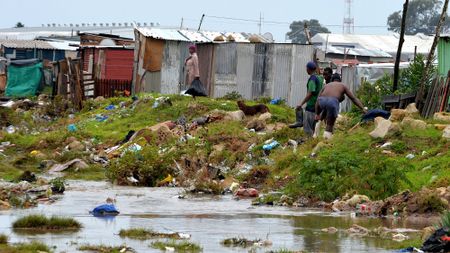
The withheld funds relate to the Urban Settlements Development Grant and the Informal Settlements Upgrading Partnership Grant.
Mkhize expressed dismay over the City returning roughly R1.2-billion to the Treasury in recent years due to under-expenditure.
He said that while most municipalities faced both backlogs and funding shortages, Nelson Mandela Bay had ample funds that remained unspent due to poor performance.
“Everywhere we go is the backlog and inadequate funding. This time it is the other way. There is a huge backlog, there is a huge amount of funding, but there is no performance,” Mkhize said.
Mkhize said neither Lobishe nor city managers would receive sympathy if they failed to act, despite having the necessary resources.
“If the reality is that you have staff, budget and an identified need, but still cannot implement, then this raises fundamental questions about governance, leadership and whether you should continue to hold the positions you occupy,” he said.
Mkhize called on the City to present a clear and actionable recovery plan to address infrastructure backlogs and ensure full expenditure of allocated budgets.
“You need to come back to us with a remedial plan that is concrete […] how do you make sure that you do not again lose money,” he said.
“We say up to here and no further.”
Vague explanations no longer tolerated
The committee issued a stern warning to City officials that vague explanations would no longer be tolerated and that it would insist on measurable corrective action.
Mkhize instructed the City’s leadership to submit a detailed written turnaround plan outlining improvements in grant spending, contract and project management, human resources, and accountability measures.
Furthermore, the municipality is expected to provide comprehensive reports on all outstanding matters raised during the engagement, including evergreen contracts, unauthorised and irregular expenditure, service delivery failures and responses to Auditor-General and Special Investigating Unit findings.

The committee said delays or non-cooperation would not be tolerated and promised to use all parliamentary mechanisms to enforce accountability, including requesting the Speaker of the National Assembly to issue formal summonses for officials to provide information and appear before the committee.
Mkhize said that, if approved, the summonses would be delivered by the Sheriff, and any deviation might constitute a criminal offence.
“The committee has the authority of Parliament to ensure accountability, and we expect cooperation. In the absence of that cooperation, we will not hesitate to use the remedies at our disposal,” Mkhize said.
The committee’s role was corrective rather than punitive, aimed at strengthening governance and ensuring communities received the services they were entitled to, he said.
“The committee will pursue this matter until there is clear evidence of correction, credible reporting and improved service delivery,” Mkhize said.
Blame game and the scapegoat facing suspension
On day one of the parliamentary hearings, the portfolio committee hauled Lobishe over the coals for repeated failures to respond to their written communication in recent months. MPs also chastised her for shifting the blame to her personal assistants and her chief of staff, Mlungisi Lumka.
Lobishe and her delegation’s appearance before the committee came after the committee and the provincial Cogta department had sent multiple letters and made phone calls between January and March asking about issues within the metro — most of which went unanswered. The committee was seeking answers following an oversight engagement with the municipality in October last year.
/file/attachments/orphans/638010475_1511252077699645_8354297948581877070_n_215999.jpg "Bay mayor Babalwa Lobishe’s chief of staff, Mlungisi Lumka. (Photo: Facebook / Nelson Mandela Bay Municipality)")
Initially, Lobishe blamed a secretary in her office for the lack of response, saying that the person had failed to bring the committee’s letters to her attention.
The failure to track the committee’s communications led to Lobishe travelling to Cape Town last week, unaware that the date of the meeting with the committee had been moved.
She said the secretary had been issued a warning, but when the committee suggested that there was no evidence that any of the mayor’s three personal assistants had received prior warnings, Lobishe turned her ire on her chief of staff.
She suggested that Lumka had advised her that disciplinary action had been taken against a secretary, but as he had failed to provide proof, she was now taking disciplinary action against him. She even suggested that she would fire him.
During the session on Tuesday, two MPs – ANC MP Nombiselo Sompa-Masiu and DA MP Marina van Zyl – received information that none of the secretaries had been issued with warnings. MPs stopped short of calling Lobishe a liar.
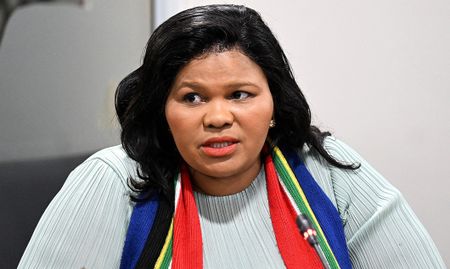
On Thursday, when asked about the allegations against him and Lobishe’s letter of warning, Lumka said he would follow the correct procedures.
“I am under a legal obligation to return representations on the allegations levelled at me. Those representations will give my side of the story. Outside of that, I am not prepared to make any comment at this stage.”
Lumka had until 4pm on Thursday to respond.
The letter in question circulated on Facebook across several accounts, drawing mixed reactions — some users urged Lumka to contest the suspension, while others suggested that Lobishe was being undermined.
Mayor says, ‘We’ll get back to you’
Municipal spokesperson Sithembiso Soyaya said Lobishe “welcomes the robust engagement with Parliament as a critical mechanism to strengthen accountability, transparency and cooperative governance across all spheres of government”.
He said the mayor acknowledged the committee’s concerns over delays and inconsistencies in responding to parliamentary correspondence and was treating them with urgency. Preliminary internal assessments, Soyaya said, found that administrative and process breakdowns in the executive mayor’s office were responsible for the delays.
Lobishe has overhauled her office’s administrative and correspondence systems, introducing a centralised tracking protocol, stronger accountability measures and a dedicated parliamentary liaison to ensure timely compliance, said Soyaya.
“On matters relating to governance, financial management and infrastructure assets, including those raised during the engagement, the municipality is cooperating with all relevant processes and will continue to act within the prescripts of the law,” he said.
“The executive mayor reiterates that accountability is not optional, it is a constitutional obligation, and Nelson Mandela Bay remains committed to restoring confidence in its governance systems.”
Turn words into actions, civil society urges Parliament
The Nelson Mandela Bay Civil Society Coalition has welcomed Parliament’s intervention in the metro, calling it a “long-overdue moment of accountability” amid deepening governance and service delivery failures.
In a statement on Thursday, coalition chairperson Peter Monga said the recent appearance by the metro’s executive leadership before the portfolio committee marked a critical step in addressing the City’s challenges.
The coalition said: “The Parliamentary process must now translate into decisive action. The coalition calls on the Presidency to urgently institute a structured, time-bound and outcomes-driven intervention to stabilise governance, restore infrastructure maintenance and safeguard the constitutional rights of residents.”
Monga said the engagement highlighted a growing gap between planning and implementation in the municipality.
“While plans, strategies and diagnostic reports exist, delivery continues to fall short. At the core of the crisis is a systemic failure of execution,” he said.
He said accountability remained weak, with responsibility often spread across officials and political leaders.
The coalition reiterated concerns about instability in key leadership positions, particularly the city manager role, as well as ongoing dysfunction in supply chain management systems.
It also raised alarm over what it described as the mayor’s apparent reluctance to fully account for critical issues during the parliamentary proceedings.
Monga said this undermined efforts by civil society to work collaboratively with the municipality, noting that little progress had been made since a February agreement to establish a joint technical team to support the metro’s recovery.
The coalition rejected claims that financial constraints were the primary cause of the metro’s decline, pointing instead to political interference, procurement inefficiencies and weakening technical capacity. “Without addressing these structural issues, no financial intervention alone will resolve the crisis,” Monga said.
The coalition warned that Nelson Mandela Bay was facing a worsening service delivery crisis, pointing to strained water resources, high water losses and unstable electricity infrastructure.
Monga said: “The metro’s water and infrastructure systems are under severe strain, with dam levels sitting at approximately 30% usable water and unaccounted-for water losses reaching an alarming 63%, the highest in the country. Electricity infrastructure remains unstable due to inadequate maintenance and insufficient protection of key assets, resulting in repeated supply disruptions.” DM