




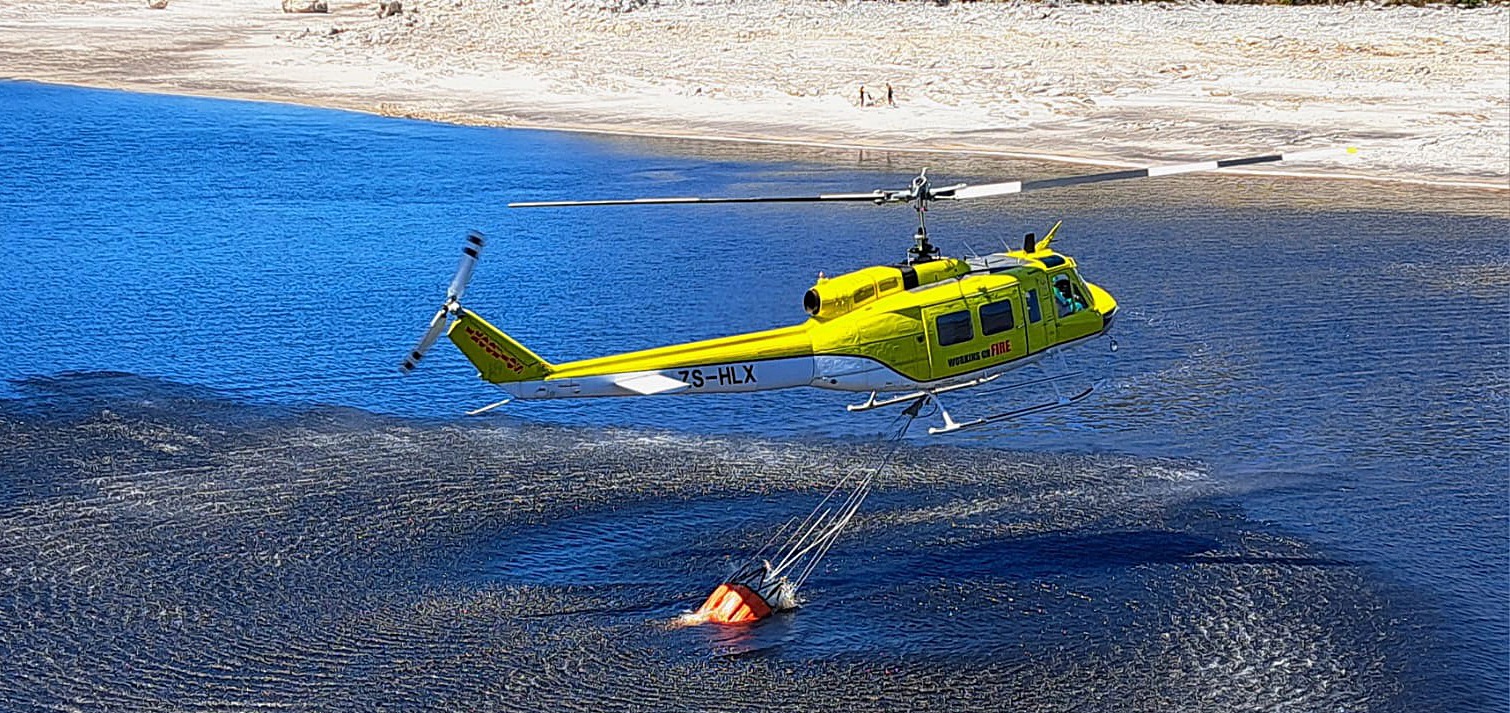
 In strong southeaster winds flying conditions become volatile. (Photo: Kishugu Aviation)
A yellow Huey firefighting helicopter clipped the cliffside above Hout Bay, descended gracefully but then flipped over, ripping off its rotors. The moment was captured on video and described by those closest to the operation as “bloody scary”.
In a story that could easily have ended very differently, the pilot, Mike Bothma, escaped unharmed.
“He’s a little bit shaken,” said Linton Rensburg, team leader at Kishugu Aviation, shortly after the incident. “But we’re just glad that he was able to walk away from it.”
The helicopter, operated by Kishugu, was part of an intense aerial firefighting effort above Hout Bay and Constantia Nek on 25 March, as crews battled a fast-moving blaze on the Cape Peninsula.
/file/attachments/orphans/Firebirds-2_920654.jpg "In wind and smoke visibility can become precarious. (Photo: Kishugu Aviation)")
Bothma is described as highly experienced. That fact only deepens the mystery of what went wrong.
“You know, I have no idea how that happened,” Rensburg said. “Let’s see what will come out from the investigation.”
A narrow escape
The crash occurred in the thick of active firefighting – one of the most demanding forms of aviation, where pilots fly low, often in turbulent, smoke-filled air, carrying heavy water buckets suspended beneath the aircraft.
According to South African National Parks, the helicopter was operating on the fire line in Table Mountain National Park when the crash occurred. Emergency services were immediately activated, including Wilderness Search and Rescue, City of Cape Town Fire and Rescue and private medical responders.
Earlier reports from the scene suggested that the helicopter struck terrain before making what Rensburg described as a relatively controlled landing – “it landed elegantly, gently, it’s just a pity it tipped over”.
Whether the aircraft came down directly in the fire zone and the extent of the damage, remain unclear. Those questions now sit with the South African Civil Aviation Authority, which has taken control of the investigation.
Controlled chaos
Firefighting helicopters are a familiar sight in Cape Town’s summer months, darting between reservoirs and fire lines, their underslung buckets releasing precise torrents of water onto advancing flames.
But behind that choreography lies a razor-thin margin for error.
/file/attachments/orphans/Firebirds-6_312016.jpg "Each bucketload carries a tonne of water. (Photo: Kishugu Aviation)")
Pilots must navigate steep terrain, unpredictable winds and rapidly changing visibility. Rotor blades can pass within metres of rock faces. One misjudgement, one gust, one moment of disorientation in smoke – and the consequences can be immediate.
“It’s a shame,” Rensburg said. “We’ve never had an accident on Table Mountain.”
That track record underscores both the professionalism of the crews and the rarity of such incidents. Kishugu Aviation, which operates as part of South Africa’s broader wildfire response network, has built its reputation on precisely this kind of high-risk work.
The machine behind the mission
The story of Cape Town’s fire choppers is part of the mountain’s essential infrastructure – a mix of private contractors, government agencies and specialised teams working in tight coordination.
Aircraft are typically fitted with Bambi buckets, each capable of carrying a tonne of water. Pilots cycle continuously between water sources – often the sea or nearby dams – and the fire line, sometimes completing dozens of drops an hour.
These operations are coordinated from the ground but executed in real time by pilots making split-second decisions.
/file/attachments/orphans/Firebirds-3_666581.jpg "John Mittelmeyer with one of the city’s well-known Huey fire choppers. An old Vietnam-era Huey, possibly the one that crashed. (Photo: Don Pinnock)")
In strong southeaster winds – common on the Cape Peninsula – flying conditions become volatile. Downdrafts, turbulence along cliff faces and shifting smoke plumes can all affect lift and visibility.
That context makes incidents like this both shocking and, in a way, a reminder of the inherent risks built into the system.
A rapid response
Following the crash, an incident management team was immediately activated and rescue technicians were deployed up the mountain face to reach the site. Law enforcement officers secured the area while aviation authorities prepared to take over.
Despite the disruption, firefighting efforts continued. “We are obviously continuing with firefighting efforts over there,” Rensburg confirmed.
Investigation under way
Both SANParks and Kishugu Aviation have stressed that details remain limited while the investigation proceeds. The Civil Aviation Authority will examine the aircraft, flight conditions, pilot actions and environmental factors to determine what caused the rotor strike.
“At this stage we have no further information available,” Kishugu Aviation said, confirming its cooperation with investigators.
Questions remain: Did wind shear play a role? Was visibility compromised? Did the aircraft encounter unexpected turbulence near the mountain face? For now, those answers are pending.
In a story shaped by risk, fire and the unforgiving geometry of mountains, the dominant note is one of relief: The pilot survived. In aviation – and especially in aerial firefighting – that is never a given.
As Rensburg put it, with a mix of understatement and gratitude: “We’re just glad he’s okay.” DM
Correction: In an earlier version of the story, we misquoted Linton Rensburg as having said that the rotor clipped the mountain. That question was asked, but Rensburg did not say the above. We apologise and have removed the paragraph.


Comments
Scroll down to load comments...