




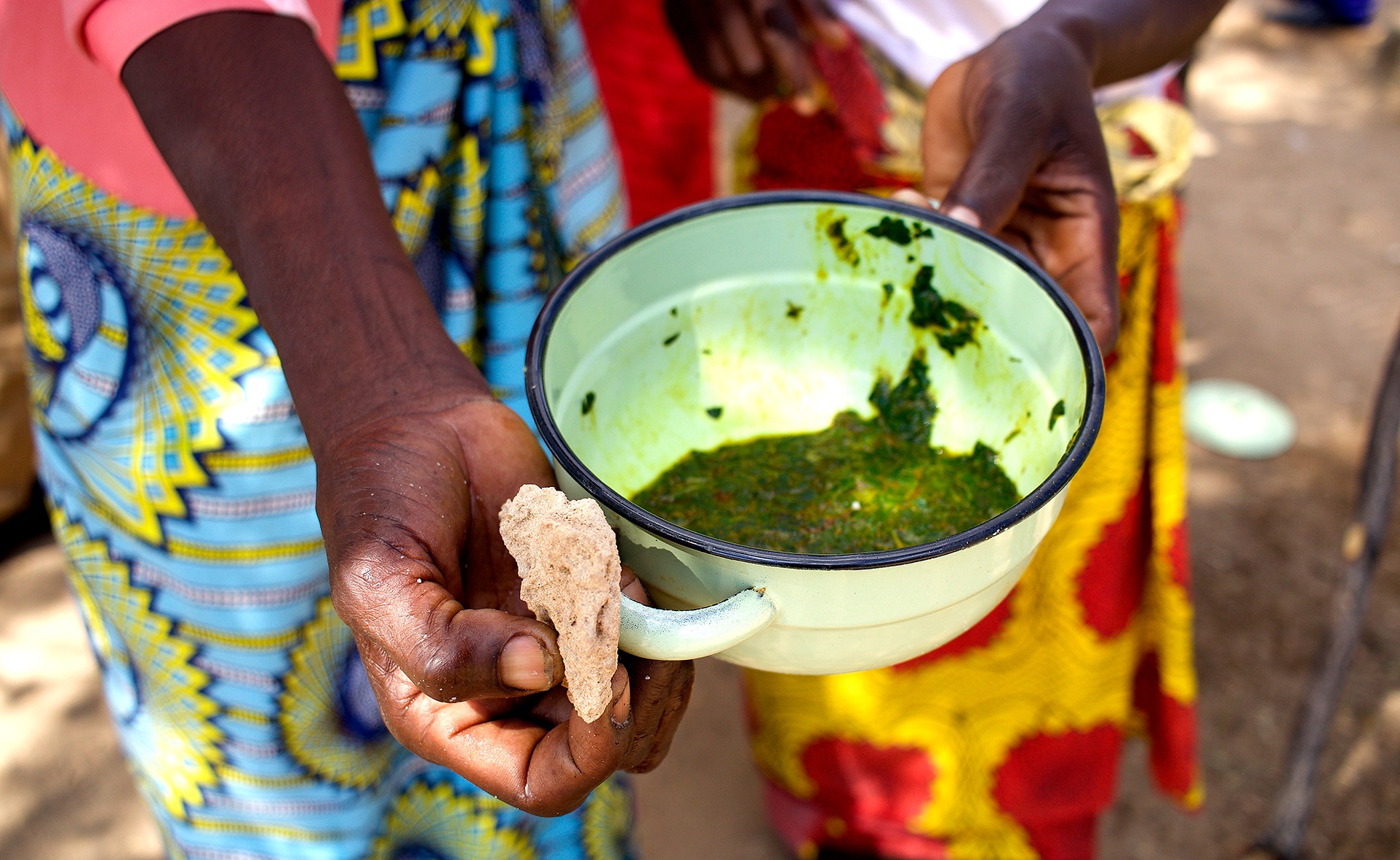
 Delele, a richly textured vegetable, uniquely illustrates the connection between language, taste and cultural knowledge in southern Africa. (Photo: Prince Sivalo Mahlangu / Magriza Made Me Cook)
 /file/dailymaverick/wp-content/uploads/2025/10/label-Op-Ed.jpg)
Isn’t delele a wonderful word? Say it slowly. Savour the syllables as they stretch and glide over your tongue. Mouth coating, silky and succulent, there is a graceful, lingering languor in the delicious duplication of le-le.
For those unfamiliar with the term, the Tshivenda and isiNdebele word delele – and its regional cognate forms derere in ChiShona, thelele in Sepedi and therere in Chichewa — is used in these and many other southern African languages to denote a plant whose leaves become velvety and viscous when cooked. The moniker is an excellent example of a food word where the sound made when naming the ingredient evokes the sensory experience of eating it.
The essence and impact of delele echo within the word. Linguists refer to the unhurried, mellifluous quality of /l/ and /r/ sounds as “liquid consonants” because they are produced with an open airflow and a fluid, flowing articulation. This contrasts with the staccato “plosive consonants” – sounds such as /p/, /k/, /b/ and /g/ – which are formed by briefly blocking breath in the mouth and then releasing it in a burst.
Across many languages, all over the world, sound carries meaning and the former are associated with a sense of gentle, smooth continuity, whereas the latter evoke interruption, impact or sudden sharp shock.
In delele, the noise traces taste and texture: mild, softly herbal, earthy flavours are embraced by a soothing lubricating loveliness. While Eurocentric palates are often unfamiliar with – and sometimes disconcerted by – its mucilaginous mouthfeel, the qualities audibly articulated in the word are savoured and sought after across Asia and Africa.
/file/attachments/orphans/PrinceMahlanguofMagrizaMadeMeCookwithIdeleleinZimbabwe_AnnaTrapidojpg_775700.jpeg "Prince Mahlangu of Magriza Made Me Cook with delele in Zimbabwe. (Photo: Magriza Made Me Cook)")
The most famous example is okra, but Japanese grated yamaimo (mountain yam), or nameko mushrooms are also celebrated for their smooth, trailing viscosity while Chinese gelatinous sea cucumber is praised for its glorious glossiness. What some dismiss as slimy is understood as a silky, slippery, cooling coating that contributes the body, richness and elegance to an epicurean experience. Delele is one way in which southern African cooks create similar states.
The sound symbolism contained within the word delele was one of several reasons the ingredient was selected by the Chirandu Group – an African research initiative dedicated to documenting our continent’s indigenous foodways and sensory knowledge – as part of a pilot project for the organisation’s Flavour Intelligence Framework. This interdisciplinary system aims to integrate sensory, biochemical, historical, cultural and ecological data to build structured ingredient profiles that support research, preservation and ethical epicurean innovation.
Recognising that southern Africa has a long history of indigenous knowledge being extracted and circulated without adequate recognition or benefit to its custodians, Chirandu’s Flavour Intelligence Framework has community collaboration and benefit sharing built into every stage.
One of the many advantages of such an approach is that everyone involved gets to see the world through someone else’s eyes. Even ideas and objects that appear self-evident can prove, on closer inspection, more complex and contrary than they first seem.
And so, it was with delele. In community meetings designed to define and refine the ingredients to be put into the pilot, researchers trained in Western Linnaean taxonomy were initially confused by local organising principles. They began the project assuming that the word delele referred to a single, clearly defined plant species.
/file/attachments/orphans/IdeleleinZimbabwe_PrinceMahlangu111_763174.jpg "Delele in Zimbabwe. (Photo: Prince Mahlangu / Magriza Made Me Cook)")
They expected to order the natural world – as they had been trained to do – according to morphological characteristics and evolutionary relationships with each organism assigned a binomial name – genus and species – within a hierarchical system designed to ensure that each biological species has one globally recognised scientific identity. Community consultation confused them because at least eight morphologically distinct and unrelated or distantly related species were offered up and accepted by local experts as types of delele.
How could all these seemingly different deleles share a name when they did not appear to have the necessary traits in common? Surely this was a mistake? It was not. The indigenous knowledge holders from within the delele consuming communities patiently explained that their classification system is based on sensory and functional profiles. Within this model there are two key elements that make all the deleles delele.
The first is that when cooked, they all produce a viscous, slippery texture. The second is that within indigenous healing paradigms, consuming delele is understood to lubricate or soothe various muscle, joint and body fluid functions in a way that mirrors texture on the tongue.
Blood pressure? Arthritis? Childbirth? Sexual dysfunction? There is a delele-based remedy to match every wellbeing deficit or pain profile.
All over Africa there are examples of such systems. A 2015 study by Otieno et al of medicinal plant markets in Tanzania showed that vernacular ethnospecies frequently do not map neatly onto Linnaean species – rather a single vernacular name may encompass several botanical species that share medicinal properties.
There are also instances when a single species may carry multiple names depending on context or use. Moteetee and Van Wyk’s 2011 work on Sesotho plant names similarly showed that vernacular terminology often encodes ecological behaviour, healing properties or functional characteristics of plants.
Linnaean taxonomy prioritises biological lineage and morphological distinction. Vernacular systems often focus on function, sensory properties, ecological relationships and effects on the body.
The two systems are designed to answer different questions. If the issue is biological identity, then Linnaean is the way to go. If functional use is on the table, then vernacular systems shine.
/file/attachments/orphans/CookingdeleleinZimbabwe_KudzaiBingepenge_770563.jpeg "Cooking delele in Zimbabwe. (Photo: Kudzai Bingepenge)")
Biodiversity research, pharmacology and regulatory frameworks require Linnaean taxonomy. Without scientific names tied to herbarium specimens, plants cannot be reliably compared, catalogued or legally protected. Traditional taxonomy is indispensable for understanding how plants are used, sensed and understood within the cultural systems that sustain them.
Both have highly structured and internally coherent logic. Problems arise only when one system of knowledge is treated as authoritative while the other is pushed to the margins of botanical, agricultural, culinary and medical discourse.
Chirandu’s work does not seek to replace one system with the other. Instead, it attempts to hold both in productive tension.
The Flavour Intelligence Framework seeks to understand how a sensory category recognised in kitchens and communities relates to botanical species, chemistry and ecology; it must translate vernacular knowledge into forms that can support scientific research while preserving the cultural logic through which these plants are recognised and used. It is therefore vital that both models are included in the analysis.
At present all the various forms recognised as delele have been collected in Limpopo, SA and Zimbabwe. They are being studied separately – as distinct botanical entities – and collectively as members of a shared sensory-functional category.
The work is exacting, but intellectual seriousness demands nothing less. Such study will take time. While we are waiting, let us all enjoy the ingredient. Whatever else it may be, delele is definitely a delight to eat and a pleasure to say. It really is the most wonderful word… DM
Dr Anna Trapido heads the Chirandu Institute, the research platform of the Chirandu Group dedicated to advancing Indigenous knowledge systems, botanical science and sensory intelligence as the foundations of next-generation flavour, nutrition and wellness. Contact Anna Trapido: anna.trapido@chiranduinstitute.com and www.chirandu.com