




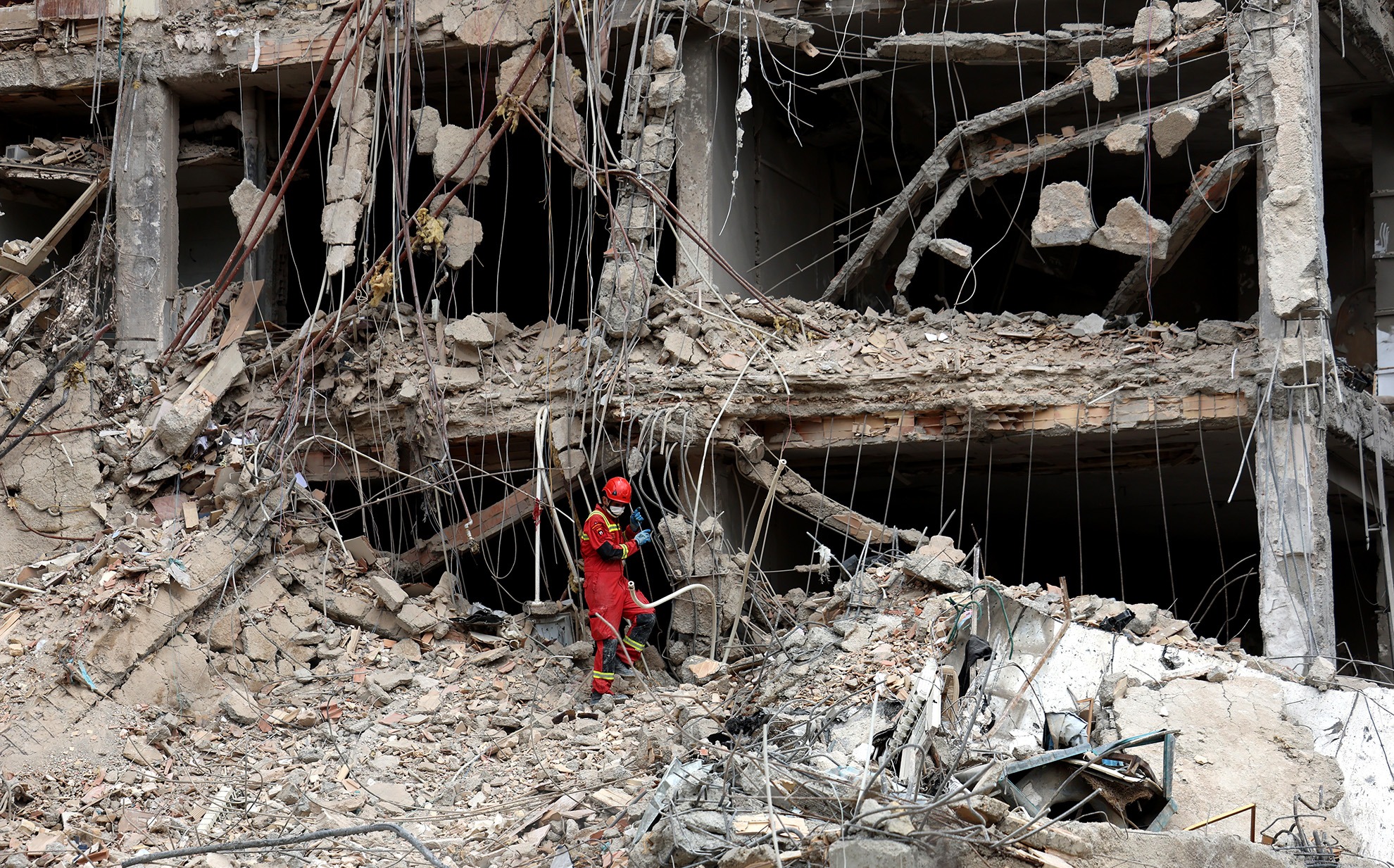
 Iranian firefighters and officials work at the site of damaged residential buildings in northern Tehran, Iran, 23 March 2026. A joint Israeli and US military operation continues to target multiple locations across Iran since the early hours of 28 February 2026. (Photo: EPA / ABEDIN TAHERKENAREH)
 By Ariba Shahid, Rami Ayyub and Alexander Cornwell
Trump told reporters at the White House the U.S. was talking to "the right people" in Iran in order to reach a deal to end hostilities, adding the Iranians wanted to reach a deal very badly.
"We're in negotiations right now," he said.
Tehran has denied that direct talks have taken place. Iran's powerful parliament speaker Mohammad Baqer Qalibaf on Monday dismissed such reports as "fake news."
The New York Times reported on Tuesday that Washington sent Iran a 15-point plan to end the war in the Middle East. Israel's Channel 12, quoting three sources, said the U.S. was seeking a month-long ceasefire to discuss the 15-point plan.
A source familiar with the matter confirmed that the U.S. had sent a plan to Iran but provided no further details.
The Israeli media outlet said the plan would include the dismantling of Iran's nuclear program, ceasing support for proxy groups, and the reopening of the Strait of Hormuz.
Israeli Prime Minister Benjamin Netanyahu's office did not immediately respond to a request for comment.
Trump told reporters at the White House that Iran had made a valuable concession related to non-nuclear energy and the Strait of Hormuz, although he did not elaborate.
Iran has told the United Nations Security Council and the International Maritime Organization that "non-hostile vessels" may transit the Strait of Hormuz if they coordinate with Iranian authorities, according to a note seen by Reuters on Tuesday.
Iran has effectively shut the waterway, where 20% of the world's oil normally transits, since the U.S. and Israel launched attacks four weeks ago, creating the worst energy supply shock in history and sending fuel prices soaring.
"It was a very big present, worth a tremendous amount of money," Trump said in his comments on Iran, adding: "It was a very nice thing they did."
But U.S., Israeli and Iranian strikes continued and sources said Washington was preparing to send more troops to the region.
Two people familiar with the matter told Reuters on Tuesday that the U.S. was expected to send thousands of soldiers from the Army's elite 82nd Airborne Division to the Middle East.
The forces will add to the 50,000 U.S. troops already in the region and accelerate Washington's massive U.S. military buildup there, fuelling fears of a longer conflict.
Pakistan's prime minister said on Tuesday that he was willing to host talks between the U.S. and Iran on ending the war, a day after Trump postponed threats to bomb Iranian power plants, saying there had been "productive" talks.
In a post on X, Prime Minister Shehbaz Sharif said Pakistan fully supported ongoing efforts to pursue dialogue and was ready to host "meaningful and conclusive talks for a comprehensive settlement."
A Pakistani government source said discussions on a meeting were at an advanced stage and if it did happen, "a big 'if'," it would take place within a week. Pakistan has long-standing ties to neighboring Iran's Islamic Republic and has been building a relationship with Trump.
The U.S. and Israel launched strikes on Iran on February 28 after saying they had failed to make enough headway in talks aimed at ending Iran's nuclear program, although mediator Oman said significant progress had been made.
(Reporting by Phil Stewart, Idrees Ali, Gram Slattery and Humeyra Pamuk in Washington, Maayan Lubell in Jerusalem and Alexander Cornwell in Tel Aviv, Ariba Shahid in Islamabad, Saad Sayeed in Bangkok, Ahmed Rasheed and Muayad Hameed in Baghdad; Additional reporting by Reuters bureaus; Writing by David Brunnstrom, Michael Perry, Sharon Singleton, Keith Weir and Michael Martina; Editing by Kevin Liffey, Ros Russell and Cynthia Osterman)