



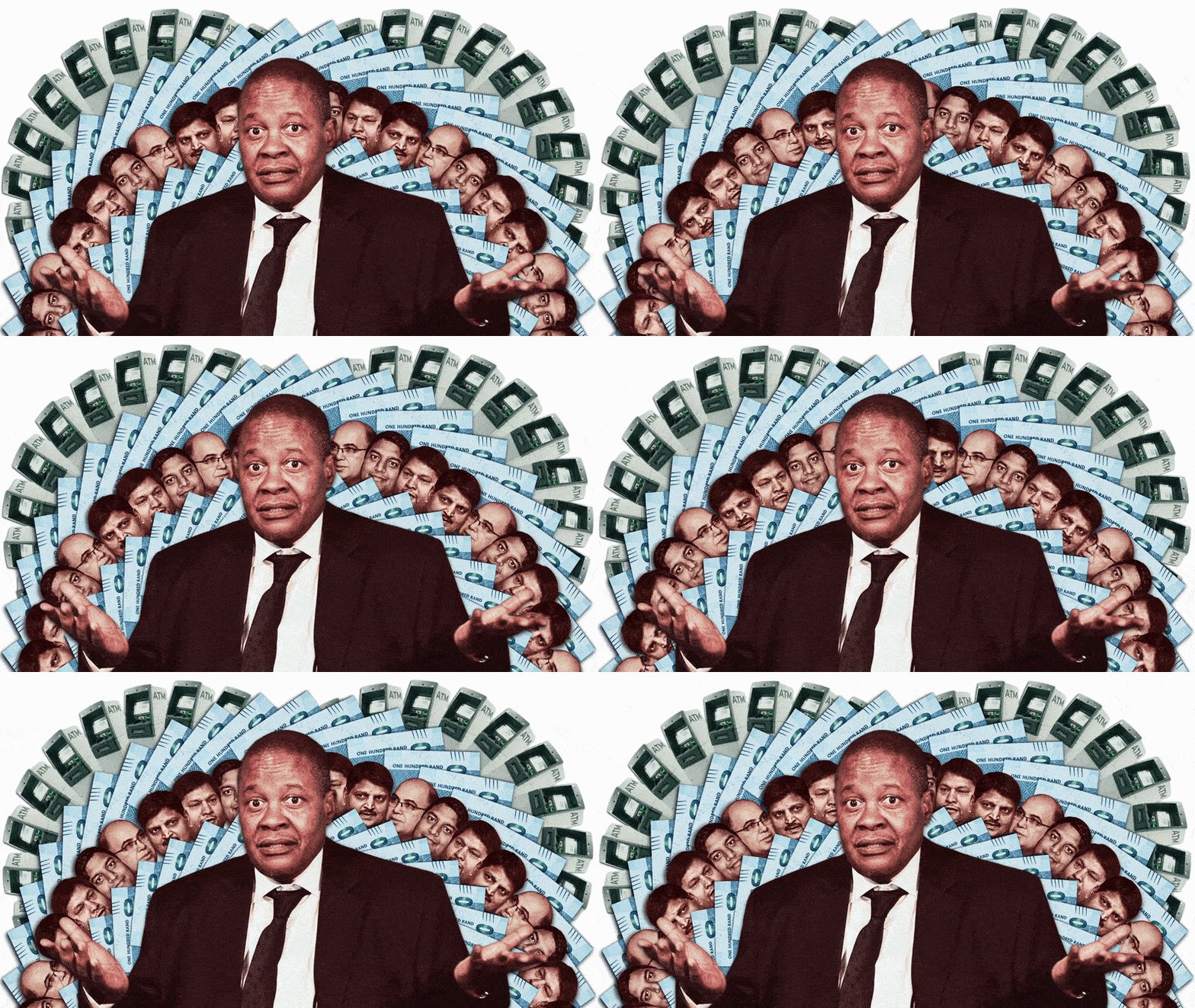
 Brian Molefe, Atul Gupta, Ajay Gupta, Rajesh Gupta & Nazeem Howa. (Illustration: Bernard Kotze)
 An alleged slush fund linked to Brian Molefe received the bulk of its substantial cash “earnings” through deposits at ATMs located near properties that the former Eskom and Transnet boss owned at the time.
Daily Maverick’s months-long investigation into the Palcocap account also reveals that cash deposits at ATMs near Eskom’s Johannesburg headquarters drastically increased only after Molefe’s move to this state-owned enterprise (SOE).
Daily Maverick’s first instalment in this two-part series dealt with several payments, or outflows, that link Molefe to the Palcocap account. For instance, we revealed that Palcocap had allegedly bankrolled Molefe’s swanky wedding in 2016, among myriad other payments allegedly made for Molefe’s benefit.
The focus now shifts to the inflows. We’ll unpack the roughly R11-million in cash deposits Palcocap received in its FNB account between November 2013 and July 2018.
Our analysis of the Palcocap inflows offers compelling evidence. The data betrays a remarkable physical proximity between those ATMs that were most frequently used to pay cash into the Palcocap account and Molefe’s properties and places of work.
We made several efforts to obtain Molefe’s comment, but he did not respond.
Palcocap’s director also ignored our requests for comment.
Gupta links
Brian Molefe, the newly appointed treasurer of the uMkhonto Wesizwe (MK) party, was exposed on two major accountability platforms for his questionable dealings with the Gupta family in the State Capture era.
Former Public Protector Advocate Thuli Madonsela’s “State of Capture” report detailed Molefe’s alleged visits to the Guptas’ Saxonwold compound. The report also flagged phone conversations Molefe had with the Guptas. At the time, Molefe was in charge of Eskom, and the visits and phone calls coincided with multibillion-rand deals involving the SOE and State Capture’s notorious trio.
Judge Raymond Zondo’s commission of inquiry into State Capture, meanwhile, heard crucial testimony relating to Molefe’s time as Transnet CEO, the position he held before he was seconded to the state-owned power utility.
A Transnet driver and bodyguard informed the commission of multiple instances where he ferried Molefe to the Gupta compound. Sometimes, Molefe would emerge from his meetings with the Guptas carrying a backpack, the witness claimed. Once, at Transnet’s headquarters in downtown Johannesburg, the driver allegedly discovered that the backpack was stuffed with R200 notes.
The witness testimony and related evidence informed a very dim assessment of Molefe’s conduct by Zondo.
“... there are reasonable grounds to believe that Mr Molefe may have committed the crime of corruption by accepting a gratification to act in violation of his duties or in order to influence the price under various contracts or the procurement of tenders favouring the Gupta enterprise”, Zondo found in his final report.
/file/dailymaverick/wp-content/uploads/2024/08/Photo-essay-Raymond-Zondo-08.jpg "Then Deputy Chief Justice Raymond Zondo at the commission of inquiry into State Capture. (Photo: Veli Nhlapo / Gallo Images)")
If Molefe had indeed accepted cash bribes from the Guptas, one pertinent question remains to be answered: What would someone in his position have done with all that hard currency?
Does Palcocap (Pty) Ltd, the Molefe-linked “slush fund” we first reported on in early March, hold the key to understanding how Molefe may have laundered his alleged ill-gotten gains?
The Carlton deposits
“Witness 1”, the former Transnet driver and bodyguard who spilled the beans on Molefe’s meetings with the Guptas, provided the Zondo Commission with key details regarding cash deposits he supposedly made on Molefe’s behalf.
According to Molefe’s former driver, the then Transnet boss instructed him to deposit cash at various banks’ ATMs in and around the Carlton Centre in downtown Johannesburg, home to Transnet’s corporate headquarters.
Zondo’s final report does not tell us exactly when the witness made the deposits. It does mention, though, that he worked as Molefe’s driver and bodyguard from February 2011 to August 2014.
/file/attachments/2989/2026-03-23_13-38-14_910336.jpeg "Transnet’s head offices in Johannesburg. (Photo: Gallo Images / Papi Morake)")
Is it possible that Palcocap may have been the recipient of some of the above-mentioned cash deposits?
In January 2014, someone made two Automated Deposit Teller (ADT) payments of R10,000 each into Palcocap’s FNB account, using an FNB machine inside the Carlton Centre.
We don’t currently have the means to identify the depositor, nor can we confirm where those funds had come from. However, it seems noteworthy that the transactions coincided with Molefe’s time at Transnet. What’s more, the driver’s testimony regarding the Carlton Centre renders the latter-mentioned transfers to Palcocap all the more curious.
A stream of cash
Between November 2013 and July 2018, Palcocap received cash deposits in its FNB bank account totalling R11.3-million. This represented 93% of the company’s “earnings”, underscoring the fact that Palcocap, by all indications, had been set up as a vehicle for receiving cash deposits.
The R11.3-million flowed into the account in a near ceaseless stream. A total of 706 individual cash deposits, to be exact, kept Palcocap in the black, with the values typically ranging between R5,000 and R10,000. The deposits were often made in a series of five or more individual transactions, adding up to total deposits that frequently exceeded R200,000 on a single day.
However, it is not the values of the deposits but rather the geographical specifics that offer the most interesting clues.
The cash deposits were made at 35 identified FNB ATM locations. There were also deposits totalling nearly R342,000 made at unidentified locations.
/file/attachments/2989/Graphic1_378407.jpg)
The known ATM locations revealed a clear preference for machines in Gauteng. A total of R9.5-million, or 84% of all cash deposits, found its way into the Palcocap account through deposits in this province. Of the 706 individual cash deposits, 603 were concluded in Gauteng.
The Centurion link
On closer inspection, the data revealed a strong correlation between some of the ATM locations and properties Molefe owned at the time.
The FNB at the Irene Village Mall in Centurion is a notable case in point. Of the 35 known ATM locations, this one received by far the largest individual chunk of Palcocap’s cash “earnings”. Between December 2013 and April 2018, someone used Irene Village Mall’s FNB machines to deposit R3.42-million into the Palcocap account. In other words, roughly 31% of the company’s cash “earnings” entered the account at this location.
Irene Village Mall’s FNB was also an outlier in terms of the total number of individual cash deposits into the Palcocap account. This location received 221 of the company’s 706 cash deposits.
As it happens, Brian Molefe’s principal residence in Gauteng was literally just up the road from Irene Village Mall. It would have taken him less than five minutes to make the 2.4-km journey from his home in the Cornwall Hill Country Estate to the FNB at this shopping centre. Molefe no longer owns this property.
Other FNB ATMs near Molefe’s residence in the estate were also used to bank substantial portions of Palcocap’s cash deposits.
The FNB in Centurion’s town centre, located roughly 8km from the estate, received R1.92-million, making it the location that received the second largest slice of Palcocap’s cash deposits.
/file/attachments/2989/Graphic2_732328.jpg)
The nearby FNB ATMs in the Centurion Mall were used to transfer nearly R230,000 to Palcocap.
The aforementioned FNB locations, together with the FNB in Centurion’s Lifestyle Centre, were used for Palcocap deposits totalling R5.6-million, just under half of the entity’s cash “earnings” during this period.
The relatively close proximity between these ATM locations and Molefe’s Centurion residence could strengthen suspicions that Molefe, or someone close to him, made the cash deposits.
Properties outside Gauteng
Another FNB branch that was used for a substantial portion of Palcocap’s cash earnings was the one located in the town of Hartbeespoort.
Between December 2014 and April 2017, someone used this branch’s ATMs to make 46 cash deposits into the Palcocap account, totalling nearly R880,000.
As it happened, this branch was the nearest FNB to a property Brian Molefe owned inside Port d’ Afrique, a residential estate near Hartbeespoort.
/file/attachments/2989/image255_932206.jpg "The Port d’ Afrique estate near Hartbeespoort in North West. (Source: estatedafrique.com)")
Molefe also owned a property inside Limpopo’s Legend Golf & Safari resort. One of the nearest FNBs to this estate was the one in the town of Mookgophong.
Between November 2014 and August 2015, someone made seven cash deposits into the Palcocap account at this FNB branch, totalling nearly R97,000.
Meanwhile, from September to December 2015, a total of nearly R49,000 was paid into Palcocap’s account at the FNB in Plettenberg Bay. Molefe owned a holiday property in this seaside town.
Move to Megawatt Park
On 17 April 2015, then public enterprises minister Lynne Brown announced that Brian Molefe had been seconded to Eskom with immediate effect.
Brown highlighted Molefe’s “extensive understanding of the public sector”, but the move would also usher in some of the most nefarious and costly Gupta-linked scandals.
Meanwhile, the Palcocap data reveals a noteworthy shift concerning the manner in which the company banked its cash earnings in this period.
/file/dailymaverick/wp-content/uploads/Ruan-powerTrip4-.jpg "Eskom's Megawatt Park in Sunninghill, Johannesburg. (Photo: Waldo Swiegers / Bloomberg via Getty Images)")
Before Molefe’s move to Eskom, the FNB in Woodmead, Johannesburg, was hardly ever used for Palcocap’s cash deposits. In fact, in the 17-month period between November 2013 and March 2015, this location received only two deposits, worth R15,400.
But four days after Brown announced Molefe’s appointment as Eskom CEO, cash started streaming into Palcocap’s account by means of deposits at the Woodmead FNB.
What makes this location so interesting is the fact that it is located just 2.6km from Megawatt Park, Eskom’s headquarters in Sunninghill, Johannesburg.
Four deposits at this branch in April 2015 alone totalled R46,600, more than triple the figure for the preceding 17 months.
The branch would become one of the most frequently used FNB locations for Palcocap deposits during the time Molefe served as Eskom’s CEO.
In all, Palcocap received roughly R426,000 through cash deposits at the FNB in Woodmead. A total of 96% of those funds entered the account only after Molefe’s move to Eskom.
/file/attachments/2989/Graphic3_119441.jpg)
Another curious thing occurred when Molefe left the power utility.
In November 2016, following the grim findings against him in Madonsela’s State of Capture report, Molefe announced that he would be stepping down as Eskom CEO.
On 1 November 2016, meanwhile, someone paid R20,000 into the Palcocap account at FNB’s Woodmead branch. It would be the final such payment the company received at this location.
Palcocap’s account records, which run all the way to October 2018, confirm that not a single cash deposit was made at the Woodmead branch after Molefe’s November 2016 exit from Eskom.
While Molefe served as Eskom CEO, someone also made Palcocap deposits at two other FNB branches located relatively close to Megawatt Park.
A total of R297,000 was deposited at the Melrose Arch branch, which is only a 15-minute drive from Eskom’s headquarters. The payments were made between October 2015 and September 2016.
Between March and June 2016, someone deposited R76,200 into Palcocap’s account at FNB’s Broadacres branch, situated less than 13km from Megawatt Park.
Deposits at the aforementioned two locations ceased after Molefe resigned from Eskom.
Molefe’s Saxonwold visits, Gupta calls
Madonsela’s State of Capture report included vital data that pointed to Molefe’s alleged ties to the Guptas.
The report revealed that Molefe’s phone had been “pinged” in Saxonwold on multiple occasions, and that he had had frequent telephonic contact with Atul and Rajesh Gupta, as well as with Nazeem Howa, one of the Guptas’ close associates.
The Saxonwold visits and phone calls occurred between August 2015 and March 2016.
Collating the aforementioned data with Palcocap’s financial records yielded some interesting results.
In all, there were 13 Gupta contact dates mentioned in Madonsela’s report. Those were the dates on which Molefe either had one or several phone calls with the Guptas or with Howa, or when his phone was “pinged” in Saxonwold.
In the majority of those instances (eight out of 13 contact dates, or 61.5%), Palcocap received cash deposits either on the contact day itself, or on the day thereafter.
So, what do our two Palcocap pieces tell us about the alleged slush fund?
One, there is little doubt that Brian Molefe enjoyed financial benefits from the entity’s funds.
Two, the company’s bank account received significant unexplained cash deposits. These “earnings” often coincided with the time during which Molefe was said to have had suspicious encounters with the Gupta family, but not always.
Finally, most of the unexplained funds were deposited into the Palcocap account at locations near Molefe’s properties and near his place of work.
We can’t say beyond a shadow of a doubt that Palcocap’s cash “revenues” came from the Guptas, but the circumstantial evidence certainly gives us reason to pause. DM
Become a Maverick Insider
R11.3-million in cash. 706 deposits. One bank account.
Unpacking these numbers took months of forensic analysis, poring over bank statements and not taking anything at face value.
Tedious? Crucial. It’s the kind of work that makes the powerful uncomfortable, and the kind that only exists because readers – people like you – fund it directly.
Pieter-Louis Myburgh has spent years following the money through State Capture. Help him keep going. Help us. Join Maverick Insider from just R75/month.
/file/dailymaverick/wp-content/uploads/PAULI-VBS-EFF-Scorpio-Logo-for-the-bottom-of-the-story.jpg)