




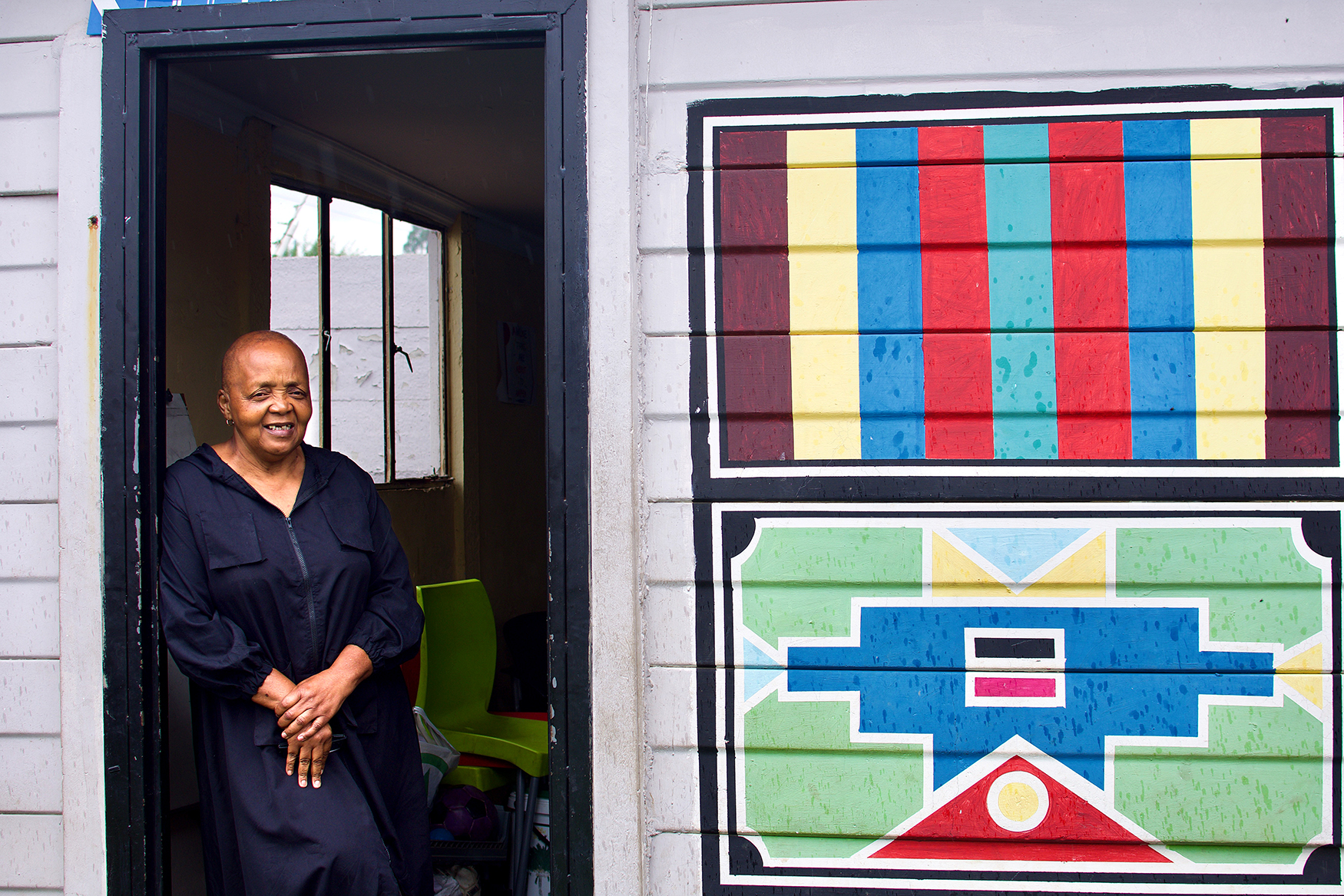
 Carol Dyantyi at the entrance of the Uzima kids centre in Ezimbuzini, Soweto, where she has dedicated her life to supporting vulnerable children. (Photo: Oliver Roberts)
It’s a cool, drizzly morning in Ezimbuzini, an informal settlement in Soweto. The air carries dust, woodsmoke, the shouts of men sorting through waste in a nearby dump. A worn electrical cable – coming from where, powering what, nobody knows – twists across the dirt, half-embedded. “Watch out,” someone says, pointing at it. Three women stand at the entrance, selling produce.
A narrow path threads through the shacks. The soil underfoot is an odd mix of red-brown and a dark, burnt black. Then, she appears – moving slowly down the centre. Residents nod as she passes. Some smile. Others step aside without being asked. She walks as if she belongs to everyone here, and perhaps she does. She carries the history of the place – its triumphs and sorrows – in her face, her bones.
This is Carol Dyantyi. People here call her Mum Carol.
She leads us through a set of heavy gates. The ground shifts suddenly – from hard gravel to bright green astro turf. Beyond it, a cluster of low buildings painted in Ndebele patterns. This is the Uzima kids centre – an early childhood development centre that also functions as an adult education space.
Uzima SA, a non-profit founded and led by Dyantyi, supports children and young women not just through education, but through care that extends into the fabric of the community. Spaces once used for illegal dumping have been reclaimed as safe areas for children. Teen mothers are helped back into school.
In the afternoons, Uzima becomes an aftercare space – keeping children safe and occupied until parents return from work. On Fridays – “bioscope day” – a plasma TV is wheeled out and a film flickers across rows of enthralled faces.
“We try to make sure they take their education seriously,” Dyantyi says.
/file/attachments/orphans/DSC8974_359514.jpeg "Carol Dyantyi at the Uzima kids centre, an early childhood development hub in Soweto that also provides care and support to families. (Photo: Oliver Roberts)")
We’re sitting in her office. Rain taps steadily against the roof. In one corner, a shelf holds stacks of books, leaflets on sex education and a box of free condoms. A piece of paper is pinned to the wall: “Diversity is the one thing we all have in common. Celebrate it every day.”
Joy and despair
Dyantyi’s life has been dense and eventful, marked by passages of both joy and despair. She was unable to complete her matric after the Soweto Uprisings – 50 years ago this June. It’s a day she still recalls with unsettling clarity. She knew Hector Pieterson. She saw his body being carried.
Years later, she returned to finish school while working as a waitress at the Carlton Hotel. In 1997, she began studying community development at RAU, now the University of Johannesburg. Two years later, she trained in HIV/Aids counselling through Unisa, supporting herself with part-time work as an auxiliary nurse at the Netcare academy.
Perhaps she did not know it then, but her trajectory towards a life of community development – she has supported nearly 16,000 children and at least 1,000 families – was emerging through proximity to need.
By the late 1990s and early 2000s, HIV/Aids had reshaped communities across SA with relentless brutality. In places like Soweto, its impact was measured less in raw statistics than in absence – parents dying, households shattered, children left to raise themselves.
For Dyantyi, the crisis was not something she observed from a distance. It arrived at her doorstep in the form of children – confused, frightened and looking for help. All across the country, they were stepping into roles they were never meant to carry: caregivers, providers, decision-makers. Many – by necessity or otherwise – stopped going to school. Others simply vanished into the cold shadows, doing whatever they could to survive.
Ikageng Itireleng Aids Ministry
In 2001, Dyantyi formalised her work, founding the Ikageng Itireleng Aids Ministry in Orlando West. She remembers one of the first families she helped. Their mother had died on the same day as the 11 September 2001 attacks in New York.
“They had nothing, nothing,” she says. “The kids had not gone to school for six months. The youngest was 13. She told me the last time they had eaten was when someone gave them two rand to buy popcorn.”
The 13-year-old girl is now a beautician, with a family of her own.
The name Mum Carol dates back to those early days. She is also called “Malo” – a Zulu word for mother.
The rain intensifies on the roof, its roar briefly swallowing our voices before softening again. Dyantyi uses her hands when she speaks, widening and narrowing the space of whatever it is she’s remembering. From the adjacent building – its windows open in the muggy warmth – come voices, sudden bursts of laughter.
/file/attachments/orphans/DSC8995_548064.jpeg "Known as ‘Mum Carol’, Carol Dyantyi sits outside the centre she founded, a safe space for children and young women in her community. (Photo: Oliver Roberts)")
She speaks of the women who shaped her in those early years – stalwarts like Winnie Madikizela-Mandela and Albertina Sisulu.
“Winnie would come down to the level that I am,” Dyantyi says. “Not as a politician, but as a woman who had the heart of the community, the heart of the people – especially the young.”
She remembers Sisulu appearing one day with her walking stick – she lived not far from Ikageng.
“She told me, ‘I’m an orphan, too. In the midst of all you that you do, you don’t know who you’re raising. You may be raising a doctor who finds the cure for cancer.’”
Alicia Keys
There are others who recognise her work and stand behind it. In 2014, Alicia Keys funded her participation in a five-month human rights advocacy programme at Columbia University. One girl from Ikageng went on to attend the Oprah Winfrey Leadership Academy for Girls.
“Even Oprah calls me Mum Carol,” she says.
But in the midst of all this light, there is deep darkness too. Dyantyi’s voice wavers as she speaks about the children who, in the end, could not be saved – boys who went to prison or took their own lives, girls who turned to the streets. One young woman, from Lesotho, was murdered by her boyfriend.
She says it breaks her heart that the voices of girls and young women are still not heard in boardrooms or government spaces. At least once a day, she admits, something happens that makes her think: Enough. I can’t do this any more.
She pauses. Takes a deep breath. Her fingers cross, then open again, her arms spreading across the table.
“But then,” she says, “I walk into the school and the little ones come running up to me, shouting ‘Malo! Malo!’ And the teacher says, ‘I’m privileged to know you, and the kids adore you. Don’t you dare give up on them.’”
Later, as we walk out of Ezimbuzini, two young women pass by, carrying wood on their heads, fixing for a fire. DM
Oliver Roberts is a multi-award-winning journalist, writer and photographer whose work has been published locally and internationally.