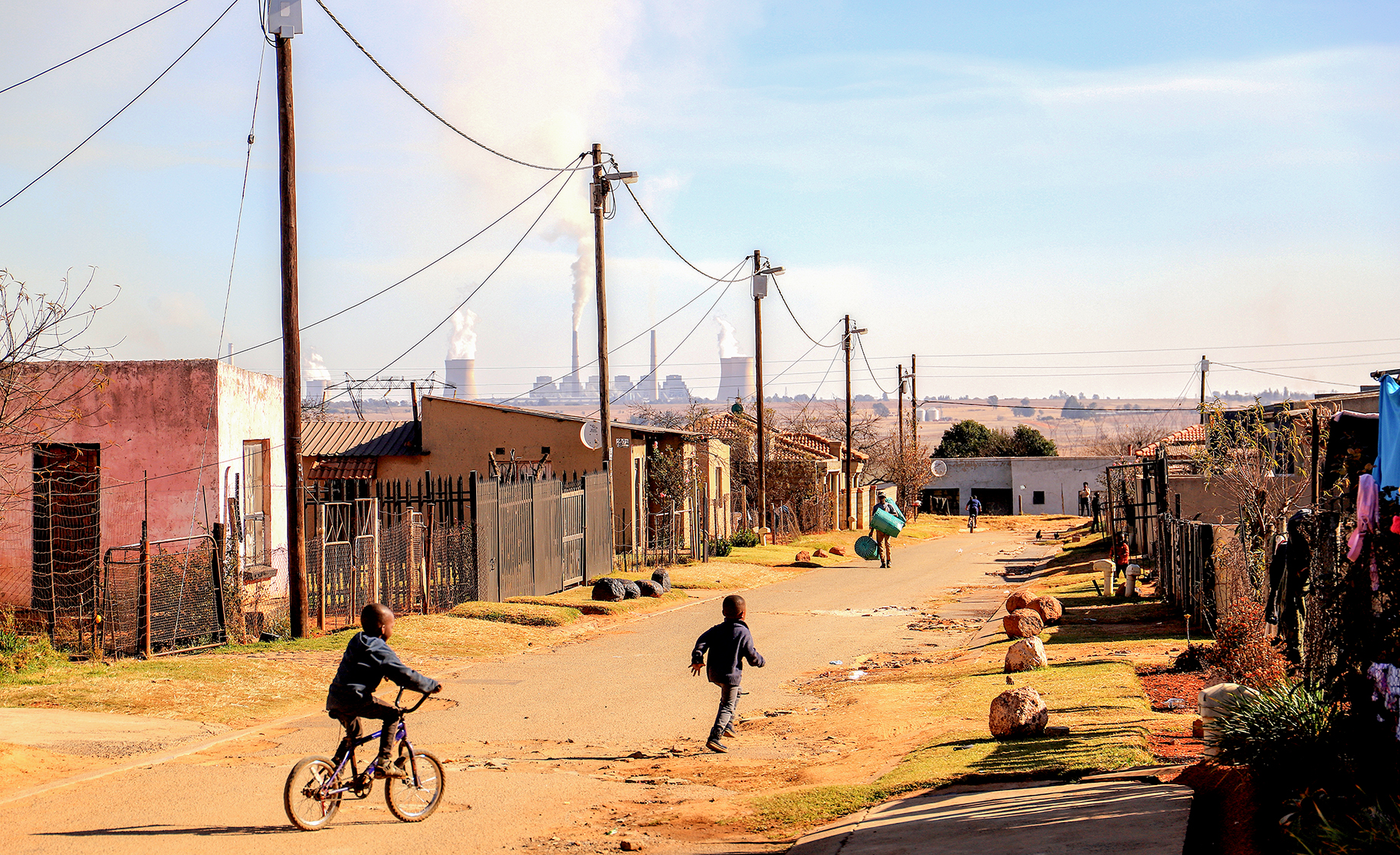
 The air in Thubelihle carries a constant yellow/ochre-tinted haze due in no small part to the Kriel Power Station and other industries in the area. Despite that, life continues and children play in the street, like in any other South African town. (Photo: Ethan van Diemen)
 It has been just over five years since the Presidential Climate Commission (PCC) was established to usher in the Just Transition in South Africa. With global temperatures hitting record highs and the 1.5°C limit projected to be breached by 2029, the PCC was tasked with building a “national consensus” on the decarbonisation of SA’s economy.
For the first time in the country’s history, the commission created a table where government, big business and grassroots activists sat as equals to dismantle the nation’s coal dependency in a manner that would put the socioeconomic and environmental rights of people first.
However, the honeymoon period of the Just Transition is beginning to fade, and the consequences of the decommissioning of Komati are still being felt on the ground. The question remains: Who really holds the power to drive the Just Transition?
Through its new report, groundWork attempts to answer the question.
Launched on Monday, 23 March, An Imbalance of Power: The Just Transition, the Life After Coal campaign and the Presidential Climate Commission, 2020 to 2025, suggests that while the “architecture” for justice has been built, cracks in the foundations are already starting to show.
/file/attachments/orphans/BobbyPeak_740736.jpeg "Bobby Peak, executive director of groundWork, watches the performance of the play, Old King Coal, by Life After Coal campaign activists during the launch of the 2025 groundWork Report at the Wits Professional Development Hub on Monday, 23 March. (Photo: Dylan Paul)")
High stakes, sidelined advice: Wins and losses
Since its establishment in 2020, the PCC has made great strides, with its crowning achievement being turning climate justice rhetoric into law. The Climate Change Act institutionalised the commission and created legal obligations for local governments to act. This was the “peak” of climate ambition, a moment when it seemed South Africa could decarbonise while delivering social justice.
However, the tide has begun to turn. The report identified a “concerted pushback” from the Minerals Energy Complex, the powerful alliance of coal-heavy industries and state departments. The most significant loss? The PCC’s evidence-based advice on South Africa’s 2025 climate pledges (NDCs) was largely ignored by the government, leading to unambitious targets that did little to move the needle on emissions reductions.
“The compact that had briefly united government, labour, business and civil society had devolved into competing narratives and divergent interests... the lower-ambition equilibrium more accurately reflected the prevailing balance of power,” the report found.
Dr Crispian Olver, former CEO and deputy chairperson of the first cohort of the PCC, joined the launch via Zoom and hailed groundWork’s latest annual report as a comprehensive and honest reflection of the successes and challenges faced by the PCC in ushering in the Just Transition.
“When it [the PCC] was set up, it was very explicitly mandated only to play an advisory role, and even that advisory role wasn’t properly institutionalised, so we would make recommendations for the President, the government, but they were under no obligation to even consider our recommendations,” Olver said.
He said that though President Cyril Ramaphosa regularly participated in meetings, and there was initially significant participation from government and business in the beginning, that began to decline, further exacerbated by the fact that the PCC had no power to summon government departments.
This shift suggests that while the PCC has what the report identified as “discursive power”, the ability to win the argument, it still lacks the “material power” to move the machines of state and industry.
Olver also pointed out that the PCC’s term coincided with significant global and local pushback against the energy transition, including from organised fossil fuel interests and large entities such as Eskom and Sasol, actively trying to undermine climate ambition.
“So I believe the way [the PCC] was set up probably needs further attention, and I hope that the new commission picks up on this issue. Ideally, [there] should be an obligation that the government considers the commission’s recommendations,” Olver said.
Law professor at the University of Witswatersrand (Wits) and current PCC commissioner for the new cohort, Tracy-Lyn Feild, said she read the report cover to cover and found it “very useful” as her tenure as a PCC commissioner began.
/file/attachments/orphans/Tracy-LynField_615605.jpeg "Tracy-Lyn Field, Wits Law professor and current commissioner of the Presidential Climate Commission, speaks at the launch of groundWork's report on the Just Transition at the Wits Professional Development Hub on Monday, 23 March. (Photo: Dylan Paul)")
“A litmus test for the Just Transition is going to be who it’s hurting, because that Just Transition will fail if it hurts like hell for the people who have been hurt like hell for decades. That’s really the challenge for us,” Field said.
She said the challenge that the PCC had before it now was developing material power in what was “nothing less than a civilisation change”, a complete system shift that had been dominated by fear, which the Minerals Energy Complex had routinely tapped into.
An authority on climate justice and governance, Fields acknowledged that it was important for the next round of commissioners to “hold the line and take the battle”, emphasising the need for increased transparency, especially as it related to Eskom’s decommissioning plans, which the entity allegedly refused to make public.
Concerns are raised about the lack of programmed responses to health issues such as respiratory problems, despite growing awareness of the broader impacts of climate change.
In an age where the battle to control the Just Transition seems to be falling in favour of the Minerals Energy Complex, as the report finds, Field believes deterministic power needs to be given to affected communities, saying, “Constituencies must fight for the Just Transition”.
Read more: A just energy transition needs the one thing the world still won’t deliver: finance
Komati: When the ‘just’ was left out of the ‘transition’
The decommissioning of the Komati power station was meant to be the flagship of a Just Transition. However, led by Eskom and the recommendations of the PPC being ignored, what actually happened was the destruction of a pivotal livelihood and the deflation of a local community, while the affected communities’ pleas for information went unanswered.
/file/attachments/orphans/fdkomati2_331450.jpg "People near the Komati Power Station in Mpumalanga on 8 November 2021, less than a year before it was due to be decommissioned. (Photo: Felix Dlangamandla)")
Critically, the report found that the Department of Mineral Resources was “missing in action” on the ground, failing to address the collapse of local livelihoods.
The PCC eventually intervened to support the community, but the damage was already done. Komati became the “own goal” that fossil-fuel lobbies used to scare the public, painting the transition as a creator of “ghost towns”.
Speaking about what life had been like in Komati since the power station was decommissioned in 2022, former Komati power station employee and current member of the Komati Steerco, Carlos Vilanculo, said many communities in the area were still struggling, two years after the power station was shuttered.
After thousands of direct and indirect jobs were lost, life in Komati has been characterised by severe economic hardship for households, high unemployment and high frustration due to stalled redevelopment projects.
“Today, it is very bad; even just talking about it is difficult. Most of my colleagues are still struggling to shift from the power station side and go to the mine or anything else,” Vilanculo said.
/file/attachments/orphans/CarlosVilanculo_716177.jpeg "Carlos Vilanculo, who worked at the decommissioned Komati Power Station, explains on Monday, 23 March, at the launch of the report at the Wits Professional Development Hub, how the town continues to struggle. (Photo: Dylan Paul)")
He said that when redevelopment projects were introduced in Komati, the desperation for employment and income led to gatekeeping, which had left affected communities out in the cold.
“I feel sorry for the next communities where they will shut down the power station because if you don’t put the community first, there’s nothing that will succeed.”
/file/dailymaverick/wp-content/uploads/2022/07/ED_388357.jpg "National Union of Mineworkers of South Africa members protest at the entrance of Duvha Power Station in Witbank on 28 June 2022. (Photo: Gallo Images / Rapport / Deon Raath)")
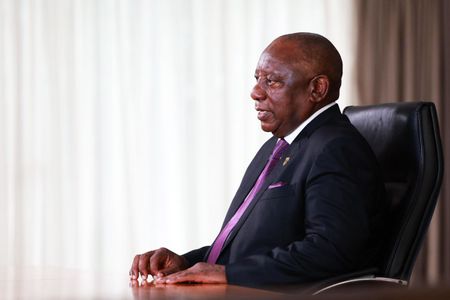
A Just Transition from the ground up
With the tenure of the PCC now under way, and three more power stations, Camden, Hendrina and Grootvlei set to be decommissioned in 2030, the nation cannot afford another Komati.
To ensure the transition is actually just, the groundWork report recommended that the following strategic priorities should be forced on to the national agenda:
- Socially and community-owned renewables (Score!): Democratising the energy system by putting ownership in the hands of the people, not just greenwashed corporates.
- Community Just Transition funds and centres: Establishing direct resource hubs in affected coalfield communities to manage the socioeconomic shift.
- Local government obligations: Rigorously enforcing the Climate Change Act at the municipal level to stop the decay of basic service delivery.
- Inclusive and transparent planning: Replacing the reliance on technocratic reports with ongoing, meaningful participation from those on the fenceline.
The report found that the grip of the Minerals Energy Complex on the state architecture remained formidable. Without a fundamental system change that moved beyond the fossil fuel economy, the Just Transition will remain a hollow phrase. DM