




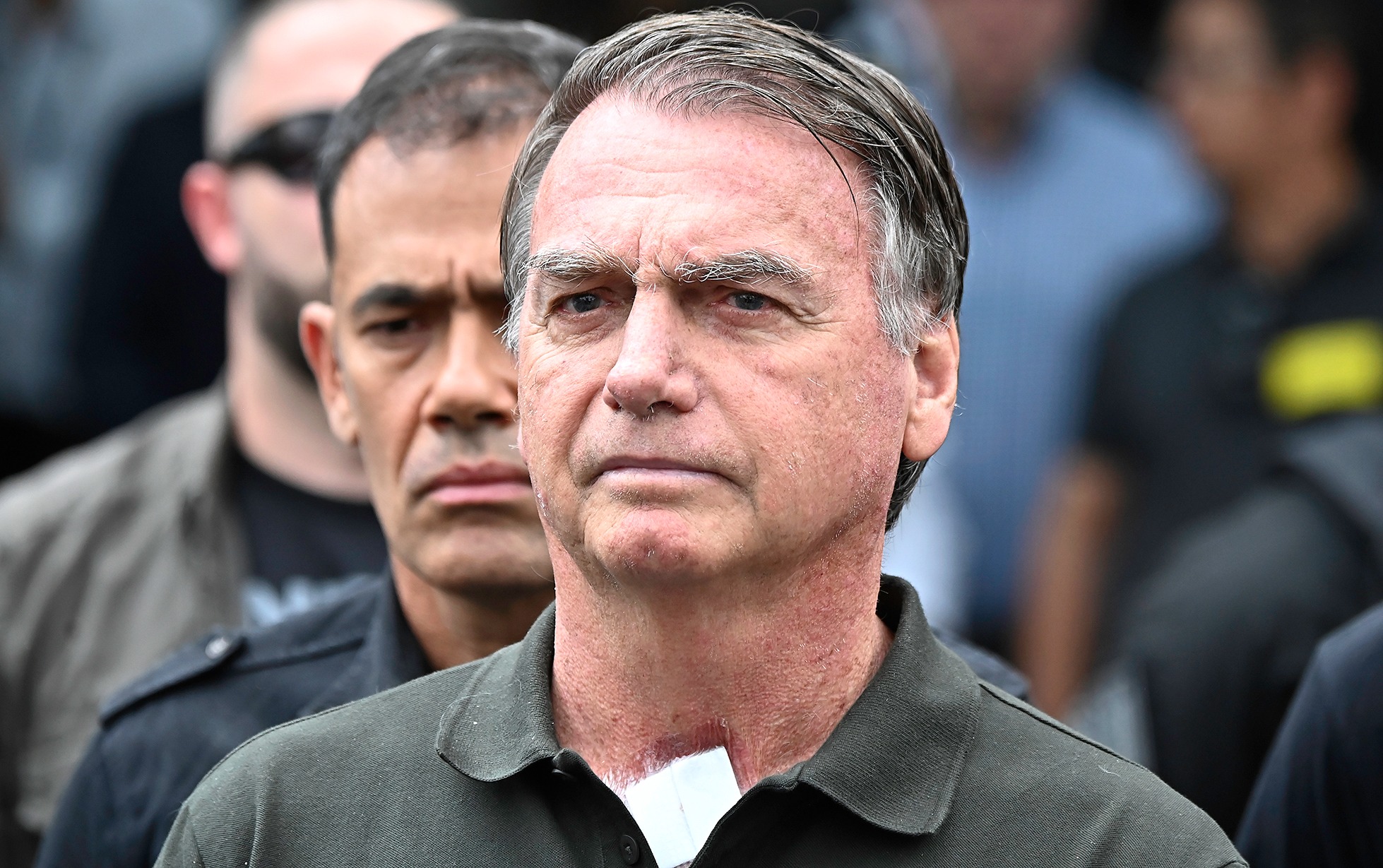
 Former Brazilian president Jair Bolsonaro. Brazil has experienced an intricate balance between politics and bureaucracy since the 1988 constitution. (Photo: Ton Molina / Getty Images)
 /file/dailymaverick/wp-content/uploads/2025/10/label-Op-Ed.jpg)
Across continents, people grow weary of politics, technocrats present themselves as saviours who promise to bypass democratic messiness, and strongmen rise by claiming that only they can “fix” the state – by force, by managerial efficiency, or by moral cleansing.
From Donald Trump to Narendra Modi, Viktor Orbán to Jair Bolsonaro, contemporary authoritarianism feeds on a simple but dangerous premise: that politics – the very substance of democracy – is the problem rather than the path.
Democracy on a Tightrope emerged from observing this dynamic inside the Brazilian state. For years, we watched elected officials and bureaucrats negotiate, clash, collaborate and sometimes undermine one another. We came to understand that the everyday relationship between politics and bureaucracy is not technical detail – it is where democracy is lived, and where it breaks.
/file/attachments/orphans/GettyImages-2267051041_927256.jpg "US President Donald Trump. There is disillusionment in democracies worldwide, where citizens are drawn to strongmen who promise efficiency over political engagement. (Photo: Alex Wong / Getty Images)")
Democracies falter when politics ignores evidence and does not respect rules and procedures, but they also falter when bureaucracies present themselves as morally superior to political choice. The balance between them is delicate, and its disruption – whether through technocratic arrogance or political disregard for institutions – creates the opening through which authoritarianism flows.
Brazil’s democratic experience since the 1988 constitution provides a vivid illustration of this complexity. Ours is a state shaped not by a single administrative logic, but by the coexistence of patterns that survived dictatorship, democratisation and reform. Clientelism continues to influence access to power; corporatist arrangements grant privileges to well-organised groups; insulated technocratic bodies present themselves as neutral while protecting their own interests; procedural universalism seeks to guarantee equal rights through legal rules; and participatory institutions involve citizens directly in decision-making.
Progressive in aspirations, unequal in outcomes
These patterns do not erase one another – they coexist, intertwine and compete. They make the Brazilian state progressive in its aspirations and unequal in its outcomes; democratic as a promise, but elitist in practice. SA, too, knows how difficult it is for a constitutional promise to overcome the weight of history, racial inequality and socioeconomic hierarchy.
Against this backdrop, the modern celebration of meritocracy has become politically consequential. A concept originally intended as a critique of privilege has been transformed into an ideology that legitimises unequal structures of power.
In Brazil, the most prestigious bureaucratic careers are overwhelmingly occupied by white, upper-middle-class men from a narrow set of regions. These actors often see themselves not as servants of public interest and democratic choice, but as custodians of a higher national rationality, endowed with legitimacy superior to that of elected leaders. This is how technocracy becomes a political project: by presenting itself as neutral, while masking the economic and social interests and historical privileges it carries.
These tensions have appeared repeatedly in Brazilian democratic life. When the government debated the Access to Information Law, parts of the bureaucracy resisted transparency by invoking the notion that they – and not society – embodied the true state. When ideology overwhelmed evidence in our drug policy, political leaders insisted on punitive approaches that research had long shown to be ineffective and racially devastating.
/file/attachments/orphans/13784070_862425.jpg "Indian Prime Minister Narendra Modi. (Photo: EPA / Gil Cohen-Magen / Pool)")
Dual-sided threat
These examples reveal the dual-sided threat: on one hand, a bureaucracy that oversteps democratic boundaries; on the other, political actors who dismiss knowledge, expertise and data in favour of intuition or ideology. Both paths weaken democracy. Both make room for those who promise to dismantle institutions in the name of efficiency or moral order.
Yet Brazil also offers examples of what becomes possible when politics, bureaucracy and society manage to act together.
The Dry Law, which significantly reduced traffic deaths, was born from listening to frontline public servants, grounding choices in empirical evidence, and crafting policy solutions that could survive political scrutiny.
The Internet Bill of Rights emerged from an unprecedented collaborative online drafting process that invited civil society, specialists, companies and public officials into a single debate. The result was a regulatory framework rooted in public reasoning rather than pressure from isolated interest groups.
These episodes highlight an often-forgotten truth: when political leadership welcomes technical expertise, and when bureaucracies open themselves to public participation, democracy becomes more creative, more equitable, and more resilient.
This interplay is not merely institutional – it is also profoundly social.
/file/attachments/orphans/GettyImages-2267400452_685940.jpg "Viktor Orban, the long-serving prime minister of Hungary. (Photo: Pier Marco Tacca / Getty Images)")
Neither neutral nor universal
Bureaucratic neutrality, as often imagined, is neither neutral nor universal. It tends to reproduce the worldview of those who dominate positions of power: disproportionately male, white and privileged. Without mechanisms for participation that bring marginalised voices into the heart of decision-making, technical debates reflect only a narrow segment of society.
That is why participatory institutions matter so deeply. They not only democratise decisions; they also democratise which forms of knowledge count and make the state more representative of the citizenry.
These reflections resonate powerfully in SA’s present context. Here, too, the relationship between political authority and state capacity is under intense scrutiny. Citizens demand better services, more accountable leadership, and institutions that can withstand both political interference and technocratic insularity.
Judicial assertiveness is celebrated by some and criticised by others; bureaucratic reform is invoked as a solution but rarely discussed in terms of power, representation or legitimacy.
The challenge
As in Brazil, the challenge is not simply building a stronger state, but defining what kind of strength democracy requires – and who gets to define it. This means thinking about the needed state capacities to build a democratic and representative state.
In both of our countries, democracy will endure only if politics is defended as a public good rather than treated as a pathology. It will endure only if bureaucracies are empowered to provide expertise and defend the rule of law without claiming supremacy over elected authority. And it will endure only if participation expands to include voices long marginalised by race, class, geography and gender.
This tripartite balance – politics, bureaucracy and society – is not easy to maintain. It is, however, the only democratic formula that has ever worked.
The tightrope is real. But the act of walking it – shaky, imperfect, collectively – is precisely what allows democracy to grow strong. DM
Register here to attend the book launch on March 26. 4pm-5.30pm, Studio 2, Neville Alexander Building, UCT Lower Campus.
Gabriela Lotta is a professor and researcher of Public Administration and Government at Fundação Getulio Vargas (FGV) and coordinates the Center of Bureaucratic Studies (NEB). She is a PhD in Political Science from USP, a former visiting professor at Oxford’s Blavatnik School of Government, and a researcher affiliated with CEM, ENAP, and Princeton’s Brazil Lab.
Pedro Abramovay is the Vice-President of Programs at the Open Society Foundations and previously held senior leadership roles in Brazil’s Ministry of Justice, including Secretary for Legislative Affairs and Secretary of Justice. He played a key role in legislative reform efforts, gun control initiatives, and internet freedom policy.
Democracy on a Tightrope: Politics and Bureaucracy in Brazil explores the complex relationship between politics and bureaucracy in Brazil’s democratic development since the 1988 Constitution. Drawing from academic research and firsthand government experience, Pedro Abramovay and Gabriela Lotta examine how technocracy, meritocracy, and institutional power can both support and undermine democratic governance. Through vivid case studies – from drug policy to the Internet Bill of Rights – the book reveals how balancing political legitimacy with bureaucratic expertise is essential to building an inclusive, participatory democracy that resists authoritarian drift.