




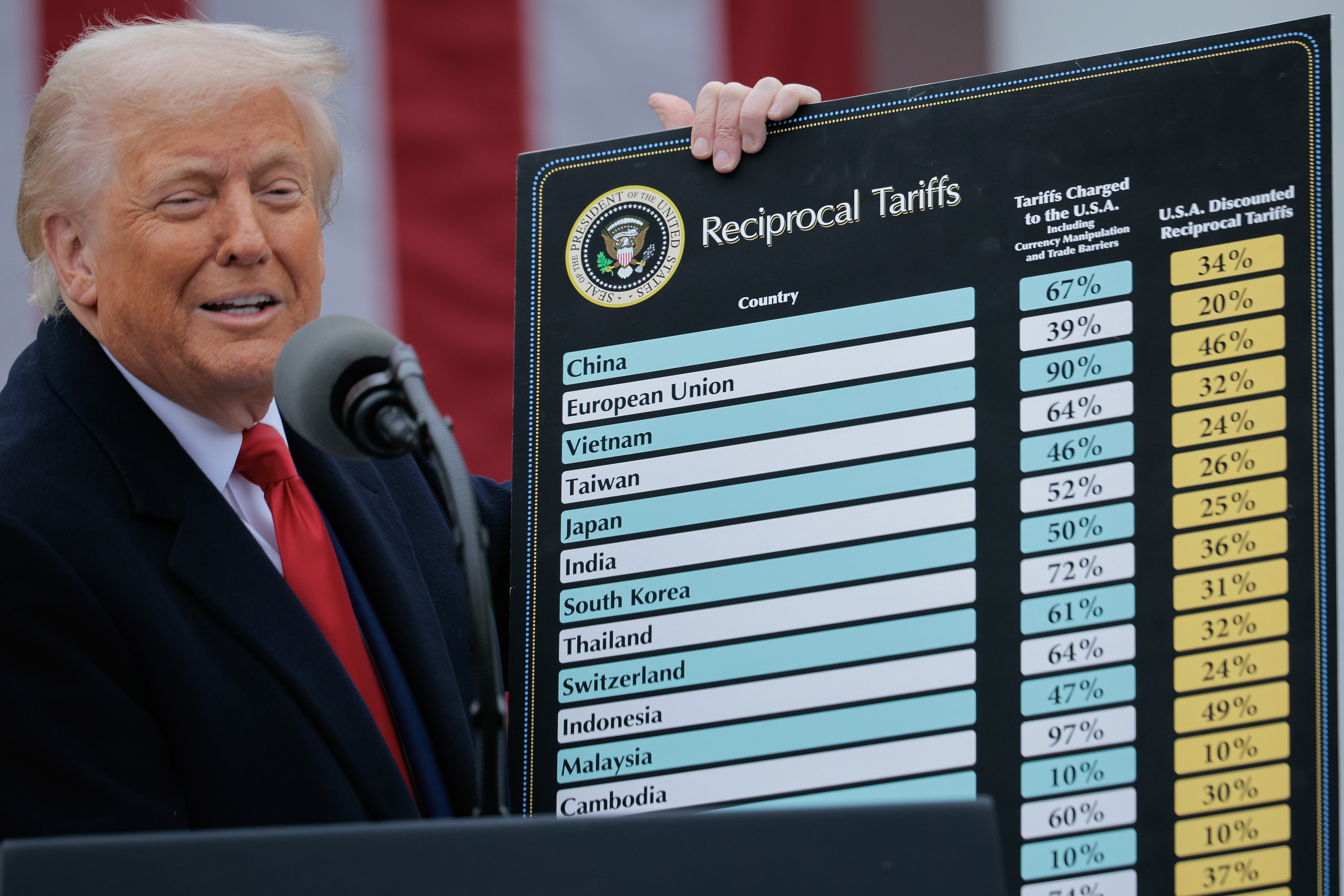
 US President Donald Trump labelled 2 April 2025 as ‘Liberation Day’ as he announced additional tariffs targeting goods imported to the US. (Photo: Chip Somodevilla / Getty Images)
Our export economy to the US has a cold. It’s a symptom of a condition that is sometimes called Trump Derangement Syndrome. Since August 2025, the United States has imposed a 30% tariff on many South African goods, the highest on the continent, which has sent shivers from Citrusdal to KuGompo City (that’s East London to the uninitiated).
Pretoria breathed a cautious sigh of relief when the US Supreme Court applied some VapoRub and struck down the president’s reciprocal tariffs, upsetting his trade bedside manner.
However, the new trade investigations launched last week appear to be President Donald Trump’s “Plan B” approach to re-administer his robust global tariffs therapy.
On Thursday, 12 March, US Trade Representative (USTR) Jamieson Greer announced a sweeping trade investigation targeting 60 countries to determine whether they had passed laws against the import of goods made with forced labour.
The list of countries includes some of the US's major trade partners, including Canada, India, Australia, Israel, the United Kingdom and South Africa. The US is South Africa’s third-largest trading partner, after the EU and China.
The investigation is one of several that the Trump administration is pursuing in an ostensible attempt to replace the International Emergency Economic Powers Act (IEEPA) tariffs that the Supreme Court rejected. The probes are being carried out under section 301 of the US Trade Act of 1974, which allows the country to impose tariffs in response to unfair trade policies.
“These investigations will determine whether foreign governments have taken sufficient steps to prohibit the importation of goods produced with forced labour and how the failure to eradicate these abhorrent practices impacts US workers and businesses,” said Greer in a statement.
“Despite the international consensus against forced labour, governments have failed to impose and effectively enforce measures banning goods produced with forced labour from entering their markets. For too long, American workers and firms have been forced to compete against foreign producers who may have an artificial cost advantage gained from the scourge of forced labour,” he added.
/file/attachments/orphans/GettyImages-2251049761_941321.jpg "US Trade Representative Jamieson Greer. (Photo: Chip Somodevilla / Getty Images)")
At a press conference on Monday, 23 March, South Africa’s Minister of Trade and Industry, Parks Tau, said South Africa had received a letter from the US indicating that it is part of this investigation.
“They [America] still have to send us the terms of reference [regarding] what exactly they would want to look at and how that would influence trade relations,” said Tau.
He described South Africa’s trade relations with the US as “fluid” and said the investigations being carried out by the US were “reflective of the posture of the country” to tariffs and trade.
/file/attachments/orphans/ED_567239_619429.jpg "Trade and Industry Minister Parks Tau. (Photo: OJ Koloti) / Gallo Images)")
‘Burden on US commerce’
After the Supreme Court ruling, Trump imposed a 10% tariff for 150 days under Section 122 of the Trade Act, reported Reuters. This is set to expire in July, unless the US Congress votes to keep it in place.
According to Eckart Naumann, an independent economist and associate at Trade Law Centre, when the court ruled against Trump’s IEEPA tariffs, it was “widely anticipated” that the administration would pursue other means of achieving similar outcomes.
“None are nearly as simple as the autonomous executive action the Trump administration took previously, either because they require congressional approval … or because they require an investigation to be undertaken, with several other procedural milestones, such as government-to-government consultations, public hearings, and so forth,” he told Daily Maverick.
The Section 301 investigations launched last week, said Naumann, are a “very broad basis on which to make potentially — and likely in this instance — adverse findings, and to use this to impose tariffs on countries beyond what is in the standard US tariff schedule.”
The probe relates to perceived failures by these 60 countries to take action on forced labour.
“The strategic importance of these countries is, of course, well known, and perhaps there is some link here. It is important to note that the investigation is not about forced labour practices in these countries, but rather, a more indirect link.
“The basic argument, essentially, is that the listed countries’ inability or unwillingness to prevent the import of goods potentially made with forced labour is disadvantageous to US competitiveness, and also works against US political interests,” said Naumann.
While Section 13 of the Constitution and the Basic Conditions of Employment Act strictly prohibit forced labour within South Africa, there’s no specific law that bans the importation of goods made with forced labour.
Wait, doesn’t the WTO have its own checks against forced labour?
Internationally, the World Trade Organization (WTO) operates more like a hospital administrator than a doctor. It doesn’t mandate strict anti-forced labour laws for its members, leaving that specific treatment plan to the International Labour Organization (ILO). However, under the WTO’s GATT Article XX, countries are granted a “public morals” or “prison labour” exception, giving them the right to quarantine illicit goods at their borders.
Naumann said it was unlikely that South Africa would challenge China in this respect.
“However, there is, of course, a possibility that South African supply chains are inadvertently exposed to inputs and goods produced under such practices,” he added.
The Section 301 prophylactic
What Greer reached for was more of a bone saw than a scalpel. This enforcement of Section 301 comes with expedited hearings that will take place between April (next week) and May (next month), which shows that this is less of a fact-finding probe and more of a predetermined diagnosis.
According to the letter of the law — well, on the new prescription issued in 2019 and now on update 32 — it allows the USTR powers to investigate and retaliate against any foreign policy that “burdens or restricts US commerce”.
This method has been used in the past to cure the US economy of “unfair trade barriers” imposed in the 1980s and 90s by Japan, Brazil and India. It was (then) used as leverage to shift the WTO’s influence over global commerce and force those countries to engage in high-pressure negotiations to open up their markets and curb their export enthusiasm.
In the Obama years, there was a similar shakedown of South Africa’s poultry market, where we had to accept US chicken under threat of being expelled from Agoa and have no fair-trade destination for South African wine and citrus. We took the medicine then, but this time is different.
This one is a callback to Trump’s first-term showdown with China — the cause for the new prescription — which left the People’s Republic with wide-ranging tariffs from 7.5% to 25% on about $370-billion in imports. Why? Those intellectual property theft allegations that got Huawei cut off from First-World tech and temporarily crippled the once-mighty tech giant.
Bitter pills
The current regimen came in two distinct doses:
Structural Excess Capacity Probe (11 March 2026): Targeting 16 economies (including China, the EU, India, Mexico and Japan), the US alleges that foreign government interventions like state subsidies and industrial planning are causing global overproduction. The USTR claims that if a country’s manufacturing capacity utilisation rate falls below 80%, it is proof of artificial overproduction that displaces US domestic manufacturing. Targeted sectors include everything from automobiles to cement to electronics.
Forced Labour Governance Probe (12 March 2026): An unprecedented expansion of trade law. Targeting 60 economies (representing 99% of US imports, including South Africa, Canada, the EU, and the UK), the USTR alleges these countries have failed to effectively ban the importation of goods made with forced labour from third-party nations. By acting as a dumping ground for artificially cheap, tainted goods, these nations supposedly create an unfair cost advantage that hurts US workers. The US is essentially demanding that the entire world adopt the extreme evidentiary standards of the US Uyghur Forced Labor Prevention Act.
An uncomfortable prognosis
It is clear that the Trump administration’s primary goal isn’t actually to slap permanent, global tariffs on 99% of US imports; doing so would trigger a fever of devastating, uncontrollable inflation inside the United States.
Instead, this is an extortionate geopolitical tourniquet, reminiscent of the Obama-era squeeze, using distorted timelines to pressure targeted nations into voluntarily signing Agreements on Reciprocal Trade (ARTs).
The US will only offer tariff moderation as a temporary painkiller if these sovereign nations completely rewrite their domestic customs and border enforcement laws to mirror Washington’s directives within an accelerated two-year timeframe.
For South Africa, that leaves a bitter choice: swallow Washington’s prescription and surrender our trade autonomy, or allow this syndrome to paralyse our central employment nervous system, much like the symptoms we are already seeing in the automotive market.
To be fair to the current US President, this new world trade medicine is decidedly America First. DM
Comments
Scroll down to load comments...