




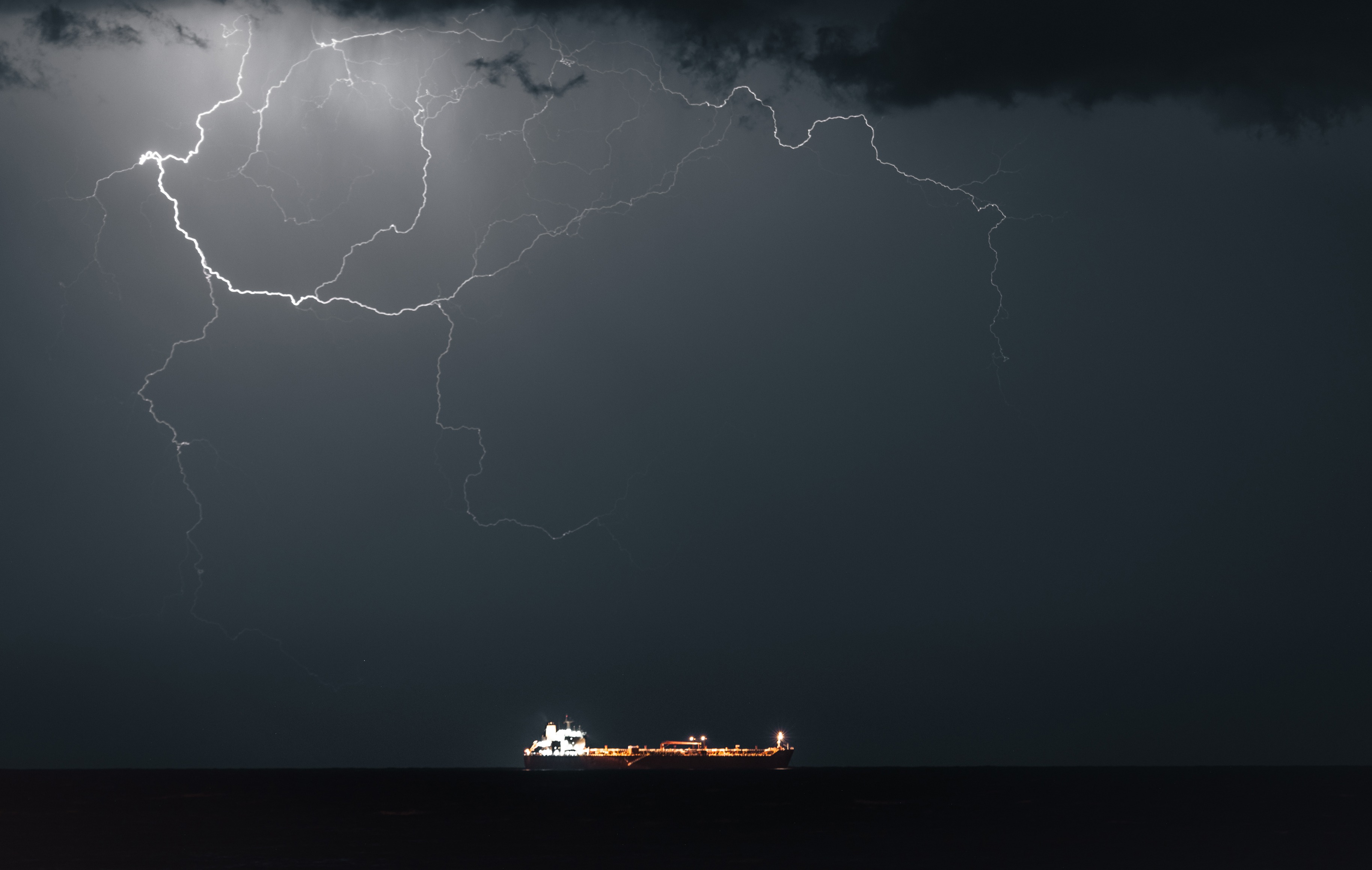
 Lightning fills the sky as META 4, an Oil Products Tanker, sails into Muscat Anchorage on 21 March 2026 at Sultan Qaboos Port in Muscat, Oman. US President Donald Trump had threatened to attack Iran’s energy infrastructure if it did not end its de facto blockade of the Strait of Hormuz by just before midnight GMT of 23 March. (Photo: Elke Scholiers / Getty Images)
 /file/dailymaverick/wp-content/uploads/2025/10/label-analysis-2.jpg)
US President Donald Trump’s announcement on Monday, 23 March 2026, that the US and Iran had held “productive” talks to end the war and that he had instructed the Pentagon to postpone further strikes for five days suggests that the end of the conflict may be nigh.
Or perhaps not. The twists and turns in this unfolding drama are sudden and jarring and the conflict could escalate again. It was revealing that he made the announcement before US markets, which were braced for another week of carnage, opened.
But even if the conflict ends next week, the damage inflicted has already been huge and lasting. And if hostilities resume, the prospects of a global recession and stagflation are real.
Stagflation broadly refers to an economy beset by high inflation and unemployment on one hand, and slow growth – or an economic contraction/recession – on the other. In short, it is the worst of all worlds and a nightmare for policy makers and the public.
Tellingly, the term first gained wide currency in the 1970s during the twin oil crises that beset the disco decade. And that shock is occurring again.
Fatih Birol, the Executive Director of the International Energy Agency (IEA), said on Monday that the unfolding global energy crisis triggered by the Iran war was a “major, major threat” to the global economy, on a par with the 1970s oil shocks and Russia’s invasion of Ukraine.
/file/attachments/orphans/GettyImages-2211272827_389940.jpg "Fatih Birol, Executive Director of the International Energy Agency. (Photo: Kin Cheung – WPA Pool / Getty Images)")
“This crisis, as things stand now, is two oil crises and one gas crisis put all together... I think no country will be immune to the effects of this crisis if it continues to go in this direction,” Birol told journalists in Australia.
The IEA – not known for alarmism – had already said last week that the conflict was the “largest supply disruption in the history of the global oil market”.
Reopening the Strait of Hormuz – where about 20% of the world’s oil supplies flow – will be the game changer, and timing is critical. Oil prices immediately fell about 10% on Monday on Trump’s announcement, and the benchmark Brent crude then rebounded a bit to over $90 a barrel early on Tuesday.
Energy markets remain on a knife’s edge and hydrocarbon flows will not reach pre-conflict levels any time soon. Last week, Reuters reported that Iranian attacks had destroyed 17% of Qatar’s liquefied natural gas (LNG) export capacity for up to five years.
That’s the thing about energy infrastructure. It takes years to build at vast cost, and the same goes for rebuilding from the rubble.
Coal comeback
Asian economies have already pivoted to coal as a buffer, and the long-term disruptions to LNG supplies signal a potential increase in demand for the fossil fuel – adding fuel to the fire of coal’s fightback as it defies the writers of its obituaries.
According to the IEA’s latest annual coal report, demand for coal reached an all-time high in 2025 for the third consecutive year.
The IEA at the time saw coal production and demand peaking and ebbing soon. But one of the consequences of this war is that such projections will probably be revised upwards at a time when the climate crisis linked to fossil fuel use is escalating.
If this shaky peace does not hold, we are back to “worst-case scenarios” that include the spectre of stagflation. Moody’s last week projected that the chance of a US recession in the next 12 months was 49%.
Revealingly, it noted that every US recession with the glaring exception of the Covid-19 pandemic had come in the aftermath of a sharp rise in oil prices, which fuels inflation. And a US recession can lead to a global recession, defined as two consecutive quarters of economic contraction.
The point about oil price shocks – massive and sudden spikes that are prolonged – is that stagflation outcomes are wired into their DNA. They stoke inflation while simultaneously slowing economic growth.
The International Monetary Fund (IMF) has a broad rule: a 10% spike in energy prices, if sustained for a year, adds 0.4 percentage points to global inflation and shaves 0.1 to 0.2 percentage points off global growth.
Catastrophic for the global economy
Such a scenario would not herald stagflation, but if oil prices remained above $100 a barrel on average for the rest of this year – about 50% more than their pre-Iran war levels – then the outcomes would be catastrophic for the global economy.
For SA, the damage will endure on a range of fronts even if the conflict soon grinds to a halt. Prospects for an interest rate cut this week or in May when the Reserve Bank’s (Sarb’s) Monetary Policy Committee (MPC) has its next two scheduled meetings have now been dashed.
“Monetary authorities are expected to keep rates steady for most of this year before cutting the repo rate by 25 basis points in Q4 2026. We anticipate several revisions to the Sarb’s forecasts, and markets will keenly assess the Sarb’s assumptions about the macroeconomic impact of the conflict in the Middle East,” said Jee-A van der Linde, Senior Economist at Oxford Economics Africa.
The Sarb may lower its economic growth forecast for 2026 or highlight that the risks to it are on the downside. But achieving the Treasury’s forecast of 1.6% this year may now be out of reach, and a prolonged conflict could even trigger a recession and stagflation.
The rand has also been battered, fetching 16.91/dollar on Tuesday morning compared with 15.91/dollar on the eve of the conflict at the end of February. The rand is notoriously volatile and has put in gains since Trump’s Monday morning announcement when it was at 17.24/dollar.
Its fate now lies largely in the hands of the US, Israeli and Iranian governments – as do those of the South African and global economies.
What comes next is anyone’s guess. April will herald a price shock of note at the fuel pumps, and the prospect for future shocks in the pipeline will hinge on the duration of this uneasy detente.
The economic stakes in this diplomatic drama are sky high. DM