




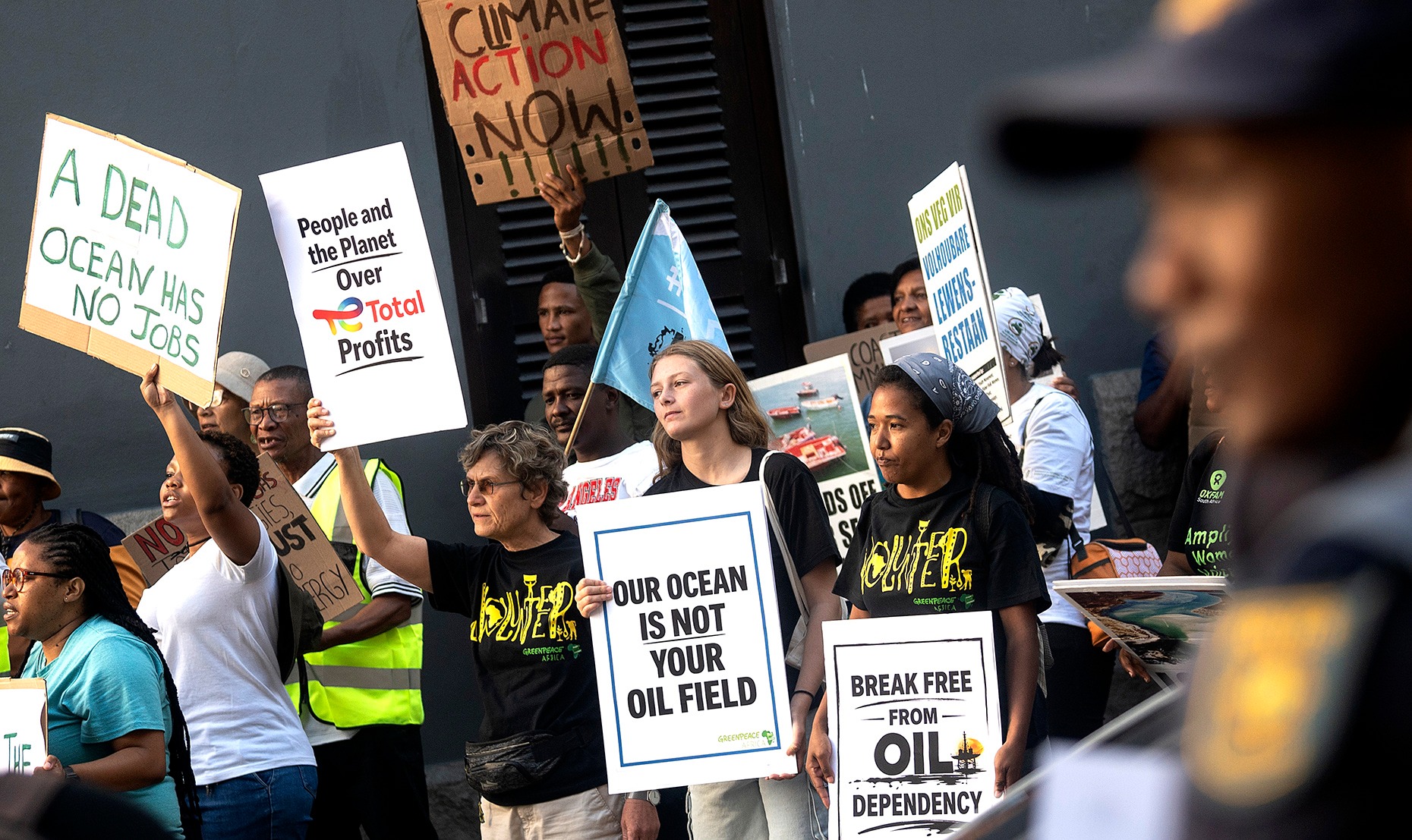
 Environmentalists and fishing communities protest against TotalEnergies’ oil and gas exploration outside the Western Cape high court in Cape Town on 23 March 2026. (Photo: Gallo Images / Brenton Geach)
In a two-day legal challenge, Aukotowa Fisheries, The Green Connection and Natural Justice asked the Western Cape Division of the High Court in Cape Town to overturn the Department of Mineral Resources and Energy’s (DMRE’s) 2023 decision to grant TotalEnergies environmental authorisation for offshore exploration in the Deep Sea Orange Basin, between Port Nolloth and Saldanha Bay.
The case is about more than who gets to drill where, but pits the government’s and TotalEnergies’ strategy bid for petroleum resource identification against the livelihood concerns of small-scale fishing communities, in addition to climate change and environmental considerations.
Fishing communities protest
On Monday, fishers and community members held a protest outside the court, calling for more consultation.
Walter Steenkamp, chairperson of Aukotowa Fisheries, a small-scale fishing cooperative in Port Nolloth, a town situated on the coastline of the drilling area, told Daily Maverick that the community wanted the right to self-determination.
/file/attachments/orphans/ED_601441_684278.jpg "Environmentalists and fishing communities protest against TotalEnergies’ oil and gas exploration project outside the Western Cape high court in Cape Town on 23 March 2026. (Photo: Gallo Images / Brenton Geach)")
“They are consulting us, but we are saying ‘no’. But the minister overruled all our decisions and decided the application must carry on. So, where is our right as a people? It is like we don’t have any communal or environmental rights,” Steenkamp said.
During proceedings, the applicants, Aukotowa Fisheries and the environmental groups, argued the following main points in front of a full bench of the high court:
1. The DMRE failed to conduct a proper “need and desirability assessment by exploration, which is linked to production, and the climate impacts of future gas extraction should be assessed now.
2. The environmental authorisation was granted based on the fact that a blowout would be “highly unlikely”, without sufficient justification, and that spill modelling underestimated the impact on marine protected environments.
3. The Socioeconomic Impact Assessment was not properly assessed, and failed to account for the survival risks to small-scale fishing communities that depended on marine resources.
4. The DMRE failed to consider the impact of exploration on coastal public property, as required by Section 63 of the ICMA
Port Nolloth is a small coastal village in the Northern Cape, the largest province in South Africa, with the smallest population, which has an unemployment rate of 27.1%. Here, fishing has become one of the cornerstones of employment. It was once a hub for diamond mining in the 1920s, but when the diamond boom died down and the mine became dormant, fishing became the main economic activity in the area.
According to Steenkamp, fishing is not merely an occupation for the Port Nolloth community. It is central to their life, culture, and heritage. It represents a fundamental way of living.
“It’s not just that we are going to catch fish for money. It is just the way we are living in Port Nolloth. Fishing is more than just a livelihood for us,” he added.
Calculating the risk of catastrophe
That is why the likelihood of a “blowout” was top of mind in the applicants’ main arguments. The group said the Environmental Impact Assessment rated the effect of a blowout as “high” or “very high”, adding that the risk was unacceptable.
An oil spill would effectively destroy the marine environment for a sustained period, leading to a severe reduction in income and livelihoods for fishers. They argued this would be particularly devastating for Port Nolloth due to the scarcity of alternative employment opportunities, placing strain on the local economic base and the social fabric.
However, counsel for TotalEnergies EP South Africa (Teepsa) argued that the statistical probability of a blowout remained low, countering that the global likelihood of such an event was a mere 0.0143%.
The government noted that 358 offshore wells had been drilled in South African waters to date, with zero recorded blowouts. From a policy perspective, Teepsa argued that the applicants’ fears were statistically ungrounded.
However, the ghost of Deepwater Horizon lives on.
On April 20, 2010, an explosion occurred on the British Petroleum (BP) Deepwater Horizon Macondo oil well drilling platform in the Gulf of Mexico. The disaster resulted in the death of 11 workers, caused the rig to sink and set off a catastrophic oil leak amounting to just over 507 million litres.
/file/attachments/orphans/2680947_587978.jpg "A file photograph dated 3 July 2010 shows the oil rig Q4000 at the site of the BP Deepwater Horizon oil well spill in the Gulf of Mexico off the coast of Louisiana, United States. (Photo: EPA / Bob Pearson)")
While Deepwater Horizon was in the production phase, unlike the exploration phase in the Orange Basin, the rig’s risk assessments in the Gulf were based on worst-case scenarios from previous spills. They didn’t account for water depths or volumes, according to a paper written by Mark Cohen, a professor at Vanderbilt University, and Alan Krupnick, the Director of the Centre for Energy Economics and Policy at Resources for the Future.
The pair argued that, as a result, the environmental assessment indicated that a spill from the well would result in no significant impact. The reality turned out to be very different.
Rather than dismissing the Deepwater Horizon catastrophe, the State argued that it “sensitised” the South African regulatory framework. The disaster prompted the creation of the South African Interim Incident Management Organisation and the South African Maritime Safety Authority (Samsa) to coordinate preparedness.
If an oil spill occurs, a process involving the government, insurers and Teepsa would be initiated to determine economic effects and issue compensation.
Teepsa maintained that it was fully insured and that any loss of earnings by small-scale fishers would be fully compensated. But, the environmental group and Aukotwa Fisheries express concern that this compensation process, administered by the Department of Forestry, Fisheries and the Environment and Samsa, would have limited efficacy in the short term due to the lengthy period it would take to run its course, thereby leaving small-scale fishers destitute.
This is not enough assurance for Steenkamp. “I know we need money, and everything is about money. But when the fish are gone, and the money is gone, where will the fishing community find fish to live from?”

Exploration isn’t production... yet
While the State has argued that the Mineral and Petroleum Resource Development Act creates a “legal wall” between exploration and production, two distinct phases, the environmental groups and fishers assert that the government failed to consider the full life cycle of the project.
They argue that exploration cannot be decoupled from production, and the DMRE cannot authorise the search for oil without assessing the environmental consequences of burning it.
They argue that exploration is inextricably linked to production, and the climate impacts of future gas extraction should have been assessed.
According to the State, exploration, governed by Section 79 of the Act, is a three-year gathering of information, whereas production, as stipulated by Section 83, is a 30-year commercial endeavour. The State maintains that it is a physical and legal impossibility to assess the impact of production when the volume, scope and even the existence of viable resources remain unknown – an argument that judges Babalwa Mantame and Mark Sher agree with.
Judgment has been reserved for a later date, but the Orange Basin case will define the boundaries of administrative action in South Africa’s energy transition.
As Steenkamp said in closing the interview with Daily Maverick, “Nothing about us without us.” DM


Comments
Scroll down to load comments...