




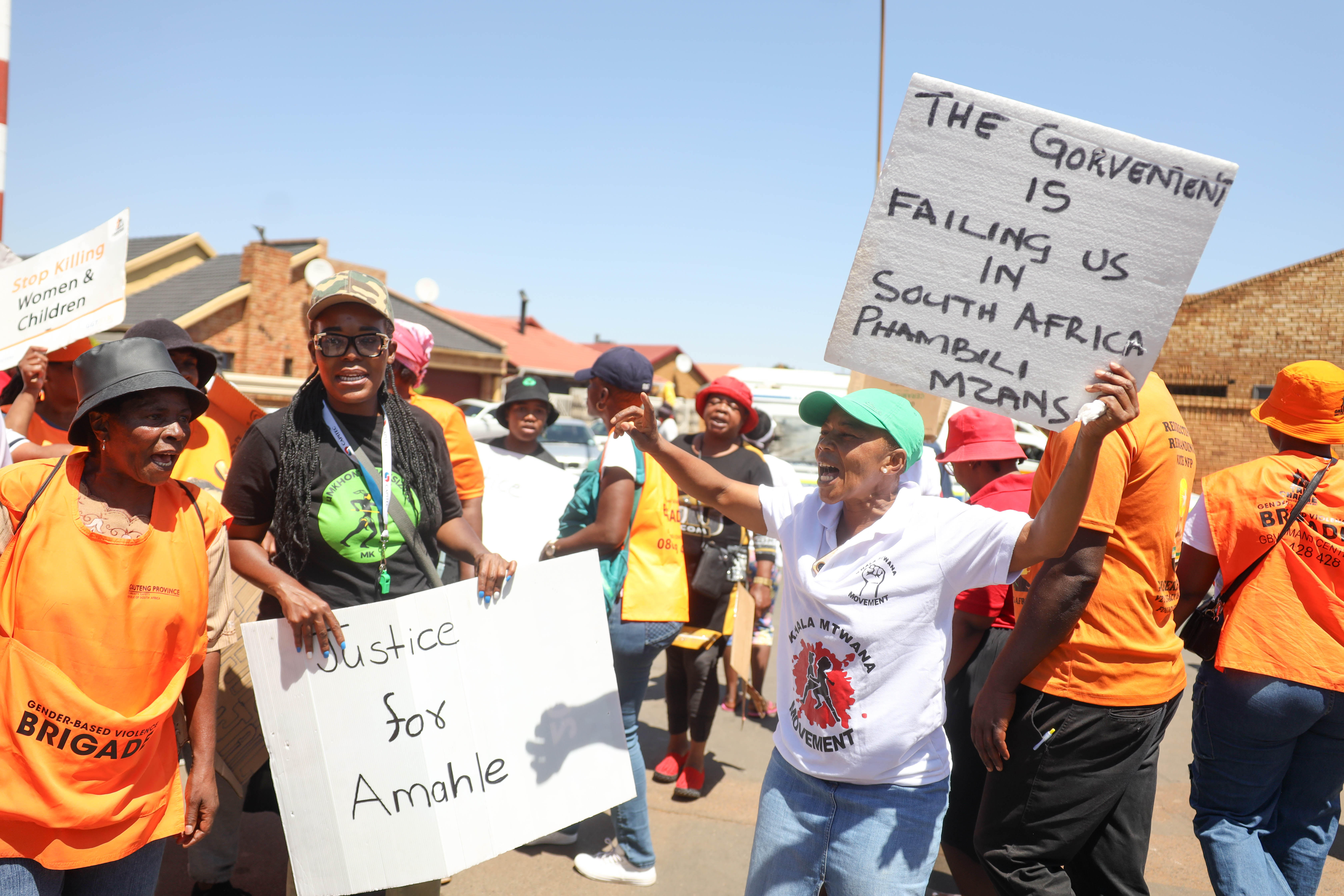
 A gender-based violence NGO pickets outside Protea Magistrate’s Court before Pethe Simiao’s bail application on 1 November 2024, in Soweto, South Africa. The suspect is accused of kidnapping, raping and murdering six-year-old Amantle Samane. (Photo: Sharon Seretlo / Gallo Images via Getty Images)
 /file/dailymaverick/wp-content/uploads/2025/10/label-Op-Ed.jpg)
The deployment of South Africa’s army to quell crime and violence in five provinces has made headlines. Apart from politicians, proponents of this approach tend to be those living in the communities that are most affected by gangs and gun crime. They want to feel safe, even if only for a short time.
Critics have looked at the long-term trends and implications of military deployment. They note that at best it provides a small window of breathing room for affected communities, but does little to address the problem in the long term.
Why does SA continue resorting to emergency responses to problems that have been around for decades? The answer lies in our failure to plan for the prevention of violence and crime.
This is apparent from an analysis of the Medium Term Development Plan (MTDP) – previously called the Medium Term Strategic Framework (MTSF) – which focuses on strengthening the criminal justice system and reducing contact crime and corruption.
In 2010, when homicide levels were 50% lower than they were in 1993, and at an all-time low, the Medium Term Strategic Framework prioritised safety. Outcome 3 aspired to ensure that “all people in SA are and feel safe”.
A list of lower-level outcomes all worked towards the same goal: reducing serious crime, particularly contact crime and trio crimes (carjacking, house robbery and business robbery); having an effective criminal justice system; combatting corruption; and improving public perceptions of crime. In 2014, the new Medium Term Strategic Framework retained Outcome 3, albeit with fewer related outcomes. But again, its focus was on responding to crime rather than preventing it.
No evidence
In the 2019-24 Medium Term Strategic Framework, safety was pushed down the list of priorities. This strategy emphasised “social cohesion” and safety. Presumably, the planners thought there might be a logical link between the two, despite there being no research evidence to support this link.
Yet while recognising the importance of reducing crime and increasing safety, no substantial thought was given to how this would be achieved.
The current Medium Term Development Plan has abandoned the term safety altogether. It focuses on organised crime and corruption, and nominally on responding to gender-based violence. Preventing crime and violence, particularly interpersonal violent crime, is missing. Reading this plan, you would be forgiven for thinking that crime and violence were under control.
What is apparent is that for 16 years, SA has failed – at the highest level – to plan for the prevention of crime and violence. Yet violence undermines development, employment, education and health. A holistic view is key. And the picture is complex.
The Medium Term Development Plan attempts to address state weakness, but does not acknowledge the simultaneous weakening of civil society. It acknowledges deepening poverty, inequality and unemployment, but resorts to magical thinking that strengthening the economy and spending on infrastructure will address entrenched cycles of poverty and inequality.
Critical stumbling block
How is this possible if the plan is meant to reflect government-wide priorities? Violence is not only a critical stumbling block to national development, but also affects people’s lives to the extent that military involvement is required.
This raises numerous questions.
Why is SA not planning for prevention at the highest level? And given that lack of planning, how will collaboration between government departments and civil society organisations, which is required to prevent violence, be resourced?
Is there an assumption that the state has the skills and human capacity for the “whole-of-government” or “whole-of-society” approaches required by strategies such as the Integrated Crime and Violence Prevention Strategy or National Strategy to Accelerate Action for Children?
Considering there is no appropriately resourced plan to prevent violence and crime, it is no surprise that the country must resort to expensive emergency measures, such as deploying the SANDF at a cost of about R883-million. Imagine how much violence could have been prevented had that money been invested in affected communities 16 years ago?
It is not only prevention that is missing from SA’s apex plan, however. The Integrated Crime and Violence Prevention Strategy and National Strategy to Accelerate Action for Children are among at least seven strategies that rely on cooperation and collaboration between more than 19 government departments and agencies, and civil society organisations.
Yet few of these government agencies are “implementing” departments, or have the capacity to coordinate. For example, implementation of the Integrated Crime and Violence Prevention Strategy is the responsibility of the Civilian Secretariat for Police Service – an important but under-resourced structure with little influence over the other departments needed to realise the strategy’s goals.
Also, most of SA’s strategies to reduce violence rely heavily on non-governmental organisations (NGOs) to deliver services at the community and family level. NGOs can offer these services on behalf of the government, but a mechanism to ensure the Department of Social Development can fund NGOs reliably and at the levels required to provide quality services is lacking.
Weak political leadership
The department’s Sector Funding Policy has not been implemented, and its status remains uncertain – not least because the department is broken and has suffered under weak political leadership for decades.
Even if that were not the case, and the Sector Funding Policy was implemented, would the resources be allocated to prevention if it isn’t a government priority in the Medium Term Development Plan?
Bringing in the military to solve what is essentially a planning and development failure traps the country in cycles of violence and dysfunction. It does not provide a way out. To prevent violence and crime, SA needs a deliberate, carefully crafted and appropriately resourced plan that makes prevention a priority. Doing this could save thousands of lives and millions of rand in the long term. DM
Chandré Gould is a Senior Research Fellow, Justice and Violence Prevention, at the Institute for Security Studies (ISS).
This article was first published by ISS Today.