



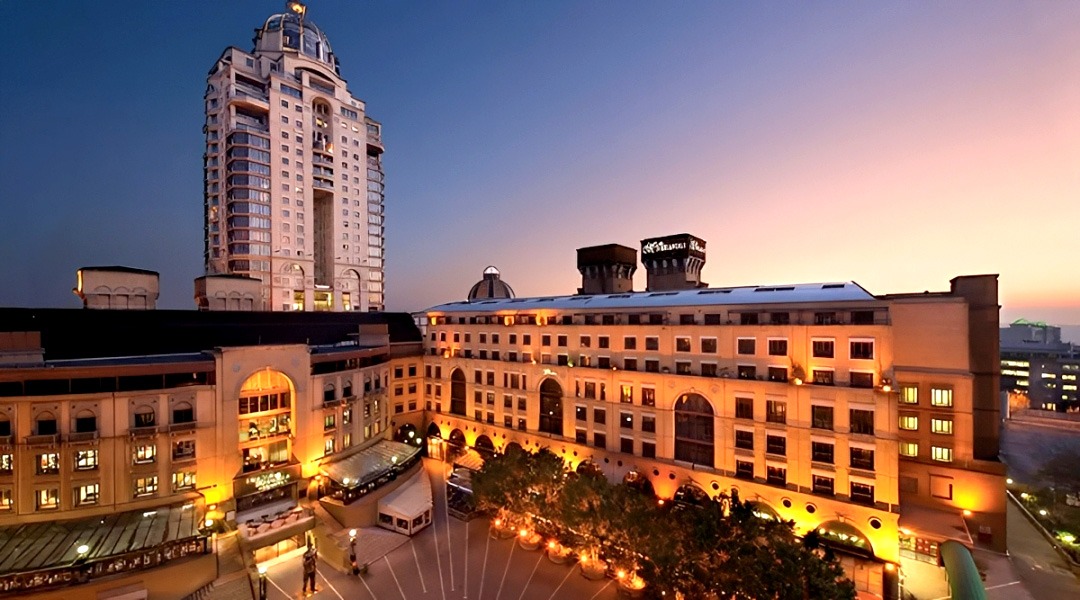
 Libya’s investments in Sandton include The Michelangelo Hotel, which has been closed since 2020. (Photo: go2africa/ Wikipedia)
 More than $210-million in real estate investments by the Libyan government in Johannesburg’s “richest square mile” have provided no visible returns for the Libyan people in more than two decades, according to The Sentry, a US-based investigative NGO.
The flagship of the state-owned Libyan Investment Authority (LIA) in SA is the plush Michelangelo Hotel in Sandton, which was the anchor hotel of the 2010 World Cup and “jewel of the LIA’s South African real estate portfolio”.
But it has been closed since 2020, largely over legal disputes between an LIA subsidiary, Ensemble, and its SA partner, Legacy Hotels, says The Sentry in a report released today (Tuesday, 24 March): The Libyan Investment Authority’s Not-So Frozen Billions: Mismanagement, Competition, and Corruption.
The LIA’s investments in Sandton are part of a wider failure of the LIA to derive any income for the Libyan people from its $62.85-billion portfolio of investments worldwide, which, in addition to SA, are also in the United Kingdom, Liberia and other African countries, says the report.
The Sentry largely blames corruption and incompetence, while in South Africa and elsewhere, the LIA has mainly blamed international sanctions, which were imposed by the United Nations and others in 2011, when an uprising supported by a Western air attack toppled Libyan leader Muammar Gaddafi.
The Sentry has calculated that about one-third of the LIA’s assets (around $20-23-billion) are not subject to any freeze, and the LIA has the ability to actively manage at least another $9.5-billion of the frozen assets via licences obtained from sanctioning authorities.
“This means that — when combined with the approximately one third of the LIA’s assets that are not subject to sanctions — the LIA remains able to actively manage around half of its total assets, or $30-33-billion.
“Given this, the Libyan people should expect that the billions of dollars invested since prior to 2011 — or at least those assets not subject to any sanctions — should be delivering a return on investment. Instead, the total value of the LIA’s assets has, in fact, fallen since 2011, and the assessed value of the assets that were not frozen or for which licenses were obtained has not increased.”
The report notes that the LIA is a sprawling organisation comprising a parent company, five subsidiaries, 430 business assets, and over 200 real estate assets across more than 70 countries.
It was established in 2006 as Libya’s sovereign wealth fund, but The Sentry says its mission was undermined from the start by its close connections with the regime of Gaddafi.
/file/dailymaverick/wp-content/uploads/2023/04/9000000117.jpg "Libyan leader Muammar Gaddafi at the inauguration ceremony of Jacob Zuma in Pretoria on 9 May 2009. (Photo: Gallo Images / Foto24)")
In 2010, five pre-existing entities were grafted on to the LIA: the Libyan Arab Foreign Investment Company (Lafico), the Long-Term Portfolio (LTP), OilInvest, the Libyan African Investment Portfolio (Laip), and the Libyan Local Investment Development Fund (LLIDF).
“Laip, in particular, was closely connected to the regime’s efforts to build influence with governments across the African continent,” says The Sentry.
The Michelangelo
As part of that effort, Gaddafi visited South Africa in June 1999 to meet “his long-time friend” Nelson Mandela. A few months later, Libya initiated an investment in SA hotels and real estate that continues to this day.
“The LIA’s South African portfolio, initiated in 1999 as a political gesture, reveals a two-decade-long failure to manage over $210-million in prime real estate. Key assets — including the prized Michelangelo Hotel, which closed in September 2020 — have apparently generated no profit for Libya,” the report reads.
Meanwhile, the LIA and its South African partner, Legacy Hotels and Resorts, “are involved in a high-stakes legal battle that could result in Legacy Hotels taking control of the LIA’s investments at a significant discount”.
The report adds that “No returns have been sent back to Libya.”
The legal battle still being fought is between Ensemble Hotel Holdings, a LIA subsidiary and Legacy Hotels, run by hotelier Bart Dorrestein.
The report says that in September 1999, Dorrestein bought, from the company Stocks and Stocks, a group of luxury hotels including The Michelangelo Hotel and several bush lodges across South Africa for R60-million and the contracts to manage them for R38-million.
/file/attachments/orphans/bart_232169.jpg "Bart Dorrestein, the CEO of Legacy Hotels.
<br>(Photo: joburg.co.za)")
(Photo: joburg.co.za)
Two weeks later, Ensemble signed a deal with Legacy Hotels, paying R19-million for a 39.8% share in Legacy Hotels and R161-million for a 100% share of The Michelangelo Hotel, The Sentry writes.
“The deal allowed Dorrestein to recoup his group’s initial investment, retain majority ownership of Legacy Hotels, and collect a surplus of R82-million ($13.6-million at that time). It was a deal that appeared to offer poor value to the Libyan people.”
The report added that both Ensemble and Legacy Hotels had declined to comment to The Sentry on how The Michelangelo Hotel could have been sold for R161-million just two weeks after Dorrestein’s group had bought it, alongside several other hotels, for R60-million.
Libya’s R3.2bn in Joburg
Meanwhile, the report says connections between Libya and the ANC deepened, mainly through Bashir Saleh, known as Gaddafi’s “banker”, who directed extensive Libyan business connections in South Africa, “most notably with the family of Jacob Zuma”, from 2009 to 2018.
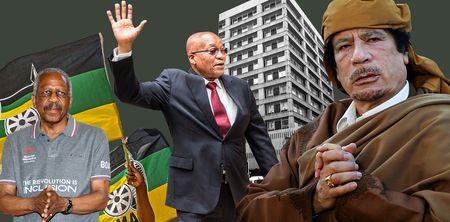
The report notes that Saleh had become chairperson of the LIA subsidiary Laip when it was formed in February 2006. Laip then took ownership of another LIA subsidiary, Laico, which lent Ensemble R1.1-billion in February 2006, which the report said had never been repaid.
“Ensemble used the loan from Laico to acquire a major plot of land adjacent to what is now Nelson Mandela Square, known as Sandton Isle, in 2008. The site was developed to include the Radisson Blu Sandton Hotel and Laico Isle retail and office units.”
In 2011, the fallout from the Libyan uprisings led the UN Security Council to sanction the LIA and Laip. The report says Dorrestein told SA media at the time that Ensemble dividends would not be transferred back to Libya to avoid them falling into Gaddafi’s hands. The Sentry report says that in 2012, the UN Sanctions Committee clarified that subsidiaries of the LIA and Laip were not subject to the asset freeze.
In 2015, Legacy broke ground on the R2-billion Leonardo Tower, a luxury tower block in Sandton. Ensemble bought 21 luxury apartments in the building for $70.9-million (about R1-billion at the time), the report said.
The report values Ensemble’s Johannesburg real estate empire at just over R3.2-billion.
It says that on 14 September 2020, Ensemble closed its flagship Michelangelo Hotel, citing challenges associated with the outbreak of the Covid-19 pandemic, while Legacy Hotels announced force majeure on its management of the hotel, citing issues related to sanctions, according to court documents reviewed by The Sentry.
The Michelangelo remains closed in an ongoing legal battle between Ensemble and Legacy.
The Sentry report notes that in March 2020, the UK Office of Financial Sanctions Implementation had issued a Red Alert notice on Laico, Ensemble’s immediate parent company. This had triggered a series of de-risking moves by Legacy’s clients and business partners, including Booking.com and Expedia.
“Legacy Hotels claimed that the dual impact of this and the Covid-19 pandemic became a threat to the continued operation of The Michelangelo Hotel, thus its announcement of ‘force majeure’.”
This, in turn, prompted Ensemble to offer to sell its shares in The Michelangelo Hotel to Legacy Hotels, but the two companies became locked in a legal dispute over the price.
Ensemble wanted R280-million, while Legacy countered with a proposal to sell the assets for R170-million to a new company in which neither Legacy nor Ensemble would hold shares or rights. This was “ostensibly to navigate exposure to sanctions”, says The Sentry report. Ensemble rejected this offer.
The impasse triggered a court battle in December 2022, which continues and now includes a dispute over Ensemble’s termination in January 2024 of Legacy’s contract to manage the hotel. The report said that as of March 2026, the legal battle was heading to the Supreme Court of Appeal.
The report added that Ensemble had dismissed as “inaccurate” media reports that it was also initiating a R1.2-trillion hostile takeover of Legacy Hotels.
Profits paused
The Sentry said many questions remained unanswered about who was really profiting from Libya’s investments.
It said, for instance, that in 2011 Dorrestein claimed that the profits of Legacy had largely been reinvested in the business, “but there are numerous records in the court documents of dividends being paid out. In February 2024, Dorrestein claimed that Ensemble had received dividends of R134.6-million ($7.2-million) by the close of February 2024, amounting to a 300% return on its initial investment. This raises questions as to where the Libyan state’s investments have gone.”
The Sentry said Ensemble and Laico “also have significant questions to answer”. It noted that while Laico had succeeded in persuading the EU to lift sanctions against it in December 2022, it remained sanctioned in the UK.
It noted that other LIA-owned assets were operating in the UK through the provision of licences. The report said it was unclear why Ensemble had not been able to do the same, “which may have allowed the business to resolve its dispute with the Legacy Group”.
“The situation of The Michelangelo Hotel contrasts with that of the Ensemble-owned Radisson Blu Sandton, which has remained open,” The Sentry adds.
Daily Maverick asked Dorrestein several questions raised in the report, but he said many of the issues were the subject of legal proceedings before the South African courts, and he could not answer them.
He added that Legacy’s engagement with Laico and Ensemble Holdings had arisen in the context of broader efforts at the time to attract foreign investment into South Africa following Libya’s re-entry into the global economy in the late 1990s.
“The relevant transactions were concluded through formal corporate processes and documented agreements and regulatory compliance when none of the current sanctions regimes were in place.”
He said that Legacy Hotels and Resorts was not a sanctioned entity and had consistently sought to operate in accordance with applicable laws and regulatory requirements, including anti-money laundering, sanctions compliance, and banking compliance requirements.
“Legacy remains committed to the highest standards of corporate governance and compliance with the laws of every jurisdiction in which it operates.”
Kais Souff, deputy CEO of Ensemble Holdings, said: “Ensemble’s position is that: it has been an active long-term shareholder in Legacy Hotels & Resorts; certain matters relating to governance and shareholder rights are currently subject to ongoing legal proceedings; and while sanctions did create operational and compliance constraints, the continued non-operation of The Michelangelo Hotel arises primarily from a contractual dispute with Legacy as former operator, including what Ensemble considers an overly broad reliance on force majeure, rather than from any absolute inability to operate a hotel in South Africa.” DM