




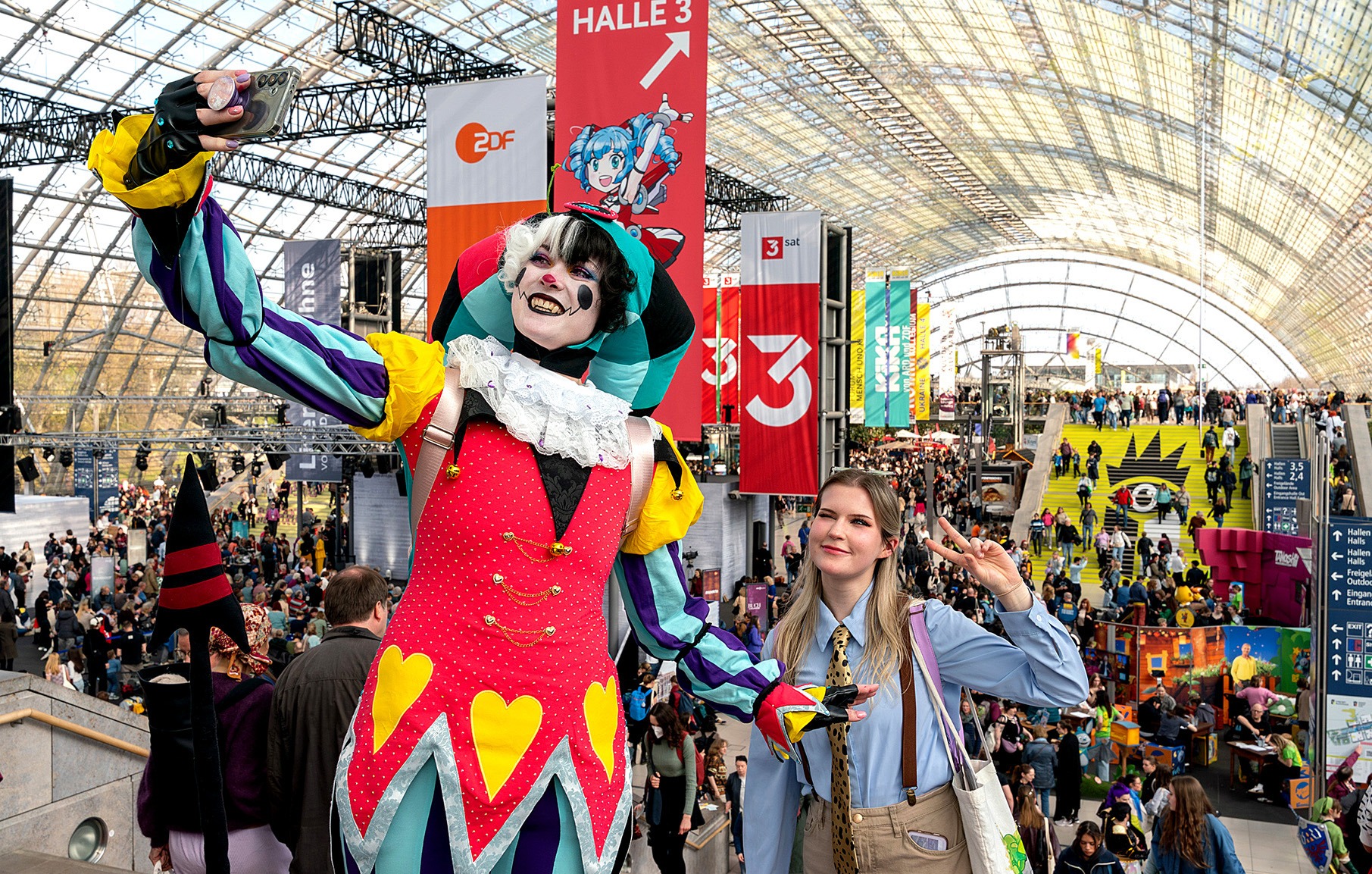
 The Manga Comic Con brought a distinct global energy to the trade fair at Leipzig Messe. (Photo: Leipziger Messe / Tom Schulze)
The Leipzig Book Fair, or Leipziger Buchmesse, is the second largest book fair in Germany. This year, its theme, “Strong Currents and Between Worlds”, centred on the Danube and how this 3,000-km river connects, divides and transcends histories, politics and democratic trajectories across 10 countries from Germany via Serbia, Bulgaria and Moldova to Ukraine.
The “Forum: Global Perspectives” featured a packed programme of author talks and panel discussions, with a similar European lens.
Although dubbed international, this was, at best, pan-European, or perhaps Global North-oriented – not international, never mind truly global.
While the dictionary definition of international refers to something involving or connecting two or more countries, both international and global are generally understood to describe something that goes beyond a set of national borders to encompass interconnectedness of politics, cultures and peoples.
Organisers would point out that 2,044 exhibitors from 54 countries showcased books, related products and services. But pickings were slim beyond Europe.
Chile and the United Arab Emirates were spotted among the book fair stands. Japan, South Korea and China were among the finalists for the “Best Book Design from all over the World” event. The closest the fair seemed to get to Africa, South Africa specifically, was the display of copies of Deon Meyer’s Leo, translated as “Die Stunde des Löwen (The Hour of the Lion)” at his German publisher’s stand.
/file/attachments/orphans/2044exhibitorsfrom54countriesshowcasedbooksrelatedproductsandservices_TomSchulze_244352.jpg "The Leipzig Book Fair featured 2,044 exhibitors from 54 countries showcasing books, related products and services. (Photo: Leipziger Messe / Tom Schulze)")
Stephanie Kitchen, executive director of the African Book Collective (ABC), a nonprofit marketing and distribution collective of more than 150 African publishers, said the most significant German book fair for international trade was the Frankfurt one, while ABC also attended the London Book Fair and smaller events.
“It’s generally relatively rare for African publishers to exhibit at European book fairs for reasons of cost as well as the difficulty in securing visas to travel,” Kitchen added.
The Leipziger Buchmesse has a strong German orientation – the literary festival “Leipzig liest (Leipzig reads)” is its companion event – unlike the Frankfurt book gathering, to which InterKontinental, an NGO promoting literature and writers from Africa that hosts the Africa Book Fair Berlin in late May, has links.
Instead, it’s the Manga Comic Con that brought a distinct global energy to the trade fair at Leipziger Messe, an economic showcase and diplomatic meeting point during the Cold War and in the heady years after the Berlin Wall fell in 1989.
In March 2026, cosplay was in action beyond the Halle 1 (or HALLE:EINS) venue, with attendees dressed as characters from Japanese manga and other fantasy and sci-fi comics walking through the crowds – and stopping to pose for selfies with visitors, but also their own photoshoots. Halle 1 not only sold comics, illustrations and merchandise from lightsabers to masks and plushies (soft toys), but had its own cosplay checkroom and cosplay repair centre.
/file/attachments/orphans/LeipzigBuchmesse2026setarecordattendancewitharound313000visitorsinattendance_TomSchulze_643926.jpg "Leipziger Buchmesse 2026 set a record attendance with about 313,000 visitors. (Photo: Leipziger Messe / Tom Schulze)</p>
<p>")
It’s fun and purposeful, catching the eye of book fair-goers of all ages, even among a book fair and literary festival programme full of riches.
It included panel discussions on current affairs, autocratisation to identity, exhibitions on book covers as propaganda and authors chatting about their books at various stages away from publishers’ stands where readers check the latest offerings.
Specialist talks unfolded on political and cultural aspects of translations, while moderated discussions also included one on flight and arrival featuring two author-actors now living in Germany, Divine Gashugi Umulisa (pen name Tete Loeper), displaced into exile during Rwanda’s 1994 genocide, and Delschad Numan Khorschid, who fled Iraq as a teenager.
Off-Messe events included the Berlin chapter of the international writers’ association PEN hosting French-Algerian writer Boualem Sansal, the 2011 German peace prize winner, following his release from jail in November 2025, and others on security and freedom of expression for writers in Algeria, Iran and Russia.
The queue at young adult romance publisher LYX wound its way along one wall of the exhibition hall, elsewhere lines formed at different tables at different times for authors’ book signings, and the potential remained to be part of a live TV discussion with top authors – if a seat or spot on the floor could be had.
Over four days, the book fair and literary fest hosted about 2,000 events across 300 venues, including a 60-minute tour of the Leipzig library organised by the German National Library.
It is almost too much.
But books are everywhere in Germany. People, including young people, reading books in public are a common sight on S-Bahns in Berlin, and elsewhere.
Controversy, protests and public backlash met Germany’s Federal Government Commissioner for Culture and Media, Wolfram Weimer, after he removed three leftist bookshops – Zur schwankenden Weltkugel (Berlin), Rote Strasse (Göttingen) and Golden Shop (Bremen) – from the list of finalists for the German Bookshop Prize. About 100 bookshops, selected by an independent jury, receive state support through grants ranging from €7,000 to €25,000.
/file/attachments/orphans/WolframWeimerMinisterofStateforCultureandMediaatthelecternduringtheopeningofthe2026LeipzigBookFair_TomSchulze_903446.jpg "Wolfram Weimer, Minister of State for Culture and Media, at the lectern during the opening of the 2026 Leipzig Book Fair. (Photo: Leipziger Messe GmbH / Jens Schlüter)</p>
<p>")
Weimer, a conservative ex-journalist and publisher, was repeatedly booed at the opening ceremony, but maintained in his speech that no state funding would be allowed to end up in the hands of “all extremists equally – right-wing and left-wing, Islamists”.
The three bookstores had been flagged in a secretive procedure that allows intelligence services to investigate NGOs and individuals over security concerns, in a Kafkaesque process where no one except the intelligence services know why, and they won’t say.
The European and International Booksellers Federation (EIBF) has come out in support of the German Booksellers and Publishers Association, condemning this exclusion for its lack of fair process and transparency and the risk to freedom of expression.
“Recognition of a bookshop’s cultural achievements should never depend on the possible political orientation of its product range. Therefore, EIBF urges the federal government commissioner for culture and the media to review his decision and reinstate the prize laureates immediately, or provide clear, verifiable evidence for exclusion.”
For the first time in 10 years, the German Bookshop Prize award ceremony was cancelled.
It’s not what the Leipziger Buchmesse would have liked.
Especially not in a year it set a record attendance; huge demand meant Saturday all-day ticket sales were stopped because capacity had been reached. About 313,000 visitors attended the book fair, literature festival and the Manga Comic Con over its three days from 19 March, German press agency dpa reported on Sunday, quoting organisers.
It’s a coup in these uncertain times of geopolitical conflict.
In a Europe marked by war since Russia’s invasion of Ukraine, the Leipzig Book Fair’s focus on the former Eastern Europe and Balkan states is explicable. But it stretches the imagination to call this global, or in a meaningful sense even international. DM
Comments
Scroll down to load comments...