




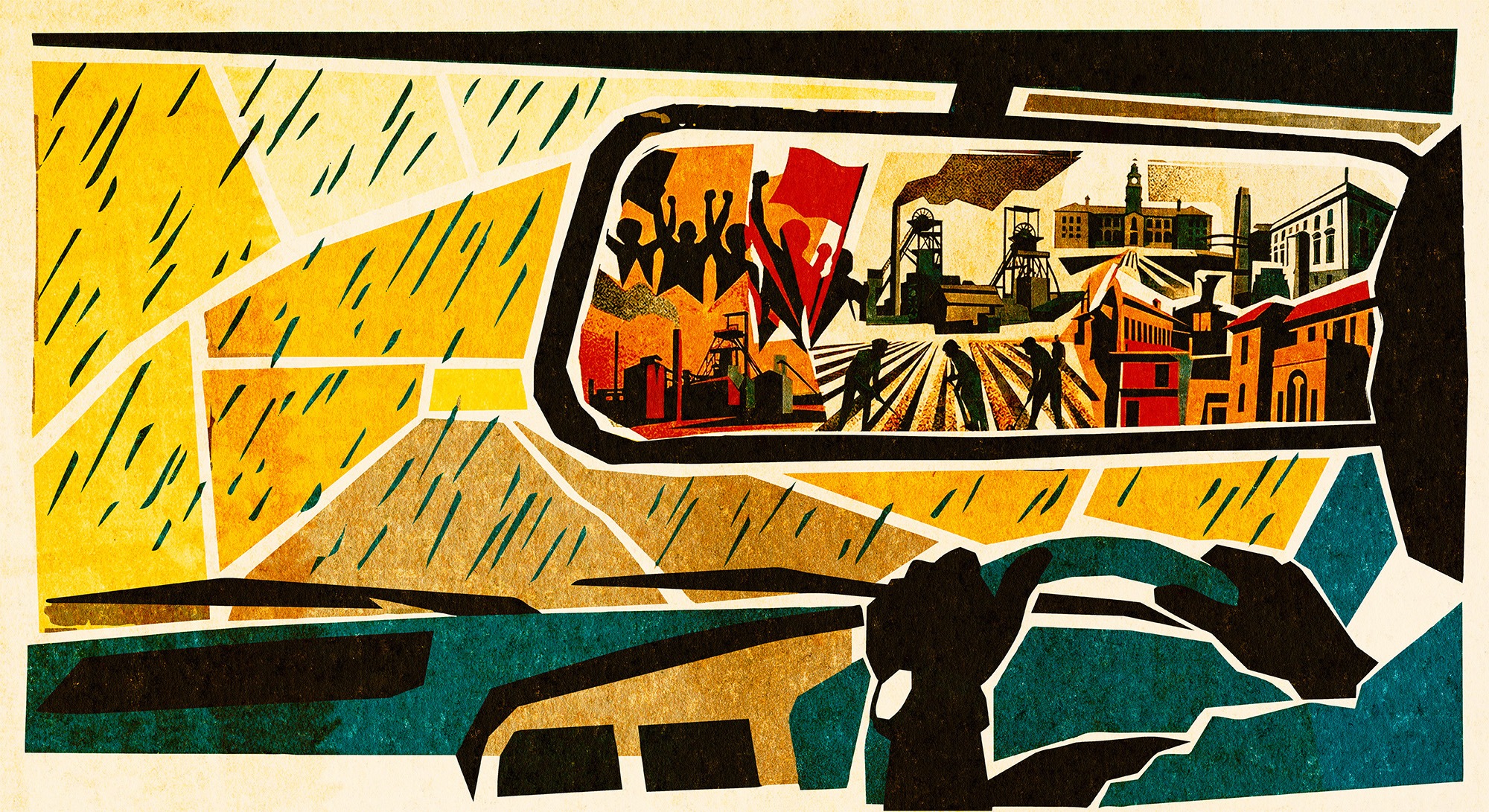
 (Illustrative image: Source generated with Google Gemini Flash Image 2.5.)
 There are times when the question “why won’t our economy grow?” just makes me want to run as far as I can to avoid it.
In some of my moods, often just after our latest data has shown that, once again, our economy is growing too slowly, I’d rather accept a (free) cappuccino than actually have the conversation for the one millionth (and counting) time.
I think one of the reasons the question is much more interesting now is because there is a possibility that things might be about to change.
I don’t just mean the reforms everyone bangs on about. I can’t be certain, but I suspect it is the possibility that the ANC will no longer be determining our economic policy.
You can imagine the argument: the ANC that has made bad choices, BEE is “killing the economy”, that, as News24’s Carol Paton argued convincingly yesterday, our economy is not growing because “it’s the politics, stupid”.
Add to that something we hardly ever think about: when we look at our unemployment figures and our economy, we tend to think about them only in terms of South Africa.
I think we’re missing something fundamental here. All our neighbours have similar unemployment rates, whether you’re in Botswana, Namibia, Mozambique, Lesotho, Zimbabwe or Eswatini.
It’s obviously obvious, because so many people from those countries are here looking for jobs.
And, the argument would go: the one thing these countries have in common, or did until recently, is that they were governed by liberation movements. This has changed slightly in that Botswana has a new(ish) government.
I think another ingredient for the excitement (for some people) is the possibility that BEE might go, it might no longer be government policy.
I have probably told you before that I find it staggering that it is really only people in the ANC who publicly support BEE. And that if the people who have benefited, and stand to benefit from it, don’t rise up and support it publicly, the policy will die with the ANC.
Of course, the ANC hasn’t helped – so many of its leaders have benefited (again and again) from very public deals.
But to blame that alone for our economy, or “just the ANC”, misses the long hand of history.
It has been conclusively shown that the impact of slavery on African societies far outlives the end of slavery. Harvard University’s Nathan Nunn wrote that the procurement of slaves led to “internal warfare, raiding, and kidnapping resulted in subsequent state collapse and ethnic fractionalisation”.
You don’t need to be a historical genius to see that one of the major reasons that the Democratic Republic of Congo is still such an impossible place to govern is because of the most awful legacy of Belgium’s King Leopold, and the way he literally destroyed people, their society and, in the end, their history.
So, if you accept that historical fact, it’s probably short-termist to just blame the ANC or BEE.
Of course, that doesn’t absolve the ANC from making bad choices. I think you’re on very firm ground to argue, as several have recently, that its insistence on conditions for everything, on placing secondary considerations on every economic policy choice, has stopped our development.
And I also understand the imperative to transform our economy. Considering that it’s now more than 30 years of freedom and so many CEOs and boardrooms are still (largely) white men, you can see that business and financial institutions weren’t going to change unless they were forced.
But BEE has also become this sort of symbol of everything many people believe to be wrong with the government’s economic policy.
It might be horrific to consider, but imagine if we removed it and the economy still didn’t grow. What then?
I think one of the problems we have now is that there are so many institutions and people intertwined in our current governance system, that it’s hard to break it all down.
I wish we would be a lot more focused on just one thing – creating jobs.
Currently, mining companies start their statements to the JSE with their safety record. It’s an important sign that human life is more important than profit.
Perhaps companies could be compelled to do the same with how many jobs they created?
But the real change would have to be political. Ministers could be told they have to create jobs or, at the least, the enabling environment for jobs.
A police minister could be made to report once a month on how they have made life safer for businesses and workers. And what they’ve done to reduce the staggering increases in commercial crime that my colleague Rebecca Davis wrote about yesterday.
And surely voters would get behind a promise to treat waste in government, and theft in government, as “stealing from jobs”.
If the government had a focus like that, we would either appoint our best and brightest to the Setas or just abolish them.
But I fear the past is a hard thing to run away from.
As long ago as 2015, more than 11 years ago, I asked in Daily Maverick whether we spend too much time on the past and not enough on the future.
It was inspired by a comment by the economist Dr Martyn Davies at The Gathering that year when he said we spend too much time watching the rear-view mirror, and not enough looking through the windshield.
We can’t forget, or avoid, or run away from our past.
But if we want our past to really be another country, we need to focus on creating jobs and growing the economy, and on the future. DM