



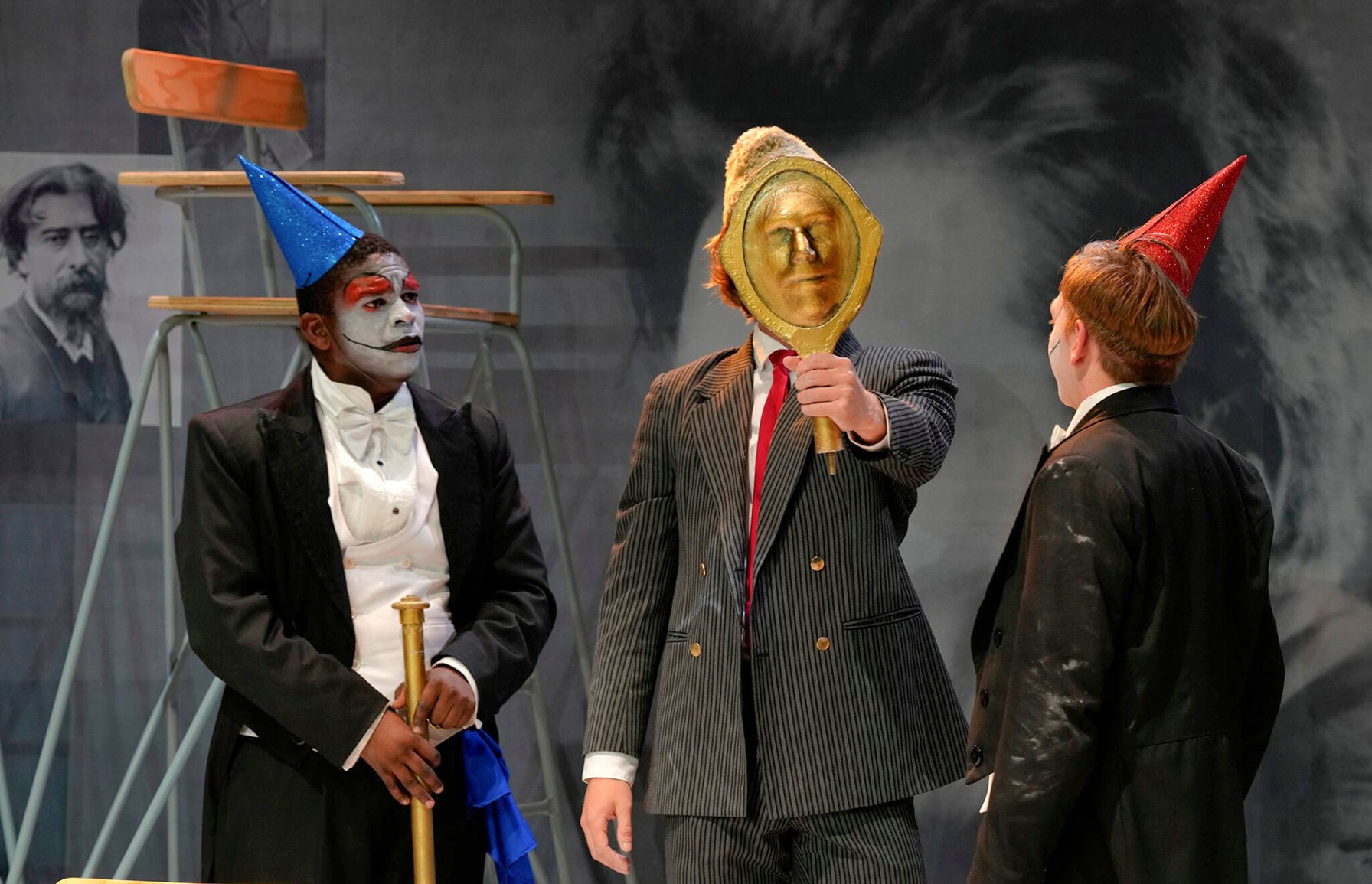
 Boklied, directed by Marthinus Basson, was written by Breyten Breytenbach and is returning to the KKNK, where it was first performed in 1998. (Photo: Nardus Engelbrecht)
 It was the pandemic and its aftermath that made Hugo Theart realise that festivals such as the annual celebration of the arts in Oudtshoorn, which he oversees, are a privilege.
Theart, who is CEO of the Klein Karoo Nasionale Kunstefees (KKNK), says it’s worth bearing the devastation of Covid in mind, because it taught us that such privileges are “fragile” and “can disappear in a heartbeat”.
“That’s why, while we have it, we celebrate it with everything we’ve got,” he says.
For anyone looking to pack up the family, lock up the house (and pray it’s there when they return), drive to the middle of the Klein Karoo, fork out on accommodation, buy theatre tickets and feed themselves for the duration, it’s a moerse privilege.
It comes down to how and where you choose to spend your hard-earned cash. Certainly, hitting this year’s 30th iteration of the festival will prove a great deal more affordable than trying to watch Bafana Bafana in North America in June – that’s if you can get through the red tape required to endure Trump’s marathon immigration queues. For anyone interested in getting a measure of our nation’s cultural pulse, KKNK is also a chance to spend time in one of the most beauteous parts of the country – and to directly support the arts sector.
Vital part of arts ecosystem
Festivals such as KKNK, Theart says, “are a vital part of the ecosystem that keeps the arts alive in South Africa”. Each year they enable numerous artists and theatre technicians to breathe a little easier, help them to keep the lights on and food on the table.
These are sentiments expressed by numerous actors, many of whom have cut their teeth in the trenches at festivals such as KKNK. Many consider it their lifeblood, an opportunity to reach a wider, more heterogenous audience.
The festival environment can be taxing, too, with fewer facilities and technical resources than in big city theatres – that, too, can be both liberating and strengthening. Festivals build resilience, provide young artists especially with the kind of stamina to endure what a notoriously tough industry has in store for them.
And they can be eye-opening for perceptive audiences who might start to see patterns, recurring themes, perhaps reach a deeper understanding of what’s biting at their fellow South Africans. The festival is, in many ways, a mirror reflecting the zeitgeist, echoing voices from our collective soul.
/file/attachments/orphans/BoklieddirectedbyMarthinusBassonwaswrittenbyBreytenBreytenbachandisreturningtothefestivalwhereitwasfirstperformedinthe1990s_NardusEngelbrecht3_627442.jpg "The KKNK festival marks its 30th anniversary with the return of Breyten Breytenbach’s ‘unstageable’ play Boklied, which debuted at the festival in the 1990s. (Photo: Nardus Engelbrecht)")
/file/attachments/orphans/StarringAlbertPretoriusandSchalkJoubertEkisnieDanieisastageadaptationofvariousworksfromfourpoetrycollectionsbyDanieMarais_NardusEngelbrecht_369756.jpg "Starring Albert Pretorius and Schalk Joubert, Ek is nie Danie is a stage adaptation of various works from four poetry collections by Danie Marais. (Photo: Nardus Engelbrecht)")
More than 89,000 visitors attended KKNK in 2025 (a guesstimate based on what can be verified through ticketed events), all of whom in some way helped boost Oudtshoorn’s small-town economy.
Apart from the weeklong accommodation boom and exposure for local businesses, the festival creates a large number of temporary jobs that would otherwise not exist at all. They range from front-of-house personnel to restaurants requiring extra staff for the week.
While Theart says its full impact is ultimately unquantifiable, the festival has an estimated direct economic impact in Oudtshoorn of between R72-million and R89-million, and up to R178-million across the Western Cape.
While good ticket sales and high attendance figures keep the beancounters happy, what’s perhaps more important for the soul of the festival is the mood swing it facilitates. Numbers aside, Theart says there’s real joy in watching the small town of Oudtshoorn “transform – almost overnight – into this vibrant melting pot of creativity, conversation and celebration”.
“You feel the energy shift,” he says. “You see strangers striking up conversations. You watch artists and audiences inspire each other. You witness the town breathe differently for a week.”
Theart uses the festival’s bounce-back following the pandemic’s two-year enforced abeyance as a measure of the high regard in which its held – among artists, audiences and loyal sponsors.
“We’ve worked really strategically to rebuild, and it’s paid off,” he says. “We’ve seen steady year-on-year growth, and over the past three festivals, audience attendance has grown significantly.”
This year represents a major milestone for KKNK. “It’s a proper anniversary celebration and expectations are definitely high. There’s a lot of nostalgia in the air, and I think many people who haven’t been back in years are making their return for this milestone edition.”
Whether you’re a loyal regular or a first-time attendee, you will find plenty to satisfy whatever kind of itch you might have. Puzzling out what to include on the programme is about striving for balance, Theart says.
“Balance between genres and disciplines. Balance between niche and commercial. Balance for different age groups. Balance between newcomers and well-established artists. Experimental work versus mainstream crowdpleasers. Our motto really is: there must be something for everyone.”
Full-circle moment
Afrikaans literary heavyweight Breyten Breytenbach, who died at the end of 2024, is a big anchor in the programme. His famously “unstageable” play, Boklied, is one of the most controversial and influential productions ever staged at the festival. Since debuting there in 1998, Theart says, “it has shaped the KKNK’s reputation for bold, high-calibre and relevant theatre”.
“Bringing it back felt like a natural, nostalgic choice, and the revived production has already collected awards since opening [at Woordfees] last year,” he says.
/file/attachments/orphans/BoklieddirectedbyMarthinusBassonwaswrittenbyBreytenBreytenbachandisreturningtothefestivalwhereitwasfirstperformedinthe1990s_NardusEngelbrecht2_878066.jpg "Boklied, written by Breyten Breytenbach, is one of the most controversial and influential productions ever staged at the festival. It debuted there in 1998. (Photo: Nardus Engelbrecht)")
/file/attachments/orphans/VerwelkingsliedthefinalplaywrittenbyBreytenBreytenbachisdirectedbyMariBorstlapandstarstwoofSouthAfricasgreatestactingtalents_GysLoubser_618275.jpg "Verwelkingslied, the final play written by Breyten Breytenbach, is directed by Marí Borstlap and stars two of South Africa’s greatest acting talents — Dawid Minnaar and Antoinette Kellermann. (Photo: Gys Loubser)")
“We’re also presenting Breytenbach’s final play, Verwelkingslied, with Dawid Minnaar and Antoinette Kellermann, both of whom were in the original Boklied. It feels like bringing full circle the bookends of Breytenbach’s contribution to theatre.”
Marthinus Basson, who directed both the original Boklied (at a time when its full-frontal male nudity and uncensored language caused walk-outs and generated buzz for the wrong reasons) and the new version (which is by no means tamer than the original), is also at the helm of a new adaptation of Flemish playwright Tom Lanoye’s 2008 play, Atropa: Die wraak van vrede (Atropa: The Revenge of Peace).
“Atropa has, sadly, since we finalised the programme, become even more relevant in ways we never predicted,” says Theart. The play, which features a stellar multigenerational cast (including Kellermann and Anna-Mart van der Merwe), transports us back to the time of the ancients, but uses that context to interpolate modernity. It has, for example, Agamemnon speaking words used by George Bush Junior and Donald Rumsfeld during the invasion of Iraq, so be prepared for some potentially devastating parallels with our present global crises.
Festival-goers should strap in tight, though – there are some 112 scheduled productions, without accounting for everything happening outside the dedicated theatre spaces. Never mind the reality that plenty of people who pour in do so for the gees, the jol and the free entertainment. There is indeed “something for everyone”, including big open-air evening concerts, literary and sociopolitical discussions, theatre talks, food events and “Klein Karoo experiences”, which run from stargazing and olive farm tours to breakfast with elephants at a game reserve outside town.
For the theatre-curious, there’s “Blitsteater” (“lightning-quick theatre”), a line-up of 20-minute experimental shows performed in little tents. Blitsteater artists receive a small grant and complete creative freedom, Theart says. “It’s a space for risk-taking, and audiences who might normally stick to the familiar often wander in and discover something surprising. That’s how we grow curiosity and hopefully build the next generation of theatregoers.”
Theart understands only too well what he’s up against in the battle to build and sustain audiences. “The arts industry is really struggling – every single day feels like some sort of battle. I suppose it’s better to fight from the inside than from the outside. At least from the inside, you can do something; try to contribute to a better system.”
He says the festival serves multiple functions beyond simply curating multiple shows and experiences. It makes the creation of new work possible, sustains artists and helps ensure that productions and projects that have been envisioned actually come to life.
“Surviving feels like a triumph,” Theart says. “We’ve consistently been able to balance the books, grow our audiences and create work – not only for people in the arts industry, but also for so many individuals in the Oudtshoorn community.”
Community at the heart of Karoo Kaarte
This last aspect – community – is at the heart of one of KKNK’s proudest achievements, says Theart. It’s a project entitled Karoo Kaarte, which turns five this year.
/file/attachments/orphans/AmuralcreatedaspartofKarooKaartein2024_RyanDammert_928666.jpg "A mural created as part of Karoo Kaarte in 2024. (Photo: Ryan Dammert)")
/file/attachments/orphans/DieSwartmerrieisfromapreviousiterationofKarooKaarte_HansvanderVeen_843776.jpg "Die Swartmerrie is from a previous iteration of Karoo Kaarte. (Photo: Hans van der Veen)")
“Too many ‘community projects’ are just box-ticking exercises,” Theart says. “They’re not rooted in the community, and they disappear as quickly as they start. Karoo Kaarte was born during the pandemic, in conversations with Vaughn Sadie and Neil Coppen. The idea was to focus on the untold and living history of the town.
“Over five years, it’s grown into this extraordinary archive of stories — personal histories, overlooked narratives, community memory. Every year it produces a theatre production, a visual arts exhibition, a zine, sometimes a comic book, and even an interactive app with stories linked to locations around the town. Season after season, the work becomes more enriched. Most importantly, the participants are all from Oudtshoorn. Professionals come in when needed, but the heart and soul of the work belong to the community itself.”
Similarly heartening is the Youth Arts Festival, established in conjunction with the Western Cape’s Education Department; it enables 1,000 learners from across the province to attend what might be their first-ever exposure to the performing arts.
Theart says that even with so much happening during the festival, the real privilege it affords is something intangible: the opportunity to have your soul touched.
“It’s those moments when you’re standing next to someone you’ve never met, laughing at the same joke, crying at the same moment in a play, dancing to the same beat, and being reminded of how unique this country is in every possible way.”
Whether it’s from a chance glimpse of a street performance, or because you stumbled into a show that, unexpectedly and without warning, “shifts you”, it’s in those moments that “the world expands, something clicks, and reality suddenly feels bigger, stranger, more possible”.
“Even if just a little, even if only for a moment, something changes.” DM
The KKNK happens in Oudtshoorn from 28 March to 4 April 2026. Find out more about the programme on the KKNK website.