




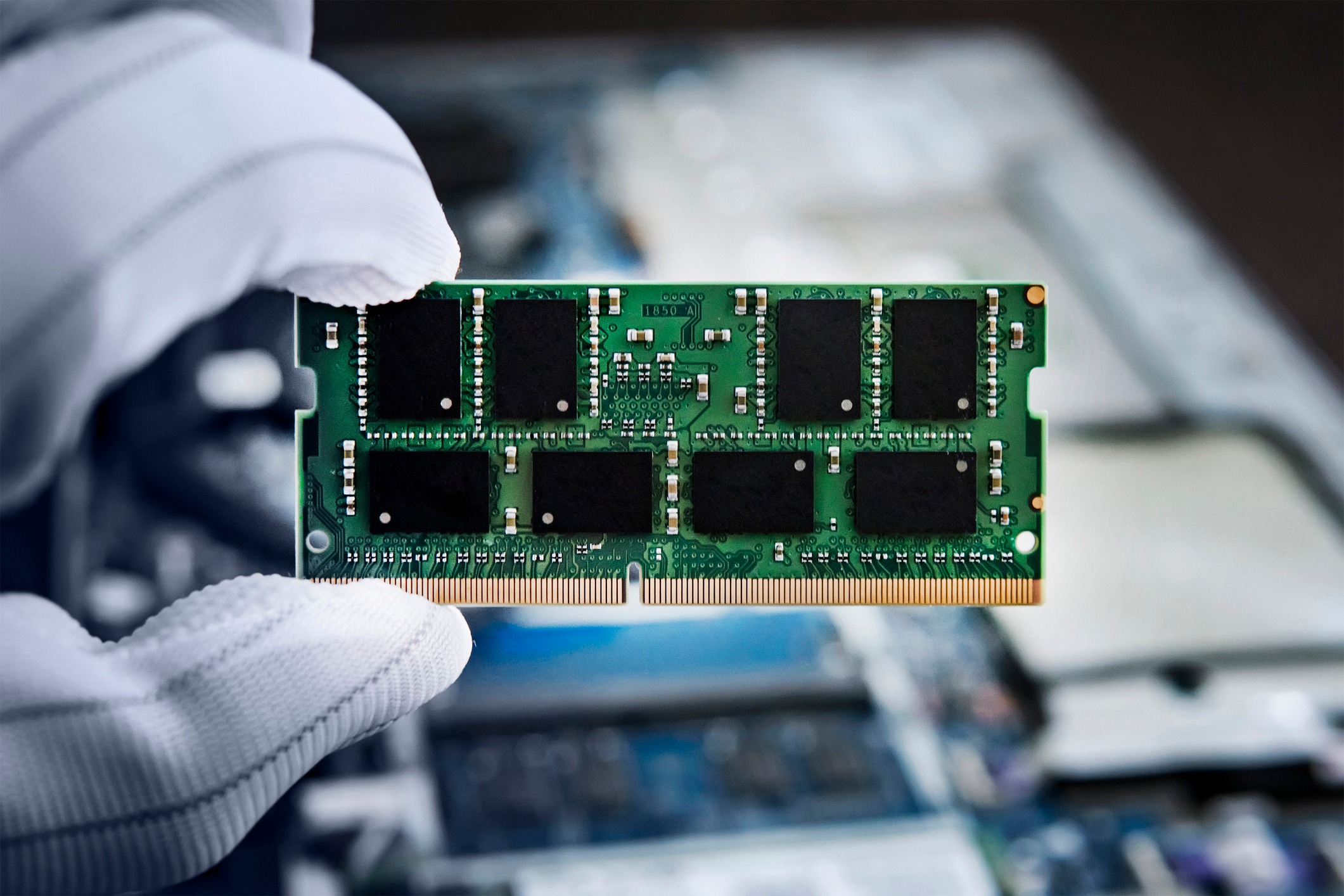
 South Africa can't hide from random access memory price surge. (Photo: iStock)
The ides of March continue with the strikes of Qatar’s gas production infrastructure having an unintended consequence of eliminating from the market about a third of the helium in the global supply chain.
While local space rock miners Renergen (now under the stewardship of ASP Isotopes – but still yet to make good on a helium delivery from the Vredefort dome) say they’re four months ahead of schedule in phase one of the Virginia Project, it is still a smidgen of what is needed for full-speed microprocessor production.
Technology is getting expensive for reasons outside the control of us mere consumers. “We’ve just experienced 102% price increase quarter on quarter in the component price of memory plus SSD,” Werner Joubert, country head for Asus South Africa, explained to Daily Maverick.
His philosophical Apple counterpart in our market, iStore CEO Chris Dodd, had fewer hard numbers to share in a similar interview, but did say that “margins are super tight across all hardware retail”.
Hurry up and buy
The two business leaders are fresh off the launch parade for the respective Asus ExpertBook Ultra (R60,000 recommended retail price) and MacBook Neo (R12,000 for the base configuration), which both reached SA shores this month.
Those are polar opposite ends of the laptop market, with the PC targeting the enterprise C-suite, a business that Asus only started in 2021 locally. MacBook Neo, however, is aimed squarely at the broader consumer market that the Cupertino brand had no real business case for in the past.
But both face an enormous task of eating as much profit margin as possible to keep the price relatively accessible for cash-strapped customers.
Joubert warned, however, that a further 35% component price increase is expected in the following quarter. He clarified that while components doubled, the average price of a full laptop device will increase by roughly 40%.
South Africa has been temporarily shielded from these new prices due to existing inventory, but that grace period is ending and “the high prices will start hitting the local retail market in May and June”.
For online retailer Evetech, which plays in both the component and full system ponds, the advice is quite clear:
“If you can afford to buy, buy now. Prices are still climbing and we won’t be able to hold current pricing for much longer as our older stock sells through and we replenish at today’s rates.”
Zooming out
If you look at the full picture, it’s easy to see how computing hardware was shaping to jump the proverbial shark. But, as Joubert expanded, unfortunately this isn’t a temporary blip; it is a “structural” issue that “is not going to come down anytime soon”.
The global race for artificial intelligence supremacy has caused tech behemoths like Microsoft, Meta and Google to effectively vacuum up advanced logic and memory chip production.
Global memory manufacturing is essentially an oligopoly controlled by three players: Micron, SK Hynix and Samsung. They have pivoted finite manufacturing capacity away from consumer electronics toward highly lucrative High-Bandwidth Memory (HBM) and enterprise DDR5 to feed the AI beast. Expanding these facilities takes four to five years and billions of dollars of investment, meaning supply can’t just be switched on overnight to meet the relentless demand driven by continuous investments from the likes of Nvidia.
Add to this the compounding nightmare of that helium shortage. Because ultra-pure helium has no chemical substitute for cooling silicon wafers during extreme-heat fabrication, fabs are being forced to slow production. This drastically raises defect rates and slashes yields, baking much higher manufacturing costs into the next generation of CPUs and GPUs.
The entry-level collapse
For CIOs, this data dictates an immediate pivot: businesses are going to have to hold on to their existing devices much longer and fundamentally extend their hardware refresh cycles.
But for the broader South African consumer, the reality is far more dire. Joubert said 52% of the local consumer base relies on entry-level Celeron devices, typically priced between R3,999 and R4,999.
If these essential machines jump to R8,999, demand will collapse because that demographic simply cannot afford the hike. This effectively threatens the affordability of basic tech for students and small businesses.
To prevent the entry-level market from being wiped out overnight, some vendors are taking a deliberate financial hit, actively absorbing as much of the cost as possible to implement gradual price increases.
Asus can sustain this financial hit and subsidise consumer laptops only because its AI server division is currently “so bloody successful,” Joubert revealed. Apple used iPhone hardware and cut quality of life features like a backlit keyboard to trim down the price of the Neo to give PC vendors nightmares.
Hard numbers to swallow
What does this mean for the local market? Evetech shared figures with Daily Maverick detailing the price hikes since the fourth quarter of 2025.
DDR5 RAM: Prices have skyrocketed between 190% and 250%, depending on capacity and speed. A 32GB DDR5 kit that cost roughly R2,000 in mid-2025 is now pushing between R7,000 and R8,500.
DDR4 RAM: Counterintuitively, legacy memory has spiked by 100% to 130% because manufacturers have simply stopped producing it to focus on AI memory.
SSDs: Solid-state drives are up 70% to 95%, with higher-capacity drives taking the hardest hit.
GPUs: Graphics cards have seen a 15% to 25% bump, with warnings of further increases rolling through as GDDR memory costs catch up.
A good defence
Retailers are also deploying defensive strategies. Evetech relies on significant stock depth, carrying inventory purchased at earlier, lower prices to create a buffer before the full market prices hit the shelves. They are also actively guiding customers toward better value options, such as recommending DDR4 platforms instead of DDR5, or right-sizing specifications to actual needs rather than overselling.
Similarly, Dodd emphasised that iStore is avoiding what he calls a “marketing ploy” of operating at a loss just for customer acquisition. Instead, they justify the Neo’s price point by focusing on “the bigger picture and the more sustainable picture” (iStore shorthand for bundling the device with free technical support and lifetime setup through their in-house iCare programme, which competing retailers do not offer free).
In a crazy twist, modders are responding to the crisis by physically desoldering memory chips from decommissioned datacentre servers and broken laptops, reballing them, and slapping them on to new desktop PCBs. While this offers cheaper new RAM, it introduces massive risks of thermal degradation and sudden hardware failure.
The bottom line remains brutal: nobody can fully insulate you from a global supply crunch of this scale. If you have the budget, buy now. Tomorrow is already more expensive. DM
Comments
Scroll down to load comments...