




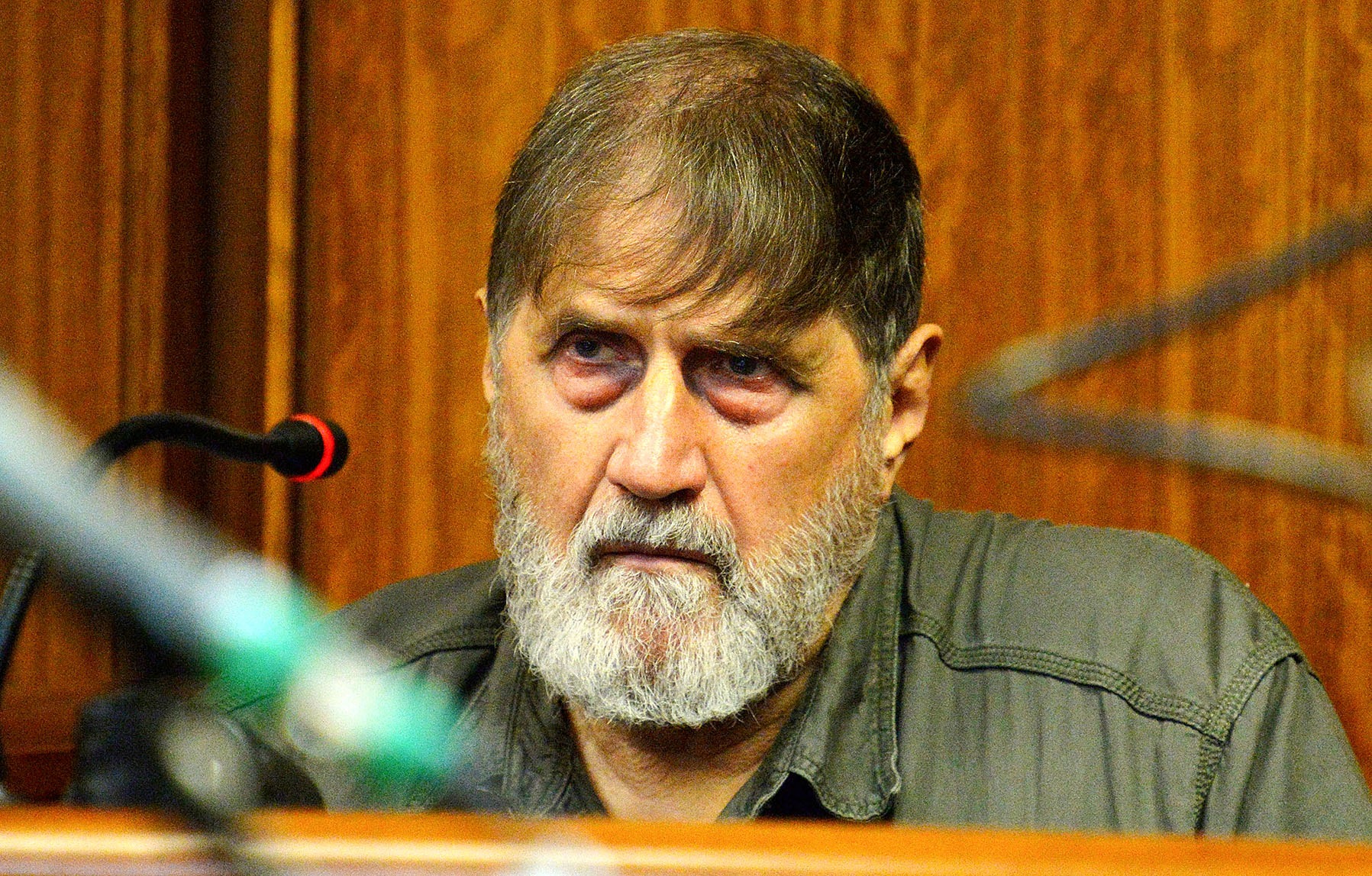
 Former Vlakplaas commander Eugene de Kock testifies in the Gqeberha high court on Monday, in the third inquest into the murders of the Cradock Four. While he admitted to hunting terrorists for the Security Police under the apartheid government, he denied any involvement in the plot to murder the Cradock Four. (Photo: Deon Ferreira)
 “Let’s get the truth out. Let’s sit down and talk the truth,” Eugene de Kock said in a somewhat heated exchange at the Eastern Cape Division of the High Court in Gqeberha on Monday.
The former commander of the apartheid-era police counterinsurgency unit at Vlakplaas shared candid insights and opinions on certain operations he was involved in, as well as the chain of command that he claims went all the way to the erstwhile presidency.
/file/attachments/orphans/DSC_3895copy_731580.jpg "Eugene de Kock testifies on 23 March 2026. (Photo: Deon Ferreira)")
/file/attachments/orphans/DSC_3917copy_789604.jpg "Eugene de Kock in court this week. (Photo: Deon Ferreira)")
However, he denied any involvement in the planning and execution of the murder of the political activists known as the Cradock Four, and claimed he became “an accessory after the fact” when members of the police Security Branch tried to cover up the murders.
On 27 June 1985, Matthew Goniwe, Fort Calata, Sicelo Mhlauli and Sparrow Mkonto were returning to Nxuba (formerly Cradock) from Gqeberha, but never made it home. It later came to light that they were abducted by members of the Security Branch at a roadblock along the N10 and subsequently assaulted and murdered.
Two inquests have been conducted. The first, in 1987, concluded the men had been killed by “unknown persons”, and the second, in 1993, presided over by former Eastern Cape Judge President Neville Zietsman, found that the police were responsible for their deaths.
Neither inquest resulted in any prosecutions. When the present inquest began in July 2025, advocate Tembeka Ngcukaitobi SC, representing the families and the Cradock community, said they sought closure, healing and reparations.
Vlakplaas background
Arriving at court under heavy police guard for his much-anticipated testimony in the third inquest, De Kock provided details on the formation of Vlakplaas, its intended purpose and some of the operations the unit conducted.
De Kock was given the moniker “Prime Evil” for his well-documented role in the execution of several operations to eliminate key political figures viewed as a threat to the apartheid regime.
His testimony in the current proceedings was delayed due to ill health.
/file/attachments/orphans/DSC_3954acopy_691464.jpg "Arriving at the Gqeberha High Court under heavy police guard, ‘Prime Evil’ Eugene de Kock (centre) gave his much-anticipated testimony in the third inquest into the deaths of the Cradock Four. (Photo: Deon Ferreira)")
/file/attachments/orphans/DSC_3923copy_871991.jpg "Eugene de Kock arrives with his legal team. (Photo: Deon Ferreira)")
During court proceedings on Monday, legal counsel for other parties involved in the inquest questioned the relevance of the testimony, seemingly trying to limit De Kock’s evidence. The 77-year-old became visibly agitated, and told legal representatives that he was there to “tell the truth”, whether they liked it or not.
He explained that Vlakplaas had been established as the command centre for anti-terrorism and counter-terrorism operations. They were mandated to arrest those identified as terrorists and were authorised to kill them should they fight back during their arrest.
“We had to track down ANC and PAC terrorists. Today, they are called freedom fighters. I have no problem with that,” De Kock said.
He said a terrorist was defined as any person who acted against state structures, and their operations were non-racial and non-religious.
/file/attachments/orphans/ED_0006976_609433.jpg "Former Vlakplaas commander Eugene de Kock at his TRC amnesty hearing in Pretoria, 1998. (Photo: Gallo Images / Oryx Media Archive)</p>
<p>")
/file/dailymaverick/wp-content/uploads/2025/06/DSC_2729-copy.jpg "Members of the legal teams and Judge Thami Beshe leave the beach where the Cradock Four’s remains were found. (Photo: Deon Ferreira)")
When asked if any of the Cradock Four were ever on the Vlakplaas radar as possible terrorists, De Kock said, “No.”
“Not a single one. They were considered activists. Activists were seen as civilians, and that did not concern me.”
He said some individuals or organisations may have considered Goniwe and the others as “politically significant”, but he did not.
“Had he planted any [explosive devices] I would have been on him like a rash,” De Kock said.
‘We would have killed AWB members’
Questioned on the matter of non-racialism, his own legal representative, advocate Juan Schoeman, asked if De Kock’s unit would have acted against members of the Afrikaanse Weerstandbeweging (AWB) if they had been identified as terrorists.
De Kock said if needed, they would have arrested the AWB members, or killed them if they resisted. They would also have “cut the head off the snake”, stating that an operation would have been conducted to eliminate the late Eugene Terre’Blanche.
/file/dailymaverick/wp-content/uploads/15.-Eugene-TerreBlanche-Ventersdorp-Town-Hall-South-Africa-2009-1.jpg "Afrikaner Weerstandbeweging leader Eugene Terre’Blanche in Ventersdorp Town Hall, 2009 (Photo: Supplied)")
“Personally, I would have planted a landmine under his vehicle,” a deadpan De Kock said.
When questioned about the infamous signal that was sent to Security Branch operatives, giving the orders to “permanently remove from society” the Cradock Four, De Kock denied having any knowledge about it.
He did, however, confirm that it was common practice for the Security Branch to use euphemisms in their communication, stating that “eliminate” or “remove’” in the context of the Cradock Four, could only have meant they needed to be killed.
“There is no other conclusion. You can play with words all you like,” De Kock said.
/file/attachments/orphans/000078281_383924.jpg "Former police colonel and apartheid arch-assassin Eugene de Kock on 6 June, 2000. (Photo: Media 24 / Gallo Images)")
/file/dailymaverick/wp-content/uploads/2025/06/DSC_0715-copy.jpg "Nombuyiselo Mhlauli is supported by National Prosecuting Authority advocate Jannie Coltman at the Bluewater Bay beach, where her husband Sicelo’s body was found in 1985. (Photo: Deon Ferreira)")
/file/dailymaverick/wp-content/uploads/2025/06/Cradock-four.jpg "The Cradock Four. (Photo: Supplied)")
/file/dailymaverick/wp-content/uploads/2024/09/Cradock-Four06.jpg "Cradock Four family members, Nombuyiselo Mhlauli, Nomonde Calata, Tumani Calata and Lonwabo Mkonto attend the inquest into the Cradock Four murders. (Photo: Deon Ferreira)")
He said he became implicated in the Cradock Four case only when Johan Martin “Sakkie” van Zyl of the Security Branch contacted him to help tamper with evidence.
During his amnesty hearing at the Truth and Reconciliation Commission (TRC), Van Zyl admitted to playing an active role in the abduction and interrogation of the four activists.
Eight former police and Defence Force officials applied to the TRC for amnesty for their roles in the Cradock Four killings:
- The “masterminds”: Hermanus Barend du Plessis, Nicolaas Jacobus Janse van Rensburg and Harold Snyman.
- Three of the killers on the scene: Van Zyl, Eric Alexander Taylor and Gerhardus Johannes Lotz.
- Two others who played peripheral roles: Jacob Jan Hendrick (Jaap) van Jaarsveld and Eugene de Kock.
All but Van Jaarsveld and De Kock were denied amnesty in 1999, yet no further legal steps were taken.
De Kock testified that Van Zyl contacted him to ask if he could assist in altering the ballistic characteristics of a firearm used in the operation. He claimed that Van Zyl said Goniwe resisted arrest, and during the struggle, a gunshot went off and the bullet went through the roof of their vehicle.
/file/dailymaverick/wp-content/uploads/2021/05/08-Mathew-Goniwe-1.jpg "Matthew Goniwe, one of the Cradock Four murdered in 1985. (Photo: Supplied)")
At that stage, the police’s national murder and robbery unit had instructed that the incident be investigated, and Van Zyl wanted to cover up any information that could link the Security Branch to the murders.
De Kock told Van Zyl that he had no one he trusted to alter the ballistic evidence.
Subsequently, Van Zyl asked if De Kock could not source a similar firearm that could not be traced back to their operation. De Kock advised Van Zyl to “throw the gun into the sea”.
De Kock was still on the stand when the matter was postponed until Tuesday. DM