




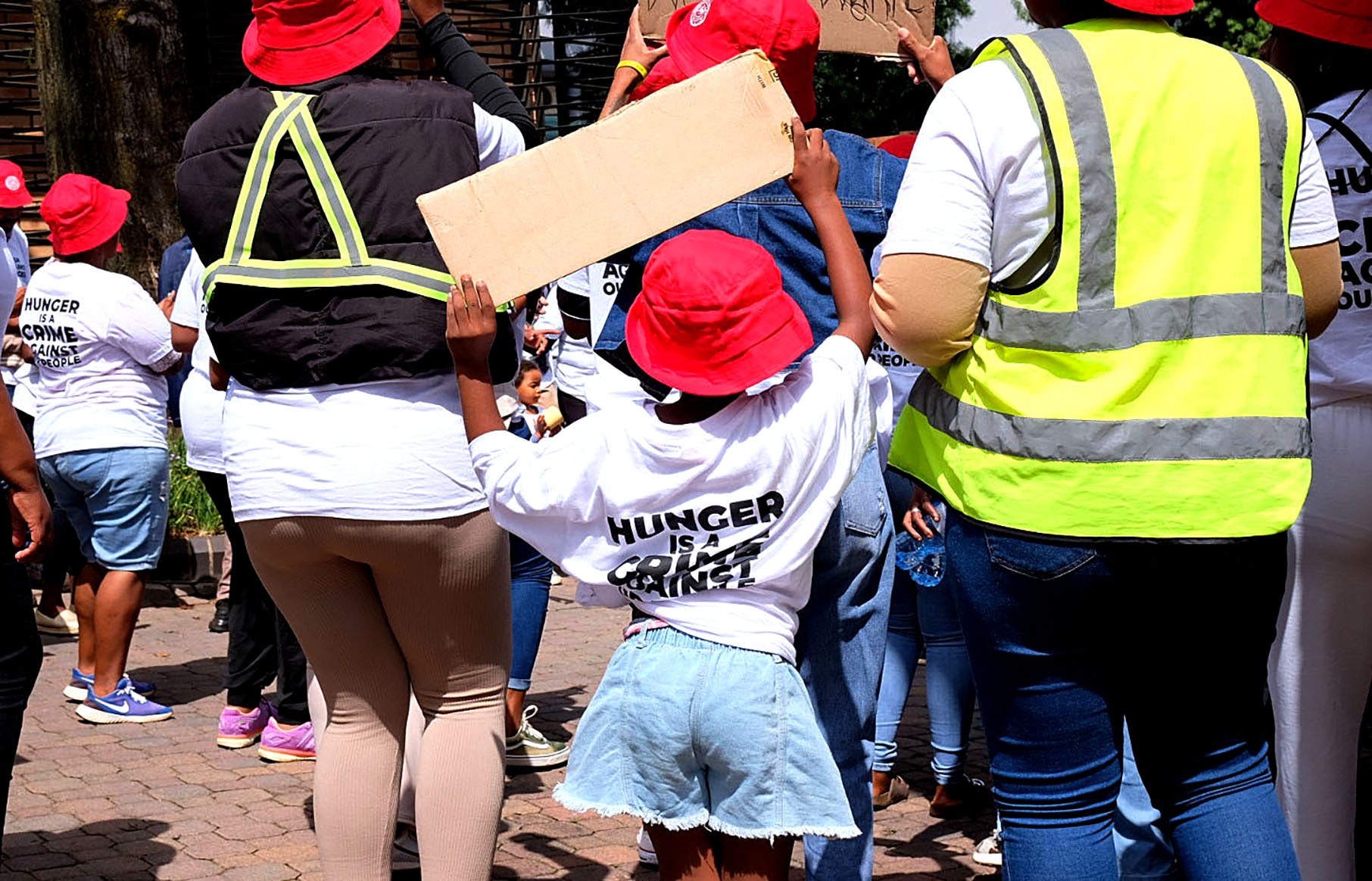
 A child attends the demonstration held by the Union Against Hunger, outside the South African Human Rights Commission’s National Inquiry into Food Systems on 20 March 2026. (Photo: Daniélle Schaafsma)
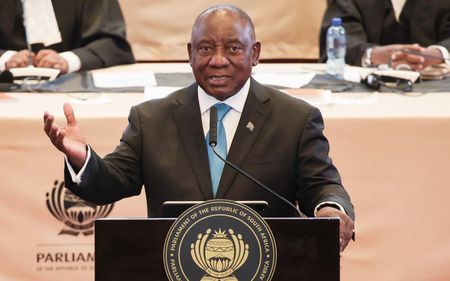
 When President Cyril Ramaphosa committed South Africa to ending child stunting by 2030, it was welcomed by civil society partners across the children’s sector as a significant political moment. Almost six weeks later, on the final day of the South African Human Rights Commission’s (SAHRC) National Inquiry into Food Systems, researchers, legal advocates and child health specialists unpacked what meeting that target would require.
The inquiry ran over seven days, hearing from statisticians, farm workers, domestic workers, informal traders, small-scale fishers, government ministers and traditional leaders. Its purpose was to examine South Africa’s food system in its entirety. But stunting – the impaired growth and development of children due to poor nutrition – emerged as a consistent thread throughout the week.
The sense of urgency around the inquiry extended beyond the hearing room. On the final day, more than 100 members of the Union Against Hunger gathered in a demonstration of support for the proceedings, calling for concrete action on hunger in South Africa.
/file/attachments/orphans/4_165037.jpg "More than 100 Union Against Hunger members demonstrate outside the South African Human Rights Commission’s National Inquiry into Food Systems on 20 March, in a show of support for the seven-day event. (Photo: Daniélle Schaafsma)")
What the numbers show
The picture painted for commissioners at the inquiry was concerning. Statistics South Africa (Stats SA) set the scene on day one. Nationally, roughly 19.7% of households were food insecure in 2023, up from 15.8% in 2019, according to Solly Molayi, acting deputy director-general of population and social statistics at Stats SA.
Broken down, the figures reveal that black African and coloured households, female-headed households, households without employed members and those in rural and farming communities were consistently the most food insecure in every year measured, he said.
On day two, Professor Julian May from the DSI-NRF Centre of Excellence in Food Security described child stunting as “a constitutional concern, perhaps even a constitutional crisis”. He said stunting reflects chronic undernutrition in the first 1,000 days of life and that its consequences – impaired cognitive development, reduced educational attainment, lower lifetime earnings and higher disease risk – are lifelong and that it had “remained at the same level for over 30 years”.
According to Professor Stephen Devereux, an independent evidence leader of the inquiry, the most recent statistic we have is the National Food and Nutrition Survey conducted in 2024, which found that child stunting had risen to 28.8%.
The inquiry also heard that South Africa had been unable to update its stunting figures consistently enough to report current data to the United Nations Sustainable Development Goals (SDG) monitoring framework. The most recent stunting figure available in South Africa’s 2023 SDG country report was from 2016, according to Molayi.
/file/attachments/orphans/1_577001.jpg "Members of the Maternal Support Grant Advocacy Coalition deliver their oral submission to the commission on 18 March. From left: Professor Simone Honikman, director of the Perinatal Mental Health Project at the University of Cape Town, Dr Edzani Mphaphuli, executive director of the Grow Great Campaign, and Tshepo Mantjé, senior ECD coordinator at the Equality Collective. (Photo: Given Makhuvele / Wysani Baloyi)<br>")
The gap before birth
The Maternal Support Grant Advocacy Coalition, which appeared on 18 March, day five of the inquiry, made the case that addressing stunting requires intervention before a child is born. The coalition proposed a nine-month grant for pregnant women from the second trimester, arguing that maternal nutrition during pregnancy is directly linked to low birth weight and stunting outcomes.
The coalition presented evidence showing that a grant at the value of the Child Support Grant, at 80% uptake, would cost about R2-billion a year, while generating an estimated R13.8-billion in avoided health costs annually through reductions in low birth weight and neonatal intensive care admissions
According to the coalition’s representatives, the Department of Social Development commissioned a feasibility study on a Maternal Support Grant in 2012. The coalition noted that a Cabinet subcommittee reviewed the proposal in November 2024 and indicated it was not yet ready for implementation
The coalition also highlighted a specific gap in the current system. Maternity protections in South Africa, through the Unemployment Insurance Fund, only reach workers classified as employees. Women in the informal economy, seasonal workers and the self-employed are left without access to maternity benefits.
Reaching the youngest children
On 20 March, the final day of the inquiry, the Children’s Institute at UCT drew the commission’s attention to what it described as a double burden of child malnutrition. Alongside stunting, which affects roughly one in four young children, South Africa is also experiencing a rise in childhood overweight and obesity, conditions that are connected rather than opposed, said researcher Lori Lake.
/file/attachments/orphans/2_784739.jpg "Lori Lake, a communications and education specialist at the Children’s Institute at the University of Cape Town, presents to the South African Human Rights Commission on the final day of the National Inquiry into Food Systems on 20 March. (Photo: Daniélle Schaafsma)")
Undernourished mothers are more likely to have low-birth weight babies who become stunted children.
Researcher Paula Proudlock pointed to the uptake of the Child Support Grant in a child’s first year of life as a key concern. Of roughly 1.1 million children born each year, only about 400,000 were accessing the grant in their first year, the period in which nutritional support has its greatest developmental impact.
She noted that early birth registration rates had been declining, which affects when families can access the Child Support Grant. The Department of Home Affairs had reduced its target for early birth registration, citing staffing and resource constraints at hospital registration desks outside of office hours.
Who is responsible
The question of how the government tracks progress on stunting also came up during the appearance of the Minister in the Presidency responsible for Planning, Monitoring and Evaluation, Maropene Ramokgopa, on day seven. She told the commission that her department had recently engaged the Department of Social Development on the need to better track whether Child Support Grant money was being used for food.
“We now realise that we are not tracking if the grants that we’re giving the children are actually being utilised for food,” she said, adding that her department would be meeting Social Development “to look at ways to track this particular system that will be able to assist us with the issue of the stunting of children and accessibility to nutritional food, not just food in general”.
A recurring question at the inquiry was which part of government has ultimate responsibility for food security and nutrition outcomes. Departments whose mandates touch on the issue include Agriculture, Health, Social Development, Basic Education, Water and Sanitation, and Planning, and the commission heard repeatedly that coordination between them remains a significant challenge.
The commission’s chairperson, in closing, noted that a report with findings and recommendations would follow. The commission had heard, she said, from South Africans across the food system – from those who produce the food to those who cannot access it – and all of it would be considered in the recommendations put to the state.
With the 2030 deadline now on record, the commission’s report is expected to directly address the question of how the government translates that commitment into measurable progress for children in their first 1,000 days. DM