




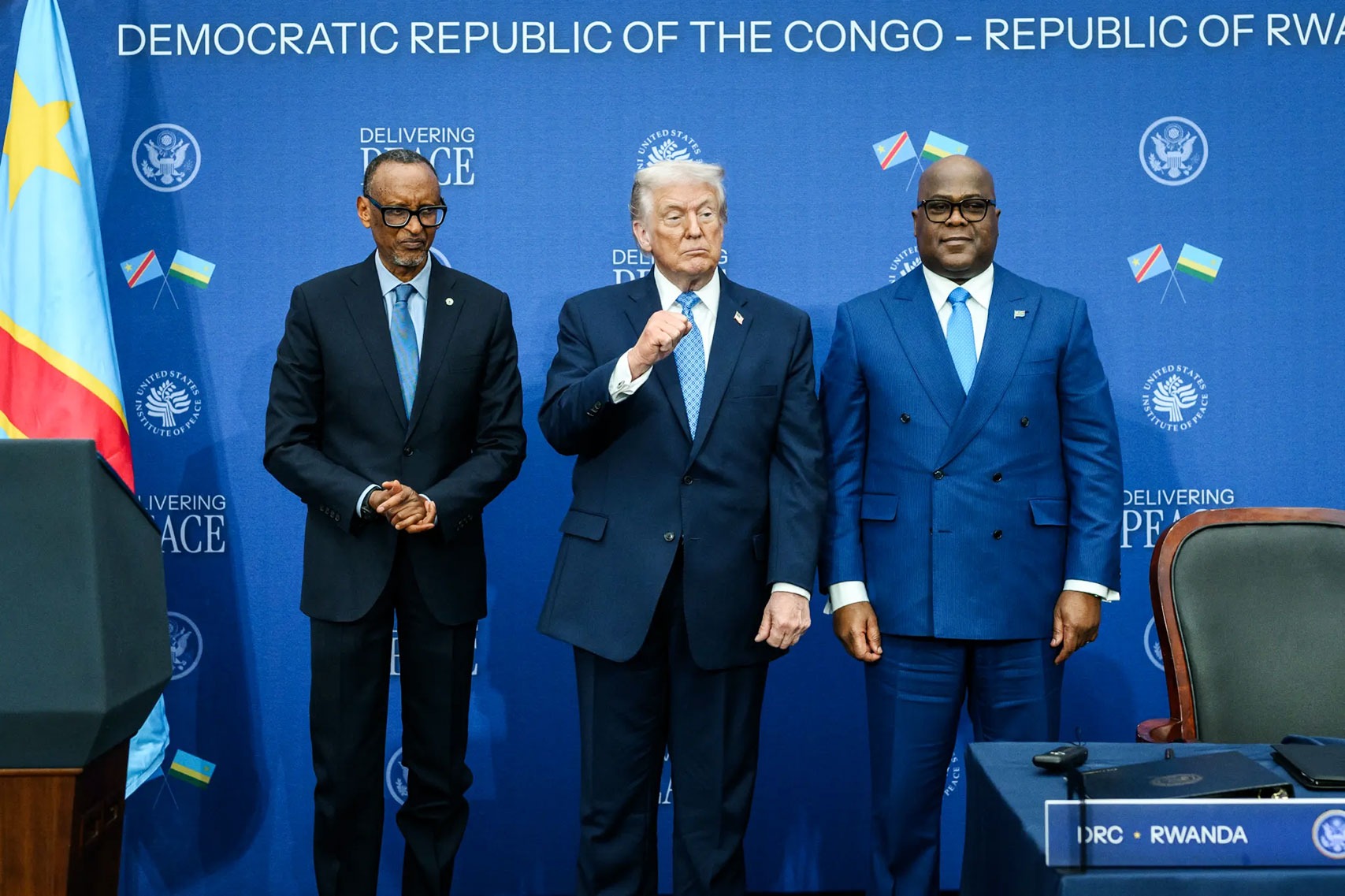
 Donald Trump meets with Félix Tshisekedi and Paul Kagame in the Oval Office on 4 December 2025. (Photo: US government)
 /file/dailymaverick/wp-content/uploads/2025/10/label-Op-Ed.jpg)
On 4 December 2025, Rwanda’s lean, spare president Paul Kagame and his Congolese counterpart Félix Tshisekedi — known at home as “Fatshi” — sat in the Oval Office on either side of Donald Trump, who was presiding like a referee at a championship boxing match.
But this was no reprise of Muhammad Ali’s famous “Rumble in the Jungle” where he knocked out George Foreman in the 8th round at a stadium in Kinshasa.
The two leaders could barely look at each other. Yet they signed a peace deal meant to end one of Africa’s most intractable conflicts: the war in eastern Democratic Republic of Congo (DRC). The optics were powerful. The reality was something else entirely.
Before the ink was dry, Rwandan-backed M23 rebels clashed with a massed force of Congolese troops, Burundian units, mercenary boss Erik Prince’s “contractors” and local “Wazalendo” militias on the northern fringe of Lake Tanganyika. Hundreds of civilians — men, women, children — were slaughtered. Hundreds of thousands fled. The city of Uvira, on the border or Burundi, fell briefly to M23 before the rebels withdrew, only to retake it later.
Back in Washington, Trump was receiving a “peace prize” from Fifa, citing the Rwanda–DRC accord as one of eight achievements he believed warranted his winning the Nobel Peace Prize. (Much to his chagrin, the real prize had just been awarded to the Venezuelan politician Maria Corina Machado.) Had anyone outside the region been paying attention, the juxtaposition might have seemed grotesque.
This week, Rwandan and Congolese delegations were summoned once again to Washington to revive the accord, after which they issued a joint statement with the Trump administration. Rwanda pledged a partial withdrawal from the DRC (to Goma), and the DRC agreed to go after the FDLR militia, which Rwanda views as a security threat linked to the 1994 genocide. Both sides pledged once again to protect civilians in the war zone.
Even as diplomacy falters, the war is evolving.
The Congolese army has begun deploying long-range drones — Chinese CH-4 systems and Turkish Anka platforms — operated with the help of Serbian technicians. M23 has responded by bombing Kisangani airport with kamikaze drones.
Meanwhile, Prince’s mercenary army of mainly Colombians, contracted to secure strategic infrastructure and mining revenues, is believed to have been driven from Uvira by Rwanda and M23.
One veteran Rwanda watcher noted: “Erik Prince still thought this was 1960, where a white man shows up with a gun and everybody runs away. He learnt the hard way.”
The resurrection of Félix Tshisekedi
A year ago, Tshisekedi looked finished. His army, the FARDC, had been routed in Goma and Bukavu — the twin gateways to eastern DRC — and had fled, looting and in numerous instances raping in their wake.
The regional cavalry that had rescued Laurent Kabila decades earlier never came. Angola was distracted. South African forces had been defeated around Goma and were effectively hostages of M23. Romanian mercenaries hired to defend Goma fled across the border and surrendered to Rwanda.
/file/dailymaverick/wp-content/uploads/2025/04/AFP__20250201__36WW7KL__v2__HighRes__DrcongoUnrest.jpg "Members of the M23 armed group secure a street in Goma on 1 February, 2025. (Photo:Tony Karumba / AFP)")
In Kinshasa, the political class rejected Tshisekedi’s call for a coalition government. Former president Joseph Kabila, operating from Namibia, was quietly preparing a return.
There was nothing standing between M23 and the mineral-rich provinces of Katanga — and beyond that, the road to Kinshasa itself. But the rebels chose not to advance, choosing instead to consolidate control. They set up administrations, opened schools, and began constructing something resembling a Rwandan vassal state across North and South Kivu.
Tshisekedi had been written off before. This time, he did something different: he called Donald Trump. The pitch to Washington was blunt: minerals for security.
Democratic Republic of the Congo sits atop one of the richest concentrations of strategic minerals on Earth — cobalt, copper, coltan, lithium, tin, tungsten, diamonds, uranium and gold. Many of these are the building blocks of the modern world: electric vehicles, missile systems, satellites, smartphones, and the batteries of the next industrial revolution.
/file/dailymaverick/wp-content/uploads/2021/06/DRC-cobalt-mine.jpg "Glencore’s Mutanda copper mine in Katanga province. (Photo: Simon Dawson / Bloomberg)")
While DRC’s southernmost provinces in Katanga hold the largest deposits, eastern Congo is rich in coltan and gold — much of which has for years been smuggled across the border to Rwanda and Uganda, entering global supply chains scrubbed clean of its Congolese origin. Despite Kigali’s denials, the pattern is well documented.
Tshisekedi’s dilemma was stark. His army could not stop M23. Regional diplomacy had failed. The UN peacekeeping mission — one of the largest and most expensive in history — had become militarily irrelevant. So, he reframed the war in the transactional language that the Trump administration understands — supply chains and strategic competition with China.
The result was the US-DRC Strategic Partnership Agreement, signed that December day in the Oval Office. Under the deal, DRC created a Strategic Asset Reserve of priority mining projects where US companies would receive the right of first refusal. These included Rubaya in North Kivu and the vast Manono lithium project.
This was the catch: Kinshasa was offering access to mines it did not yet control — giving Washington a direct incentive to help the DRC recover them.
The coltan war
For Tshisekedi, the primary obstacle was Rwanda.
Paul Kagame commands one of Africa’s most effective militaries. His forces have operated in Mozambique and the Central African Republic and are widely trusted by Western security planners. He has a defence pact with Israel covering cybersecurity, artificial intelligence and technology transfers.
But inside DRC, Rwanda is widely disliked. M23 has a base of support among Banyamulenge communities, who have been historically discriminated against, but Kigali is deeply unpopular among much of the rest of the population. Populist radio shows and social media have further raised the anti-Rwandan temperature. The non-Banyamelenge wing of the rebellion, Corneille Nangaa’s Congo River Alliance, is dismissed as a Rwandan proxy.
The struggle now centres on Rubaya, one of the world’s richest coltan deposits, which accounts for up to 30% of global supply of the ore used to produce tantalum — critical for semiconductors, aerospace systems and smartphones.
/file/dailymaverick/wp-content/uploads/2025/08/2de733c4534fbe2f23f22dfe9e6ce949.jpg "A coltan mine near Rubaya. (Photo: Getty Images)")
Since capturing it in 2024, M23 has turned Rubaya into a major revenue stream, generating close to $1-million a month. Much of the output is smuggled into Rwanda before entering global markets.
The fighting for Rubaya has evolved into a “coltan war” where M23’s control of the high ground, such as “Sita” hill, is equivalent to controlling global mineral flows. But the rebels are under pressure from the aerial attacks.
In February, a precision drone strike near Rubaya killed M23 spokesperson Willy Ngoma along with several senior commanders, a big blow to the rebel movement.
Western investors want to transform Rubaya from a dangerous site manually mined by thousands of artisanal miners into a regulated industrial operation capable of supplying traceable tantalum to international markets. Heavy rains in recent weeks have caused landslides that have led to hundreds of deaths.
One of the companies associated with these discussions is TechMet, a Dublin-based company whose CEO is the South African Brian Menell and whose shareholders include the US government’s development finance agency, the Swiss commodity trader Mercuria Energy and the sovereign wealth fund of Qatar.
For Kinshasa, Rubaya is both a military objective and a geopolitical bargaining chip.
Sanctions on Rwanda
While the US is very unlikely to put boots on the ground in DRC, it has other weapons at its disposal. In March, the US imposed sanctions on the Rwanda Defence Force and several senior officers, accusing Kigali of backing M23 and exploiting Congo’s mineral wealth.
This had the immediate effect of forcing a basketball team owned by Rwanda’s Ministry of Defence to withdraw from the Basketball Africa League, which is run by the NBA — a blow for a country that takes pride in branding its image through sports teams.
However, Rwanda’s military procurement relies on suppliers such as China, Israel, and Turkey, so the sanctions are unlikely to have an impact on Rwanda’s war effort.
The sanctions have had one unintended effect. The European Union, which funds some of Rwanda’s deployment in northern Mozambique, where they are holding the line against Isis-linked insurgents, is reconsidering its support because of the sanctions. Kigali has warned that if funding ends, it may withdraw its forces, which also help guard the gigantic TotalEnergies liquefied natural gas project.
/file/dailymaverick/wp-content/uploads/2024/09/ISS-Rwanda-in-Moz-main.jpg "Rwandan counterterrorism special units and Mozambique police patrol streets in the town of Palma, Cabo Delgado, on 18 December 2023. (Photo: Cyrile Ndegeya / Anadolu via Getty Images)")
Rwanda might have another reason for wanting to get out — it hasn’t been paid by the Mozambican government in 10 months. But the danger is that jihadists in Mozambique are already regaining momentum, fuelled by new recruitment and foreign fighters.
A war that cannot be won
On the ground in eastern DRC, little has fundamentally changed. M23 remains well-commanded and backed by Rwanda. But its supply lines are stretched thin. Whatever its military strength, it lacks the numbers to control and administer vast territories for long periods of time.
The Congolese army remains fragmented, corrupt and weak. The war has become a hybrid conflict shaped as much by remote machines in the sky as by militias with AK-47s.
Nearly eight million people are displaced across eastern DRC. A decisive military victory for Kinshasa appears unlikely. At best, Tshisekedi can contain the rebels and negotiate from a slightly stronger position. As one analyst put it: Congo is “a colossus with feet of clay”.
/file/dailymaverick/wp-content/uploads/2025/09/12032649.jpg "The Bulengo camp for displaced persons near Goma on 16 February 2024. (Photo: Mose Kasserka / EPA)")
The December agreement was never just a peace deal. It was a grand bargain for Rwanda to step back militarily and for both countries to integrate into a regional mineral economy backed by the US. Peace, in other words, was tied directly to minerals.
On 5 February, Kinshasa presented Washington with a list of 25 priority mining assets available to US investors. Rubaya was on that list. But the deal signed in Washington contained a fatal flaw: M23 was not a party to it.
The movement is supposedly in separate talks in Doha — and has made clear it is not bound by any agreement Rwanda signs. This creates a structural escape hatch, allowing the rebels to hold veto power over peace. As one US official put it: “This is not the end game. It’s the starting point.”
The view from the ground
A businessman operating in the region offers a more cynical assessment.
“Rwanda is a small country. It already gets much of what it needs from eastern Congo — gold, coltan, everything coming out of North and South Kivu.
As for the sanctions, he says:
“What are they going to do — sanction everyone who trades with Rwanda?
“The gold goes through Dubai. That’s where the origin is cleaned. There is very little the US can do to stop that. And the US is not going to fight a war in eastern Congo.”
He points to the reality on the ground:
“You have more than a hundred Wazalendo militias. That means three here, five there, 10 somewhere else — all with AK-47s. Even if M23 signs a deal, those militias won’t necessarily respect it. They live off artisanal mining. There is money involved.”
The only theoretical solution, he says, would be for Kinshasa to effectively relinquish North and South Kivu, “but Tshisekedi cannot do that. It would destroy him politically.”
So, the cycle continues: “Agreements announced. Signatures. Statements. Then the fighting resumes.”
The logic of the war remains intact
The economic logic of Tshisekedi’s Washington strategy is more limited than it would seem. He has promised 100,000 tonnes of copper exports to the US — out of a total production of roughly 2.6–2.7 million tonnes. The US will receive perhaps 10,000 tonnes of cobalt, a tiny slice.
Meanwhile, the structure of the mining sector remains unchanged. If US firms buy into assets like Glencore’s copper and cobalt holdings, they will probably pay a huge premium — potentially $9-billion — for stakes that benefit sellers more than DRC. And at the end of the day, Chinese firms remain entrenched across Katanga.
One of the leading promoters of the US-DRC strategic partnership is the American-Canadian billionaire Robert Friedland, who is offering zinc, germanium and gallium from his Kipushi mine for offtake by the US. But the jewel of his DRC copper assets, the Kamoa-Kakula project, is partnered with the Chinese company Zijin, so he is in no position to offer it to the US.
Still, Tshisekedi has achieved something few thought possible. He has drawn the US directly into the geopolitical struggle over DRC’s minerals. That alone has shifted the strategic landscape even if it has not ended the war.
The bottom line is that the Washington Accord is not a peace treaty. It is a sophisticated freeze. It codifies the current balance of power while postponing the underlying conflict.
Paul Kagame has, once again, reshaped the rules of African geopolitics. Tshisekedi has, for now, survived — and there are moves in Kinshasa to amend the Constitution to enable him to extend his rule beyond the constitutionally mandated endpoint of 2028.
But in eastern DRC, where minerals flow, militias proliferate, and foreign powers circle, the logic of the war remains intact.
And so, the cycle continues. DM
Phillip van Niekerk is the managing partner of Calabar Consulting, a risk consulting company specialising in Africa. The views expressed are his own. He also publishes Africa Unscrambled on Substack.