




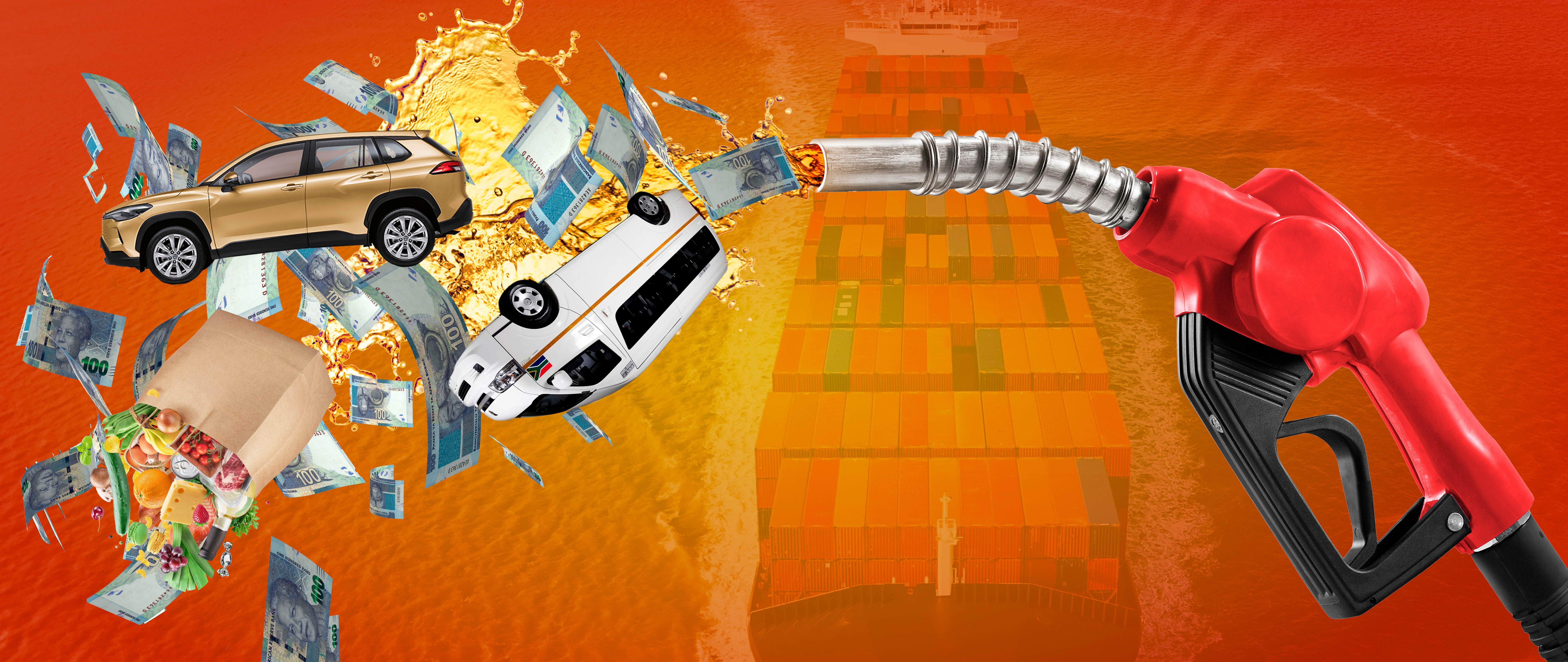
 Illustrative image: Jocelyn Adamson: Pump and money. (iStock) | Cars (iStock). The Independent Quest, a container ship registered in Portugal, leaves Antwerp harbour in Hansweert, the Netherlands, on 15 March 2026. (Photo: Olivier Hoslet / EPA)
 Conflict in the Middle East has dominated the headlines for the past few weeks, with speculation about what US President Donald Trump might do next and how long the war will continue as millions of anxious eyes track the oil price, which skated up to $120 a barrel before falling to hover around $100.
As I write this article (Thursday, 19 March), the oil price is $108 a barrel and its lowest point in the past five days was about $96.
Though international politics may often seem far removed from daily reality, the truth is that the Middle East conflict is likely to have a direct impact on your pocket in several ways that trickle down from one to the other, much like a sticky oil drip pooling into one large, messy puddle.
Fuel price increases
The first and most obvious one is the anticipated impact on the fuel price. Frank Blackmore, lead economist at KPMG South Africa, says it might be possible for fuel prices to increase, as recently reported, by R8, but that would require much more depreciation in the rand, combined with a much higher oil price.
Pegging the oil price at around $105 and the rand/dollar exchange rate at R16.75 just over a week ago, Blackmore said: “What this means for the fuel prices is that… the new price would be around R5.30 higher for April than it would have been in March. “This represents a 26% increase in prices to a level for 95 octane inland, which is still below the highest we saw a year or so ago at the height of inflation.”
/file/dailymaverick/wp-content/uploads/2023/10/GettyImages-1239465552.jpg "Refuelling at a petrol station in Cape Town on 23 March 2022. (Photo: Dwayne Senior / Bloomberg via Getty Images)")
After the usual monthly review, new fuel prices are scheduled to take effect on Wednesday, 1 April, and the Department of Mineral Resources and Energy is expected to announce the official price changes only a few days before the implementation date.
Efficient Group chief economist Dawie Roodt has predicted that prices could increase by roughly R5 a litre for petrol and about R8 a litre for diesel.
What that looks like for you
If you own a popular car such as the Toyota Corolla Cross with a 47-litre petrol tank, it currently costs (at R20.19 a litre) about R950 to fill up.
If the price of unleaded petrol goes up as per Roodt’s estimate by R8 a litre, it will cost R1,325 to fill your tank in April. That’s an immediate difference of about R375 every time you fill your tank. If you fill up four times a month, that works out to an extra R1,500 leaving your pocket.
As AA chief executive Bobby Ramagwede points out: “You don’t have a choice. You still have to drive to work – you’ll just have to find the money somewhere else.”
Commuters will also feel the pinch as buses and taxis push up their prices to accommodate the fuel price increase.
In July 2022, after a fuel price increase, some taxi commuters reported paying an extra R5 per trip. Twice a day, five days a week, that adds up to an extra R50 a week, more than R200 a month. Career website Indeed.co.za reports that the average worker’s salary in South Africa is about R6,935.
/file/attachments/orphans/6I1A4661_850277.jpg "Minibus taxis line up at Bree Taxi Rank in Johannesburg on 10 March 2026. (Photo: Felix Dlangamadla)")
Logistics costs will rise
The trickle-down from fuel prices to logistics costs is inevitable. Nicky Weimar, group economist at Nedbank, notes that in addition to the oil price shock, the new fuel levy increases announced in the Budget, totalling 21c a litre, will come into effect in April. “Together, these developments are expected to translate into a sharp increase in average petrol prices from April,” he says.
This means the cost of goods around the country is going to rise as suppliers and distributors face the increased fuel costs of transport.
As Woolworths CEO Roy Bagattini told Daily Maverick last week, the popular retailer is “very fortunate” in that about 90% of products are locally sourced in South Africa, which means Woolworths is not affected by the slowdown or closure of shipping routes.
However, its competitor Shoprite told Currency News in the first week of March that 162 containers of goods to stock its shelves were stuck in transit.
Bagattini also pointed out that there are likely to be increased costs on containers and on shipping insurance for companies in general. “The logistical cost component is likely to seriously impact companies’ income statements. And then, very directly, as shipping routes change with more ships coming around the Cape of Good Hope, that’s going to create congestion in our ports,” he said.
This could lead to delays in offloading imported products and getting them into stores – a scenario for which Woolworths is already preparing.
On the cost of diesel, Bagattini said Woolworths does have a “substantive investment” as trucks move around the country, delivering products to stores. He recalled previous years when severe load shedding pushed up diesel costs, which “was costing us up to R30-million to R40-million incremental a month”.
He added: “I don’t think this [the Middle East crisis] is going to have that sort of impact, you know, but we have learnt that for every R1 increase in diesel prices, it will cost us at least R1-million extra per month.”
/file/attachments/orphans/WWpic1copy_845274.jpg "Woolworths has many South African suppliers in its value chain. (Photo: Woolworths)")
Tertia Jacobs, treasury economist at Investec Corporate and Investment Bank, says that as transport and logistics costs rise because of higher diesel costs, it raises the risk of higher second-round price increases on retail goods and manufacturing inputs.
Which brings us neatly to the next round of impacts on your pocket.
Cost-of-living increases
When retailers face the cost of goods stuck in transit and increased logistics costs, it will translate into higher food prices as the impact trickles down to the shelves.
Weimar says basic food inflation is expected to moderate, supported by lower global food prices and strong domestic crop production, which should help to cushion the impact of foot-and-mouth disease on meat prices.
However, Jacobs says food price inflation faces upside risks from higher transport costs and rising fertiliser prices, which have increased by roughly 30% amid supply disruptions linked to the closure of the Strait of Hormuz.
/file/attachments/2989/13802634_310340.jpg "In this drone image, MSC Ela, registered in Panama, leaves Antwerp harbour, near Hansweert in the Netherlands, on 4 March 2026. The closure of the Strait of Hormuz amid the escalating Middle East conflict is leading to growing concern about global petroleum supplies. (Photo: Olivier Hoslet / EPA)")
South Africa imports about 80% of its fertiliser, which accounts for roughly 30% of agricultural input costs, according to AgriSA.
Going back to July 2022, when load shedding had a severe impact on diesel costs and, in turn, on logistics costs, food inflation was running at about 9.7%.
However, to put that in perspective, consumer inflation moderated to 3% in February, with food inflation easing to 3.7%.
“The anticipated increase in inflation [as a result of the Middle East crisis] has likely removed the prospect of more interest rate cuts in 2026,” Jacobs says, adding that rising inflation erodes real disposable income, reducing household purchasing power.
All these factors show that, as distant as it may seem, the Middle East conflict is quietly rewriting your monthly budget, one litre, one trip and one grocery basket at a time. DM
This story first appeared in our weekly DM168 newspaper, available countrywide for R35.
/file/attachments/2989/DM-20032026-001_776230.jpg)