




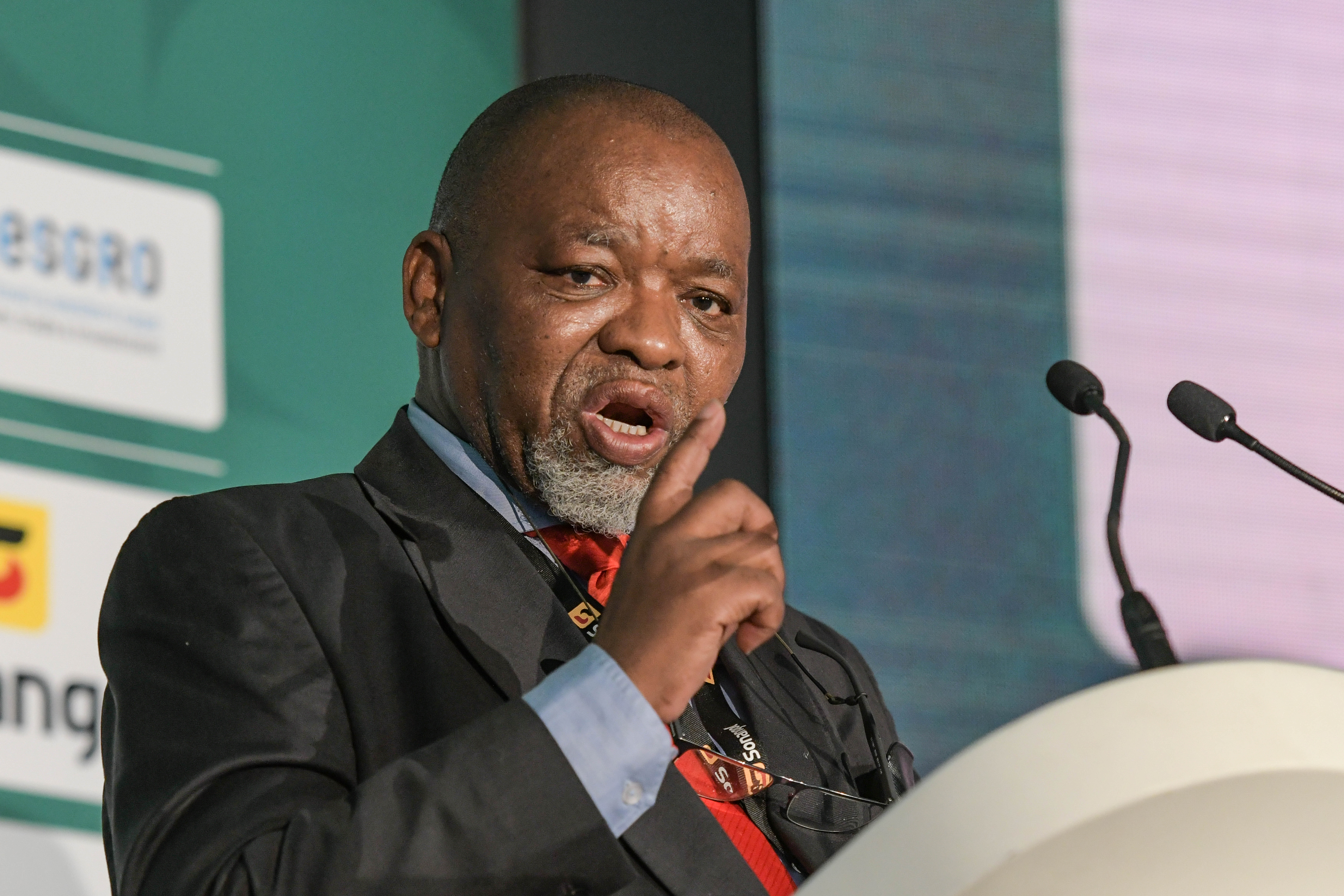
 CAPE TOWN, SOUTH AFRICA - NOVEMBER 09: Gwede Mantashe (Minister of Mineral Resources) during day 1 of the 2021 African Energy Week ("AEW") at the V&A Waterfront on November 09, 2021 in Cape Town, South Africa. The AEW is a four-day event of the African Energy Chamber is described as one seeking to unite African energy stakeholders, drive industry growth and development and promote Africa as the destination for African-focused events and for the future of Africa's energy sector. (Photo by Gallo Images/Jeffrey Abrahams)
 There is nothing little about Minister of Mineral and Petroleum Resources Gwede Mantashe’s ... er ... finger. But he is, of course, quite optimistic that the chaos in the energy market right now could firm the ground up for a local oil and gas ladder to help the African continent climb out of energy poverty.
“South Africa, and indeed the African continent at large, cannot afford to remain poor while endowed with abundant natural resources,” Mantashe stated in his opening address at the Southern Africa Oil and Gas Conference that convened in Cape Town on 16 and 17 March.
“We must harness these [oil and gas] resources responsibly to drive inclusive economic growth, create employment opportunities and eradicate poverty.”
It was a welcome change from conference appearances in the past where his words were trained on George Soros and America’s Central Intelligence Agency as possible obstacles on Africa’s path to prosperity.
Mantashe framed the urgency of local development against the backdrop of heightened geopolitical tensions and the US-Israeli war on Iran, which have severely disrupted fuel supply chains, driven the cost of air travel to new highs and created massive volatility in global oil markets.
Crucially, he was wagging his finger at his detractors by claiming legislative urgency is necessary to ensure that local oil and gas developments “do not remain indefinitely suspended in lengthy litigation processes that create investor uncertainty”. Touché.
“There must be a time where SA is going to have its own gas. So where will that gas go? It’s going to come to me...”
These were the words of Oliver Naidu, president of Dutch multinational Vopak’s SA business unit, during an interview at the Africa Energy Indaba at the beginning of March.
Vopak specialises in providing tank storage for liquid chemicals, gases and oil products, and Naidu is also the project owner of the Zululand Energy Terminal – southern Africa’s first liquefied natural gas (LNG) terminal. He spent 21 years at Sasol and is well placed to navigate the energy landscape. “You cannot have a single point of supply in your country,” he said. “With energy you must have a diversified portfolio. Having an import and local production, I think, is the perfect mix.”
/file/attachments/2989/P4gwedemain_552667.jpg "Minister of Mineral and Petroleum Resources Gwede Mantashe. (Photo: Frennie Shivambu / Gallo Images<br>Background image: iStock)")
Background image: iStock)
Naidu’s call for a diversified portfolio is predictable and it is equally as opportunistic as Mantashe’s petition to accelerate the implementation of the Upstream Petroleum Resources Development Act.
Immediate shocks for SA
SA is in the throes of an acute macroeconomic shock. The price of Brent crude has rocketed past the psychological $100-a-barrel mark, and maritime insurance premiums have risen sharply since the functional closure of the Strait of Hormuz.
Because SA is an import market, its basic fuel price is tethered to international petroleum prices and the rand-US dollar exchange rate. Global geopolitical shocks are therefore immediately passed on to the consumer as imported inflation. And the fallout of the US-Israeli attacks on Iran – the so-called Operation Fury – has been swift and brutal on the local front.
Kirby Gordon, marketing chief at FlySafair, painted a grim picture of the consumer impact after the airline blinked first as Jet A-1 fuel spiked 70% in a single week.
“The persistence and scale of these fuel costs have left FlySafair with no reasonable alternative... Instead of increasing fares across the board or hiding costs, we have chosen to introduce a clearly labelled, temporary surcharge,” he said in a press statement.
He continued by explaining that this wasn’t a profit mechanism, but a desperate measure to maintain service continuity.
There is another pain point, quite unexpected in the heavy industrial sector. Malcolm Curror, Chief Executive of United Manganese of Kalahari, pointed out that energy was embedded in nearly every stage of the mining value chain.
“When fuel prices rise sharply, the cost pressures ripple through logistics networks, freight rates and ultimately pricing.”
Curror also said United Manganese of Kalahari was now limiting ore transportation by road to reduce its exposure to diesel, even if this put pressure on export volumes. SA is the primary supplier of manganese to the global steel and battery-making market.
/file/attachments/2989/p4graphic_400342.jpg "Oil refineries in South Africa.")
Deindustrialisation woes
How did the country become so hopelessly exposed to the whims of foreign wars and international oil traders? It’s a deep, structural and largely self-inflicted wound: the radical deindustrialisation of its downstream refining capabilities.
Historically, Mzansi had a refining capacity of more than 700,000 barrels per day (bpd) spread over six refineries. Today, its capacity is about 35% of that and it procures 70% of its fuel consumption as finished petroleum products.
The remaining operational facilities are a shadow of the sector’s former glory: Natref refines 108,000 bpd, Astron Energy does 100,000 bpd and the Sasol synthetic fuel (coal-to-liquids, CTL) plant in Secunda does 150,000 bpd.
The rest are fallen giants. The Sapref refinery in Durban (180,000 bpd), which once supplied 35% of national capacity, was indefinitely paused in 2022 by BP and Shell after the KwaZulu-Natal floods. The Enref facility (120,000 bpd) suffered a fire in December 2020 and was unceremoniously converted into an import terminal by Engen.
The core catalyst for this infrastructure degradation was a corporate standoff over the government’s Cleaner Fuels II (CF2) regulations. To be fair, these mandated expensive upgrades for ageing refineries were to meet Euro 5 environmental standards and open SA’s transport market to next-generation vehicles – while also making good on its climate goals.
But the multinational oil companies looked at the numbers and decided the retrofitting wasn’t justifiable on economic grounds without state subsidies or cost recovery mechanisms. When the government pushed back at providing financial support, the oil majors simply shuttered their plants and pivoted to importing CF2-compliant finished products.
/file/attachments/2989/ED_556356_777519.jpg "Minister of Forestry, Fisheries and the Environment Willie Aucamp. (Photo: Sharon Seretlo / Gallo Images)")
This pivot has exposed a terrifying vulnerability in the country’s strategic storage mandate. The Strategic Fuel Fund manages an adequate 45 million barrels of physical storage at Saldanha Bay. However, holding raw crude oil without having the operational refineries needed to convert it into useable petrol and diesel is not helpful in these times of dire straits.
To pour salt on the wound, a parliamentary oversight visit this month revealed a worrying reality: only two of the six massive 7.5 million-barrel concrete tanks are actually dedicated to strategic national reserves. The remaining four tanks have been leased commercially to third-party international oil traders to generate operating revenue for the Strategic Fuel Fund.
Looming gas cliff
As if the liquid fuels crisis wasn’t enough, SA is also staring at a gas cliff in 2028. The country gets almost all its natural gas from Mozambique’s Pande and Temane fields. However, Sasol warned it would cease supplying external industrial customers by 2028 due to resource depletion.
MJ Khan, digital communication head of Sasol, provided important context in terms of what remains of local supply: “Sasol supplies about 30% of SA’s domestic fuel needs. While our Secunda CTL plant does make a significant contribution, this percentage also includes output from Natref. Both facilities are currently supplying to their total market capacity.”
The collapse of Mozambican gas threatens between 70,000 and 100,000 jobs in the local manufacturing sector.
But despite the reliance on imported fuels, SA actually holds significant untapped subsurface hydrocarbon potential. All that shale gas under the Karoo? All part of these endowments. But getting it out of the ground has proved to be an administrative and legal disaster.
On the sea front, TotalEnergies successfully proved an estimated one billion barrels of oil equivalent in the Outeniqua Basin (Block 11B/12B, to be specific). However, in July 2024, the French supermajor formally exited the block. Developing the deepwater subsea infrastructure to pipe the gas to the shuttered PetroSA Mossel Bay refinery was assessed as “too challenging to economically develop and monetise” without sovereign pricing guarantees – the aforementioned state subsidies.
/file/attachments/2989/SelmaIMG_richafricacocom_875043.jpg "Selma Shimutwikeni, CEO of RichAfrica Consultancy and convener of the Namibia International Energy Conference. (Photo: richafricaco.com)")
TotalEnergies and QatarEnergy turned instead to the deepwater Orange Basin on the West Coast in 2024. Operators there hope to mirror the massive 30-billion-barrel discoveries made just across the ocean border in Namibia.
However, regulatory paralysis and environmental legal challenges – what Mantashe loves calling “lawfare” – have resulted in zero exploration wells being drilled in SA waters since 2022. By contrast, Namibia has drilled more than 20.
Pesky environmentalists
Mantashe framed this as a moral failing in the sea of poverty in SoA.
“The truth is that rising oil and gas prices have a direct ripple effect on the cost of living. The lack of access to these resources has an even greater impact, as it can lead to energy poverty, rising unemployment and the further entrenchment of poverty and inequality,” he said.
“Regrettably, we have not yet been able to fully explore and exploit this potential due to ongoing blockages against oil and gas development in the name of environmental protection.”
Tasked with ensuring that this scramble for hydrocarbons doesn’t violate the Constitution, Minister of Forestry, Fisheries and the Environment Willie Aucamp acts as a necessary counterweight, but unlike former office bearers (read: Barbara Creecy and Dion George), Aucamp is more open to Mantashe’s charms.
“Environmental legislation and regulations are not designed to hinder development. Rather, they exist to ensure that development is responsible, sustainable and resilient over the long term,” Aucamp explained. “Striking the balance is often difficult because South Africans need and want economic development, but not at the expense of the environment.”
Zooming out to the broader regional picture, Selma Shimutwikeni, chief executive of RichAfrica Consultancy and the Namibia International Energy Conference, told Daily Maverick that SA’s vulnerability could be mitigated by regional cooperation.
“Where we see the most practical opportunity is in pooling infrastructure, knowledge and investment. Shared logistics hubs, ports, pipelines, power transmission corridors and skills development programmes can unlock value more efficiently and reduce duplication of investment across the region.”
Long-term vision
The energy pooling narrative comes from the African Union and is a great long-term vision for the continent. But right now, to combat the gas cliff and the loss of energy sovereignty, the government has several capital-intensive strategies in play.
Legislatively, Mantashe’s calls to speed up the implementation of the Upstream Petroleum Resources Development Act, which was signed into law in 2024 and separates petroleum regulation from mining to fast-track exploration, is the obvious step. This is tied to the lifting, in October 2025, of the 2011 moratorium on shale gas exploration in the Karoo Basin, which holds an estimated 200 trillion cubic feet of technically recoverable gas.
To establish an LNG value chain, the Transnet National Ports Authority and the Strategic Fuel Fund are advancing a R27-billion import terminal at the Port of Ngqura, with similar infrastructure targeted for Richards Bay and Saldanha Bay. As Naidu explained, gas acts as an “anchor type of strategy” to provide baseload stability alongside fluctuating renewables.
But LNG is not a silver bullet. Energy modellers warn that, without underground geological storage, storing LNG for intermittent peaking power is incredibly expensive.
There is also the risk of stranded fossil fuel assets in the face of global carbon tariffs (like the EU’s Carbon Border Adjustment Mechanism), which make hybrid systems combining solar PV, onshore wind and large-scale battery energy storage systems theoretically cheaper and faster to build.
However, perhaps the most audacious plan is the Central Energy Fund’s acquisition of the shuttered Sapref refinery for a nominal fee of R1. Now rebranded as the South African National Petroleum Company, the government aims to secure strategic partners to upgrade the site into a 450,000 to 600,000 bpd mega-refinery within five years. (The fund declined all interview requests at the energy indaba.)
Whether the government has the capital, capacity and political will to execute a multibillion-rand mega-refinery revival remains to be seen.
What is certain, however, is that the crisis brought on by the attacks on Iran has exposed the brittle bones of SA’s energy infrastructure. A country that is sitting on massive offshore and onshore potential is being held hostage by the price of Brent crude and the whims of international shipping insurers.
If Operation Fury teaches the local energy dog new tricks, they need to be implemented with unprecedented speed. DM
This story first appeared in our weekly DM168 newspaper, available countrywide for R35.
/file/attachments/2989/DM-20032026-001_776230.jpg)