




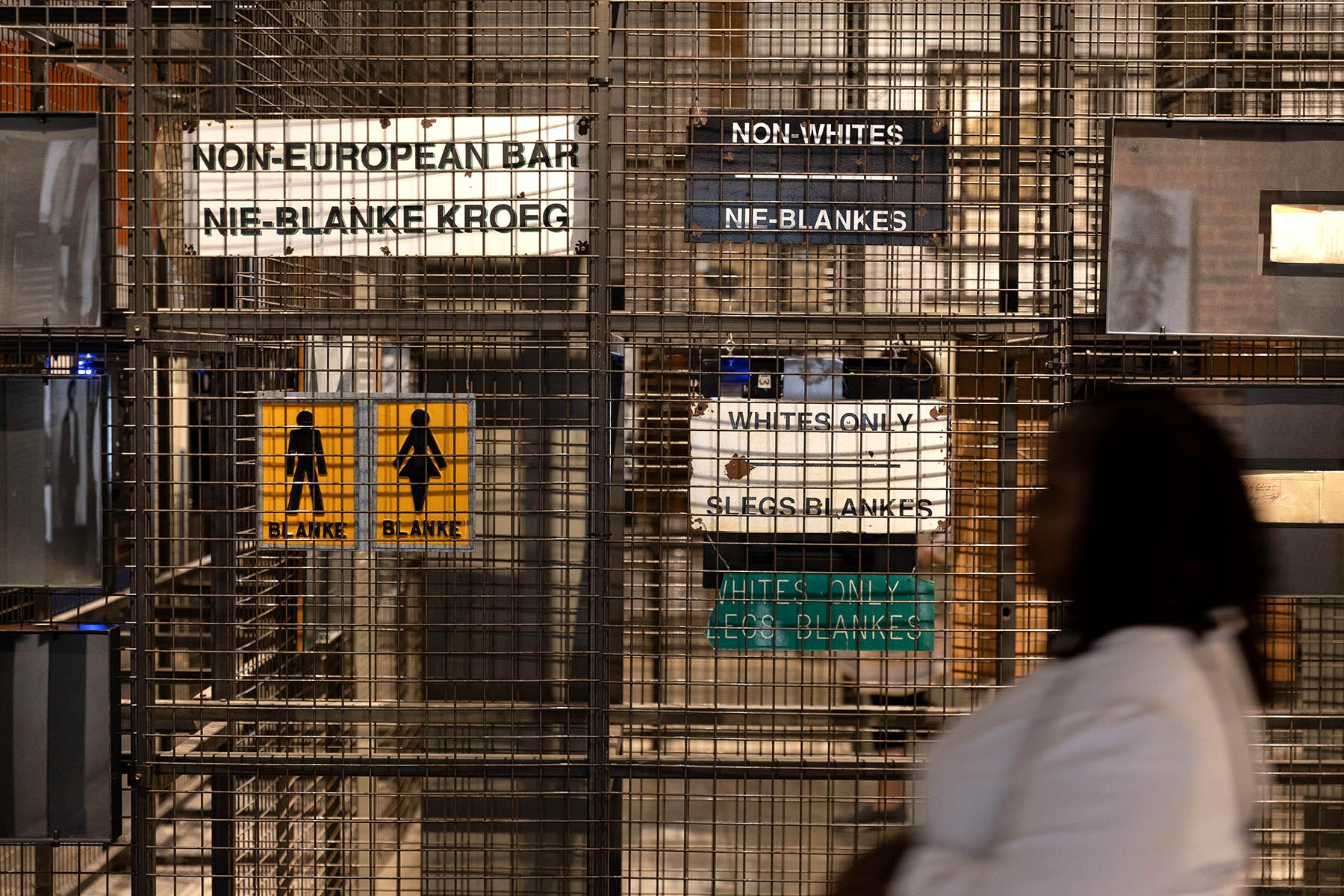
 A visitor walks past an exhibit in the Apartheid Museum in Johannesburg on 18 March 2026. (Photo: Our City News / James Oatway)
 As the country commemorates Human Rights Day this weekend, Johannesburg is home to an important part of the country’s history: The Apartheid Museum.
The museum opened in 2001 and welcomes an average of 800 visitors per day. Despite these impressive foot-traffic figures, curator Emilia Potenza feels that there are still many South Africans, particularly young people, who don’t know much about South Africa’s history.
“We are often shocked by the fact that younger visitors do not know about apartheid. They are shocked to see the very graphic content that the museum displays. Films showing the mass uprisings of the 1980s, led largely by young people, often leave a lasting impact.
“When they see that they could have been one of those kids on the street, protesting and fighting against the apartheid system, it becomes very real,” she said.
For many visitors, especially the younger generations, the experience is both educational and deeply emotional, according to Potenza.
/file/attachments/orphans/Apartheid_museum_08a_841282.jpg "Visitors look at a Casspir armoured vehicle in the Apartheid Museum in Johannesburg. (Photo: Our City News / James Oatway)")
/file/attachments/orphans/Apartheid_museum_04a_731958.jpg "A visitor walks past an exhibit in the Apartheid Museum. (Photo: Our City News / James Oatway)")
Speaking to Our City News, Potenza said the museum tells a much broader story than apartheid alone. The discovery of gold in Johannesburg played a role in creating a system that eventually became apartheid.
“The museum tells a century of South African history with a focus on the apartheid period. In order to understand apartheid and how it came about, you really need to understand right back to the discovery of gold in 1886 and how that transformed South African society,” she said.
She believes that the transformation of Johannesburg laid the foundation for a system built on racial inequality and exploitation.
/file/attachments/orphans/Apartheid_museum_15a_413897.jpg "Emilia Potenza, curator of exhibitions and education at the Apartheid Museum. (Photo: Our City News / James Oatway)")
“It depended entirely on cheap black labour in order to make the gold-mining enterprise the profitable one that it became. This system evolved into apartheid, a rigid structure of segregation that controlled where people could live, work, travel, and even who they could love,” Potenza said.
Inside the museum – in Ormonde, south of Johannesburg – visitors are confronted with the harsh realities of that system.
“What the museum shows is how apartheid was implemented – the harshness and brutality of it, and the complete denial of human rights of all South Africans who were not considered to be white,” Potenza said.
She added that through photographs, films and personal accounts, the museum captures both the suffering caused by apartheid and the resistance that ultimately led to its downfall.
/file/attachments/orphans/Apartheid_museum_12a_348127.jpg "Curator Emilia Potenza. (Photo: Our City News / James Oatway)")
“One form of repression was followed by resistance and then followed by repression that went on for nearly four decades, until the transition to democracy in 1990,” she explained.
The museum also reveals the scale of the violence inflicted during that time, including the detention, torture and killing of thousands of young people.
“It is a very gruesome and horrifying period of our history. Visitors respond in different ways. For black South Africans, the experience can evoke anger and pain. For white South Africans, it often brings feelings of shame and a renewed commitment to confronting inequality. It is a case of feeling ashamed, feeling embarrassed, feeling shocked, and feeling determined – we hope – to fight against racism and discrimination,” she said.
The museum is privately run by the Apartheid Museum Trust and is not government-sponsored. While schoolgoing children and students make up the majority of the visitors, international tourists, including from the rest of Africa, are a close second.
Potenza believes that the museum also reflects on how far the country has come. In spaces like the Ernest Cole Hall, photographs capture everyday life under apartheid, from overcrowded classrooms to segregated public spaces.
“It shows how South Africa became a land of signs where every aspect of life was segregated. While those visible forms of segregation have been dismantled, the museum challenges visitors to consider what still needs to change.”
The museum’s relevance lies in its ability to connect the past with the present.
“Human Rights Day is not only about remembering what happened in 1960. It is about recognising the responsibility that comes with freedom and ensuring that the injustices of the past are never repeated. And within the walls of the Apartheid Museum, that responsibility is brought into sharp focus,” Potenza said.
Entry to the museum is free for South Africans this weekend. DM
This story was produced by Our City News, a nonprofit newsroom that serves the people of Johannesburg.
/file/attachments/2985/WhatsAppImage2025-11-21at1946001_346702_1cea9e715c05dc0a538fc79753ac3401.jpeg)