





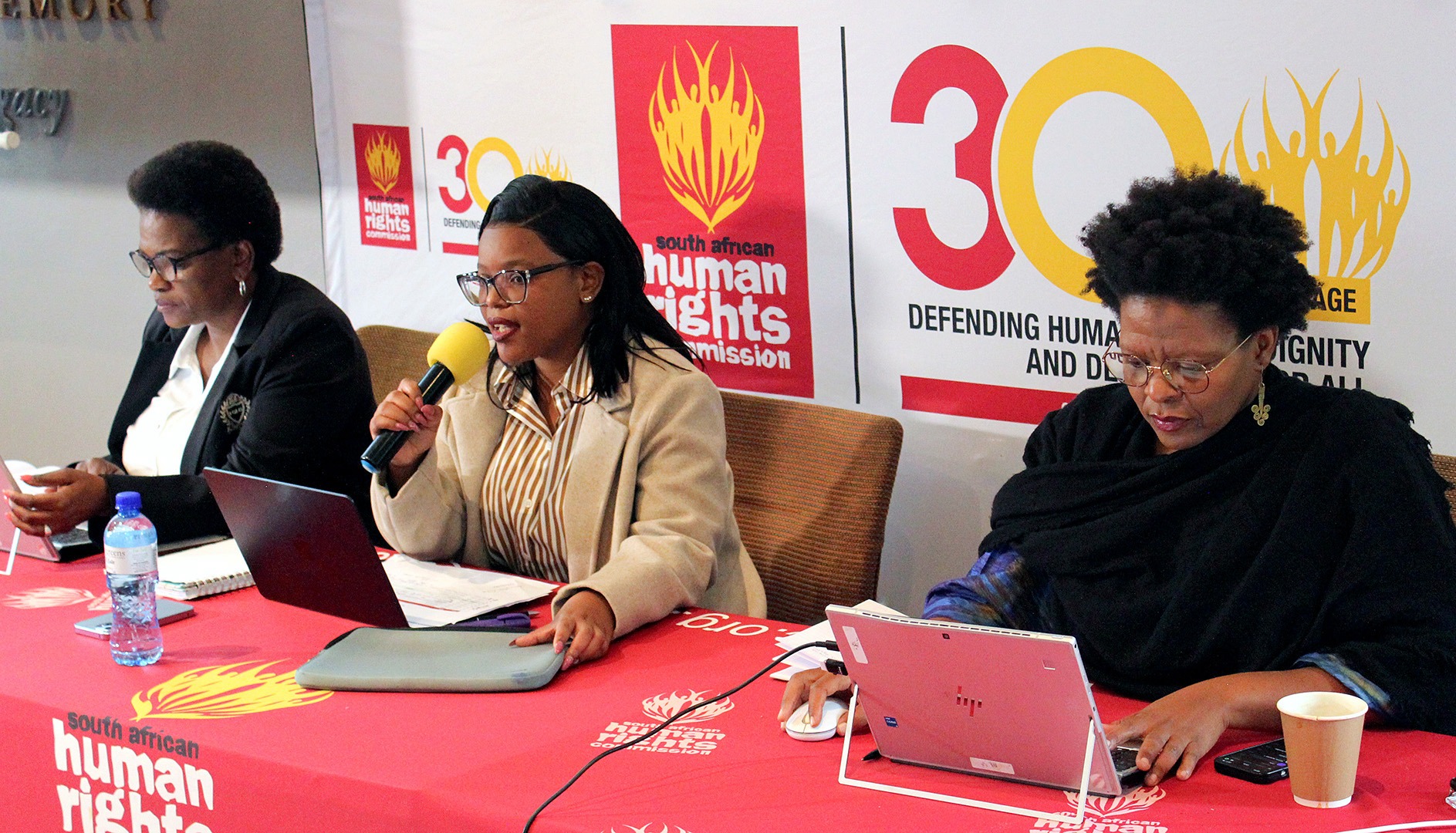
 From left, Commissioner Philile Ntuli, Commissioner Sandra Makoasha, the inquiry chairperson, and Commissioner Nomahlubi Khwinana preside over the National Investigative Hearing into Food Systems at the Nelson Mandela Foundation. (Photo: Given Makhuvele / Wysani Baloyi)
 “We account to the Constitution and to the people of the Republic of South Africa,” said Commissioner Sandra Makoasha, the chairperson of the SA Human Rights Commission (SAHRC) national inquiry into food systems in SA, addressing a director-general whose minister, like many others, had failed to appear at the inquiry. “When the commission is called useless in public, no one in the department considers that it is because they failed to assist the commission in adhering to their constitutional mandate.”
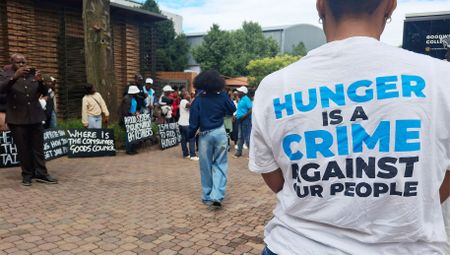
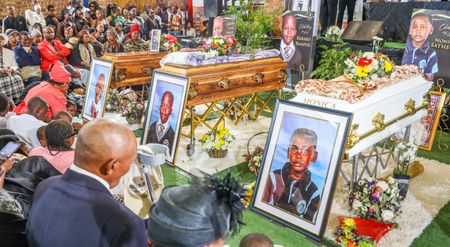
Across six days, the SAHRC’s inquiry has heard testimony that is, by any measure, urgent. Seasonal farm workers survive the six-month off-season on their children’s support grants. A child was killed while scavenging food from a dump site. Pregnant women are going hungry while, as one researcher put it, “one million neural connections form every second” in their unborn children’s brains. Getting the government to reckon with that picture has proved complicated.
Empty chairs, full agendas
The commission’s process began well before the hearings. Ministers identified as key stakeholders were sent formal invitations by the SAHRC, many as early as December 2025. Where invitations went unanswered, the commission escalated to statutory subpoenas for some. What followed, across multiple departments, was a pattern the panel grew visibly tired of repeating.
/file/attachments/orphans/56_554624.jpg "Minister of Rural Development and Land Reform Mzwanele Nyhontso (left) and Acting Director-General Clinton Heimann appear before the commission on 19 March 2026, a day after the minister was ordered to present himself physically following his initial absence. (Photo: Given Makhuvele / Wysani Baloyi)")
The Minister of Land Reform and Rural Development, Mzwanele Nyhontso, was first scheduled to appear on 18 March, the fifth day of the inquiry. An acting deputy-director-general of the department tendered an apology, citing a portfolio committee meeting in Cape Town. The panel ordered the minister to appear physically the following morning, which he did, though not to present evidence.
The letter of invitation that the SAHRC had sent did not reach the minister due to confusion with the wrong email addresses being used, according to the department. When asked about the communication breakdown that had seen the subpoena also go unacknowledged until days before the hearing, the minister was candid: “I don’t want to talk about it. I have to fix the communication within my own office. There is something that is not right, and it reflects badly on me.”
Across the week, the same story repeated in different forms, when departments sent acting officials with delegation letters the panel ruled insufficient, or with no written delegation at all.
/file/attachments/orphans/35_919080.jpg "Director-General Dr Sean Phillips (right) and Chief Director for Water Use Authorisation Sipho Skosana from the Department of Water and Sanitation appear before the commission on 19 March 2026. (Photo: Given Makhuvele / Wysani Baloyi)")
All were warned to return with their ministers. A list of those who failed to appear will be published by the SAHRC. The last day of the inquiry, 20 March, is expected to be crowded.
The chairperson named her frustration directly on 19 March: “I’m emphasising my disappointment in the way ministers have not responded to us timeously today, and sent their delegations to apologise.” The inquiry, she noted, operates on a budget, and every minister who fails to appear generates costs the commission must absorb to bring them back for a second leg of the inquiry.
Regulations written before the Constitution
Two ministers made substantive presentations, although not on the days they were scheduled to appear; both gave the commission something to work with and push back against.
During his submission on 18 March, John Steenhuisen, the Minister of Agriculture, described the central paradox plainly: SA produces sufficient food nationally, yet more than 20% of households remain food insecure. He attributed this to poverty and unemployment, and households being unable to access this food.
But some organisations, including Women on Farms and the South African Federation of Trade Unions (Saftu), had argued in their submissions that the export-oriented model concentrates the benefits of that production. Steenhuisen defended exports as necessary to sustain farming operations and create jobs, noting that 1.5 jobs are created per hectare of farmed land. Commissioners pushed him to reconcile this with the lived experience of those doing the harvesting.
On pesticides, John Mudzunga, the Registrar for Act 36 of 1947 (the Fertilisers, Farm Feeds, Agricultural Remedies and Stock Remedies Act) within the Department of Agriculture, acknowledged that safety evaluations rely entirely on data submitted by industry applicants, that the governing legislation dates to 1947, and that reviews happen only upon notification of harm, rather than proactively.
When Commissioner Philile Ntuli, who is on the panel for the inquiry, pressed him on whether this system adequately reflected constitutional obligations, Mudzunga said: “The realisation of human rights, we do consider those, but I don’t think we do that to an extent that would be sufficient, as provided by the constitutional framework of this country.”
Commissioner Nomahlubi Khwinana pressed further, asking whether the Department of Agriculture was effectively using a racially motivated piece of legislation form 1947 to make decisions while ignoring section 2 of the Constitution as the supreme law of the country. Mudzunga acknowledged the institutional framework was “biased towards the advancement of the issues of agriculture”, though stopped short of saying constitutional obligations were being ignored entirely.
On transparency and public participation, the picture was equally troubling. Mudzunga confirmed that before a pesticide is registered, there is no process for public participation, and communities have no mechanism to indicate what level of risk they are willing to assume on their own behalf.
“That is a serious gap in how we manage the process,” said Mudzunga, who has worked in the Office of the Registrar for the past 25 years. When Commissioner Nthuli asked why, 30 years into constitutional democracy, the department had still not introduced democratic processes into pesticide decision-making, the Director-General for the Department of Agriculture, Mooketsa Ramasodi, pointed to ongoing legislative review, which would reach Parliament by 2027-28, he said.
An interim civil society engagement structure established after a 2023 Stellenbosch colloquium was offered as partial mitigation, but commissioners were not satisfied.
“It’s shocking as I sit here to hear that 30 years into democracy as a country,” said Khwinana. “We’ve got a department, and they say that, hey, you know what? We haven’t done it.”
/file/attachments/orphans/46_142435.jpg "Agriculture Minister John Steenhuisen (middle) leads his delegation before the commission, accompanied by Director-General Mooketsa Ramasodi (left), and Lebogang Botsheleng, the Acting Deputy Director-General for Food Security & Agrarian Reform, on 18 March 2026. (Photo: Given Makhuvele / Wysani Baloyi)")
Steenhuisen pointed to his own stated priority upon taking office 19 months ago: “To introduce a modern and progressive legislative and regulatory environment.” But the gap between that stated intention and the current reality –an act from 1947, no public participation, no proactive review, and a pesticide registry not yet publicly available – was one that the commission documented carefully.
Organisations including the South African People’s Tribunal on AgroToxins and the African Centre for Biodiversity had alleged that pesticide regulation had effectively been handed to CropLife South Africa, an industry body, a claim Mudzunga denied, noting the department was currently in litigation against CropLife over pesticide restrictions, and expressing confusion about a CropLife protocol that appeared to give the organisation control over whether adverse reaction data would be made public.
Makoasha told Daily Maverick that CropLife South Africa had been identified as one of the additional stakeholders to be invited to the second leg of the inquiry.
Corporate power
Minister of Trade, Industry and Competition, Parks Tau, acknowledged what community organisations had been arguing throughout: SA’s food system is shaped by “deep structural dualism” and significant corporate power, with a small number of firms controlling inputs, logistics and retail shelf space.
In their submission to the SAHRC, the Southern African Faith Communities Environment Institute went further, documenting how supranational and philanthro-capital power, including billionaire-funded foundations, systematically reshaped African agricultural policy to favour corporate interests, embedding technocratic industrial systems while marginalising indigenous farming practices.
/file/attachments/orphans/26_662049.jpg "Minister of Trade, Industry and Competition, Parks Tau, delivers his oral submission on 17 March 2026. (Photo: Given Makhuvele / Wysani Baloyi)")
When asked about this, Tau agreed that the “rocket and feather” effect, where falling production costs are not passed on to consumers, constitutes a violation of the constitutional right to food, with competition law his primary proposed remedy. But Amandla.mobi had documented years of failed engagement with major retailers, arguing that without mandatory pricing transparency, monitoring remained superficial and fines imposed on price-fixing cartels amounted to little more than the cost of doing business.
The Just Transition in Food Systems Network argued that pricing behaviour was currently shielded as proprietary information, and that without greater transparency requirements, monitoring would remain superficial.
The commission has entered its last day on 20 March with a full witness list and a pattern it has now named.
“We always want political heads to be the voice,” Makoasha explained, “particularly when we see that the nation is worried about people’s food insecurity, because it says to South Africans that the commission is taking it seriously, and the ministers themselves are taking it seriously.” DM