




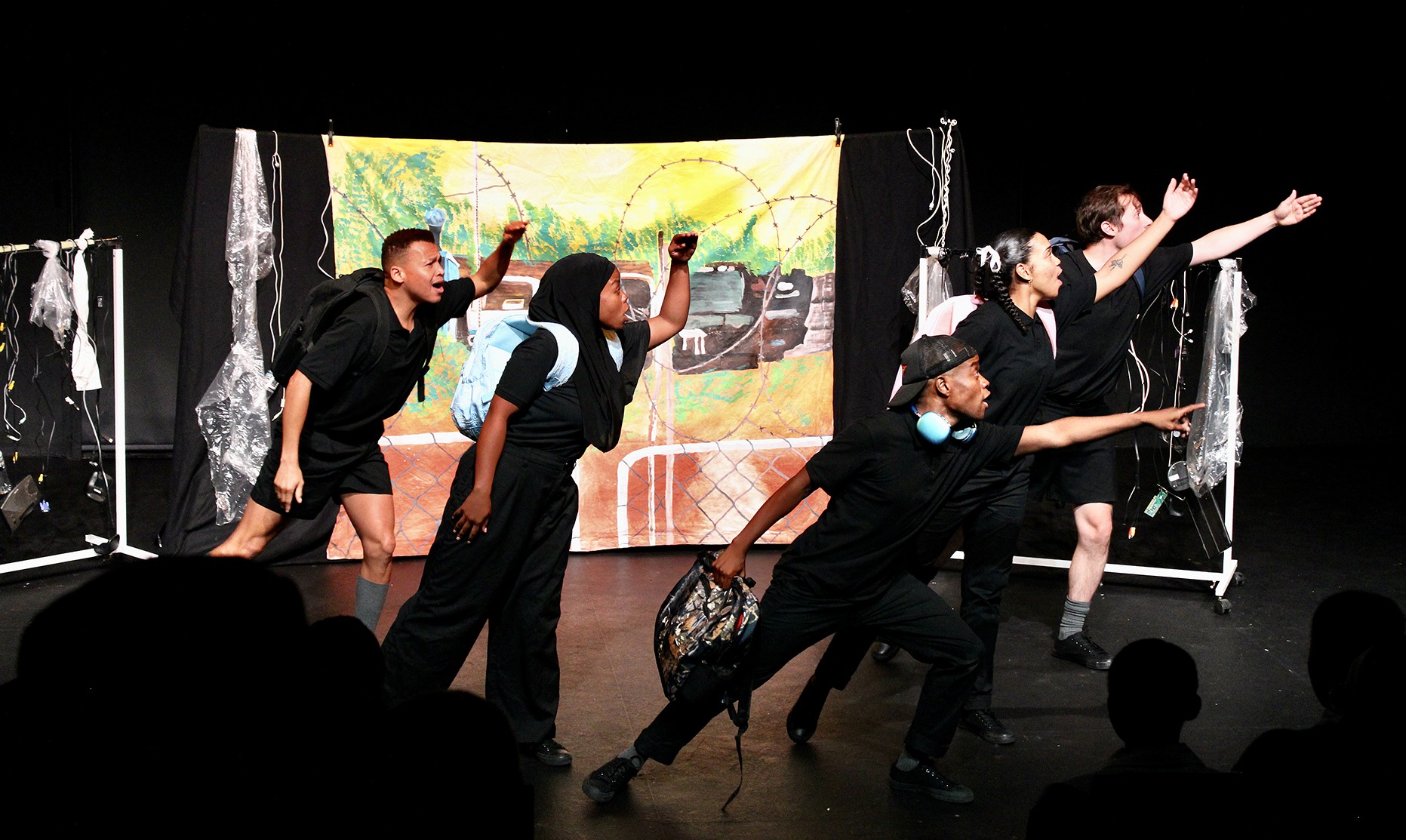
 The Skin We Are In, which is touring schools in Gauteng, highlights the issue of generational racism, self-image and the scientific discovery that all humans originated in Africa. (Photo: Lillian Roberts)
 On 19 March, learners from six Vaal schools settled in to experience the play The Skin We Are In at the Market Theatre in Johannesburg, a production presented by the Windybrow Arts Centre and Turquoise Harmony Institute, in partnership with ASSITEJ South Africa and the South African Human Rights Commission (SAHRC).
The play is an adaptation of the book by Dr Sindiwe Magona and Professor Nina Jablonski. The story follows a multi-racial group of children lumped together for a group project at school, who must work their way through religious, racial and cultural differences.
/file/attachments/orphans/41287D23-0BE6-47A0-A6D2-1418E8EFEE68_1_201_a_933911.jpeg "The Skin We Are In production uses sound effects, music and dancing to set the scene. (Photo: Lillian Roberts)")
The play highlights the issue of generational racism, self-image and the scientific discovery that all humans originated in Africa.
There’s pantsula, rap battles and recycling. There’s Afrikaans, Xhosa and English spoken. The actors don’t rely on many props; instead, the production uses sound effects, music and dancing to set the scene.
It’s a metaphor for social cohesion and nation-building in a post-apartheid South Africa. The play risks centring whiteness (through the character Tim, played by Diego Haimty, and his sense of belonging socially in a new school) and while there is equal time spent on how Njabulo, played by Thabang Chauke, deals with his identity in relation to Tim, it remains in relation to him. They resolve their conflict by focusing on what they do have in common – rap music – and ultimately put their differences aside to form a duo.
The concepts of blackness and whiteness were formed through historical power struggles of colonialism, and remain a social fact, but not a biological reality, the play reminds us.
/file/attachments/orphans/185B8FAE-A048-470F-B084-87FB00A7C375_1_201_a_704179.jpeg "In The Skin We Are In, Tim (played by Diego Haimty) and Njabulo (played by Thabang Chauke) resolve their differences by focusing on what they do have in common – rap music – and ultimately form a duo. (Photo: Lillian Roberts)")
Mosie Mamaregane directed the play, and Omphile Molusi adapted it for the stage. The production uses storytelling, music, dancing and audience engagement to introduce ideas about race, identity and belonging in an age-appropriate way.
After the performance, the actors asked the Grade 4 to Grade 7 children questions about what happened and what they thought it meant. Engagement was high, despite their having to sit still for an hour.
All six schools took the stage to present their interpretations of the importance of human rights and anti-racism, quoting and explaining the Bill of Rights and the Constitution, performing songs and staging a debate on anti-racism.
“It teaches us to stand up for what is right, even if it is difficult,” said a Grade 7 boy during their performance.
The Ahmed Kathrada Foundation and the Gauteng Department of Education (Sebibeng East District) took the 120 learners to see the production during Anti-Racism Week.
Narratives to inspire social cohesion
“So this is what we do as an institute. We are trying to inform and practise social cohesion and nation building,” said Aylan Cetin, from the Turquoise Harmony Institute. “Our focus was mainly on adult people before, [but for the] last five, six years, we have been focusing on young people because changing the mindset of adult people is impossible.”
/file/attachments/orphans/A7EE254B-8AC7-4A73-BCB9-5361CBAEA2F0_1_201_a_716758.jpeg "The Skin We Are In cast: (From left) Khanyisile Ngwabe (Aisha); Diego Haimty (Tim); Bisma Memon (Roshni); Thabang Chauke (Njabulo); and Lesego Molotsi (Chris). (Photo: Lillian Roberts)")
Cetin said that over the last two years with the production visiting 10 schools, he has continued to receive positive feedback about the play’s impact, including from his own children.
Gerard Bester, head of the Windybrow Arts Centre, told Daily Maverick that originally, the play was performed by the Kwasha! Theatre Company.
“One thing I’m really happy about is even though we don’t have the Kwasha! Theatre company, because it was an incubation developing young artists and youth, I’m happy that even with the recasting that we’ve been able to do, it’s still the youth we’re still developing,” said Aroma Lebooa, manager at the Kwasha! Theatre company and administrator at the Windybrow Arts Centre.
“The fact that we’re trying to tour it to schools. I think it’s also creating employment for these young artists, hopefully throughout the entire year.”
Lebooa originally thought the play would be suitable only for those in Grades 6 and 7.
“Now we’ve been doing it for Grade 4s and Grade 5s, and they’ve been taking in the information so well, and are still able to give good feedback. So I think it’s also showing me that, you know, putting in more trust in young people to understand these stories.” DM