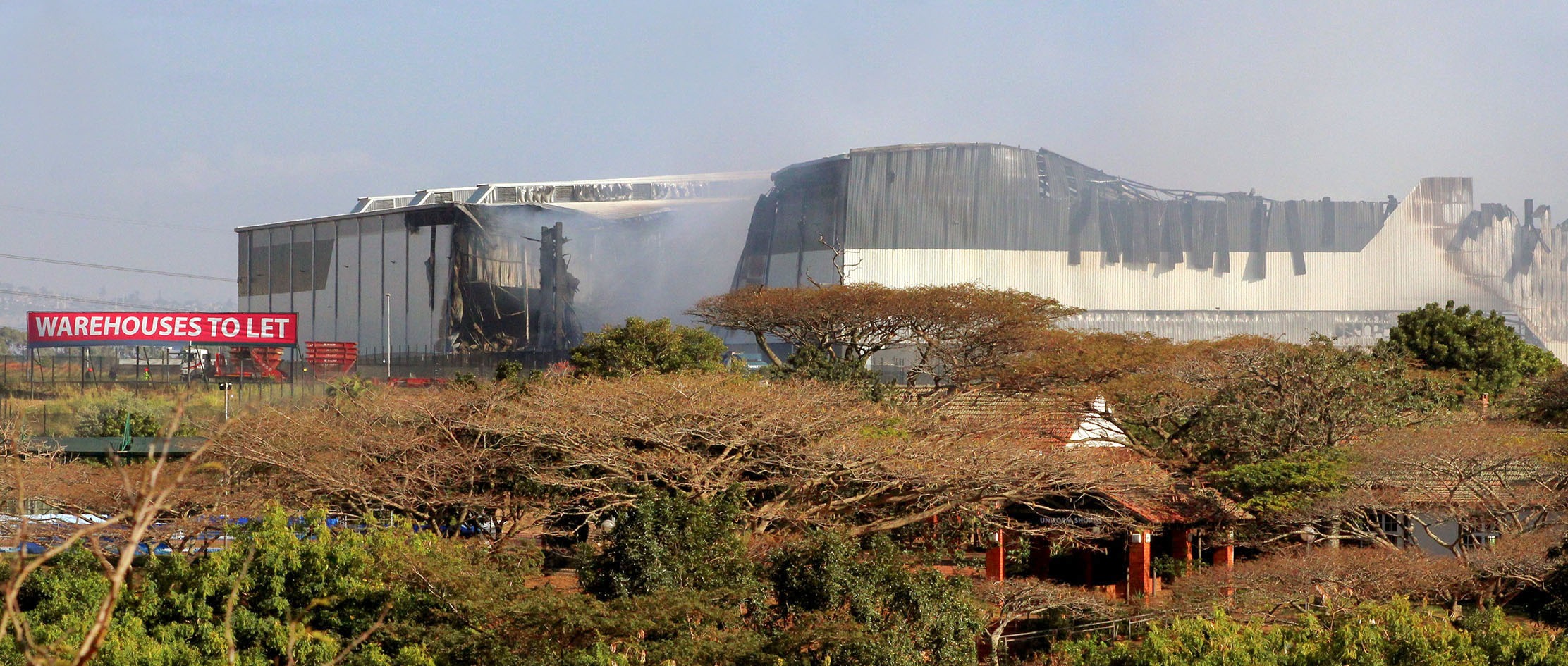
 The UPL chemical warehouse in Durban after the massive chemical fire in July 2021. (Photo Tony Carnie)
 The local subsidiary company of the Mumbai-based UPL agrochemicals group is putting up a fight against a court application that would open the door for a class action lawsuit for damages. This comes in the aftermath of the massive chemical fire in Durban during the 2021 July insurrection.
Lawyers acting for the South Durban Community Environmental Alliance and 12 local residents told Judge Jacqueline Henriques that a class action – a relatively new legal mechanism in this country – would serve the interests of justice.
“Having patently caused major and unprecedented harm to the members of the proposed classes, on the back of an environmental catastrophe, [UPL] appears to be unwilling to take responsibility for the harm that it has caused the human beings that are at the heart of this matter.
“The fact that the majority of such persons are also likely to be among the poorest of the poor compounds the situation,” they argued.
But UPL has engaged a team of attorneys and four advocates to block the proposed class action, arguing that it was the real victim and that the class action route could enable some of the very “looters” who set its warehouse on fire to claim financial damages from the company.
/file/attachments/orphans/tonyclass2DeadfishnearthemouthoftheOhlangeRiversoonafterthechemicalspillPhotoBenCarnie_869983.jpg "Dead fish near the mouth of the Ohlange River soon after the chemical spill. (Photo: Ben Carnie)")
The applicants’ claim was filed last July, just hours before the provisions of the Prescription Act threatened to extinguish future avenues for legal redress for alleged damage to health, livelihoods and wellbeing – including the potential for significant health damage several years from now.
This act sets a general three-year time limit for legal claims to be lodged.
However, before any evidence can be heard, the court has to “certify” that a class action is a suitable legal course. Class actions allow legal steps to be taken on behalf of groups or “classes” of persons.
In this case, the four classes of applicants are made up of:
- Fisherfolk allegedly out of pocket after being deprived of their ability to catch fish and other ocean resources for subsistence purposes because nearly 40km of the Durban coastline was closed for several months due to UPL’s chemical pollution.
- Beach street traders out of pocket for similar reasons.
- Subsistence farmers from the Blackburn Village informal settlement who were unable to grow crops due to the pollution of soils and river water near the chemical spill site.
- Ordinary Durban residents living within a 10km radius of the UPL Cornubia warehouse who allegedly suffered illness or injury from the airborne poison plume.
/file/attachments/orphans/tonyclass4WarningsignsontheUmhlangabeachfrontaftertheCornubiachemicalfirePhotoSheenaCarnie_753979.jpg "Warning signs on the Umhlanga beachfront after the Cornubia chemical fire. (Photo: Sheena Carnie)")
The residents are represented by LHL Attorneys, Richard Spoor Attorneys and two counsel (Andy Bester SC and Ross Bosman). UPL has engaged four counsel to oppose the case (Alfred Cockrell SC, Adrian Friedman, Pranisha Maharaj-Pillay and Ntokozo Qwabe).
The applicants ague that UPL’s attempt to block the case is “unmeritorious”.
“The broad tenor of its opposition is to raise technical objections to the proposed certification. This tack is adopted instead of grappling with the merits of the applicants’ case through a factual rebuttal.”
The residents argued before Judge Henriques that they are only required to establish a prima facie cause of action for certification and to also demonstrate that evidence exists to support it.
At this stage of the legal battle they were not required to prove their case and the court did not need to consider the merits of evidence, the probabilities, or the prospects of success.
Legal duty
They argue that in terms of the National Environmental Management Act (Nema) and other laws, UPL is liable for damages due to its “wrongful and negligent breach of one or more duties of care”. UPL also had a legal duty not to pollute any areas with the chemicals and pesticides under its control.
“[UPL] persists in its contention that it should somehow escape certification merely because (so it contends) it did not set fire to its own facility. For the same reason, it contends that it should be absolved of responsibility for the subsequent chemical spill.”
However, if the company had taken “reasonable steps” to prevent the pollution from the fire and the chemical spill, the harm which the members of the classes suffered would not have ensued.”
They argue that UPL failed to take these steps, despite having known of the risks and having been in a position to prevent them.
“Class actions remain somewhat novel in SA. Merely because the prosecution of a class action may be difficult is not sufficient for the Court to close its eyes to what is, we submit in this matter, a patent wrong for which (UPL) should be held accountable.”
But in its heads of argument, UPL argues that a class action could require the company to pay damages to “potentially thousands of people” who were affected by the arson attack.
“The application lacks a tenable cause of action, rests on class definitions that are overbroad and unworkable, and proposes procedures that would collapse into a morass of individual mini trials.”
UPL ‘a victim, not wrongdoer’
The company’s legal team argues that UPL was a victim, not a wrongdoer.
“Foreseeability and causation are not properly pleaded: the papers do not allege (let alone demonstrate) that the general manner of harm – an arson-driven warehouse fire and its consequences – was reasonably foreseeable to UPL.”
The proposed classes to this action were also too broad “because they inevitably will include some of the looters”.
“It is overwhelmingly likely that members of the classes will include at least some persons who caused the fire, i.e. the looters... It is imperative that the Court guard against a situation arising where the looters are entitled to be members of the classes. To permit this would offend a basic tenet of our law that a person cannot benefit from his or her own wrongful or unlawful conduct.
“We do not suggest, of course, that all, or even most, of the members of the proposed classes were looters – we simply do not know and neither do the applicants. However, the legal convictions of the community would be deeply offended by the notion that looters could have a delictual cause of action against a victim of arson such as UPL.”
The company further pleads that it lost chemical stock valued at about $50-million in the fire, and also incurred a further R575-million in expenditure on environmental containment, assessment and clean-up.
/file/attachments/orphans/tonyclass5SmokepoursfromtheburningchemicalwarehousePhotoSboneloDlamini_598263.jpg "Smoke pours from the burning chemical warehouse. (Photo: Sbonelo Dlamini)")
The company denies that it liable for further financial damages claims under National Environmental Management Act or other laws.
“The present case is a textbook example of one that gives rise to potentially limitless liability. In cases such as Country Cloud and Bewick, and the several cases cited in those decisions, the factual examples of indeterminate liability are invariably similar to the facts of the present case. They relate to a situation in which harm caused in one place, triggers a cascading series of events which, if carried to their logical conclusion, would lead to liability which is either almost limitless, or impossible to define.
“The available facts showed that UPL could not possibly be blamed for the arson attack on its leased warehouse.
“Once the arson occurred, UPL took all possible steps to try to arrest the fire. It was let down by the emergency services which were overwhelmed by the sheer scale of the looting and lawlessness. In these circumstances, it could not be just and appropriate for UPL to be held liable in delict for the consequences of the arson.”
‘Real risk of fraudulent claims’
There was also a “real risk of fraudulent or opportunistic claims, including claims from the looters, but it will become impossible to allocate damages fairly and consistently across the classes”.
Responding to UPL’s concerns about any “looters” claiming damages, the residents says this fear is no reason to invalidate the entire class action.
“To do so would not be in the interests of justice, and most certainly would not be in the interests of the thousands of other class members who would essentially lose their right to vindicate their claims.”
This fear could be remedied easily by adding a condition to class membership stipulating that no person convicted of arson at UPL would be allowed to benefit from the proposed class action.
Lawyers representing the current 12 applicants say that anyone who believes they may be eligible to join the class action is encouraged to register or to find out more by visiting this link.
After two days of legal argument, on March 18 and 19, the case has been postponed to March 24 for final arguments. DM