



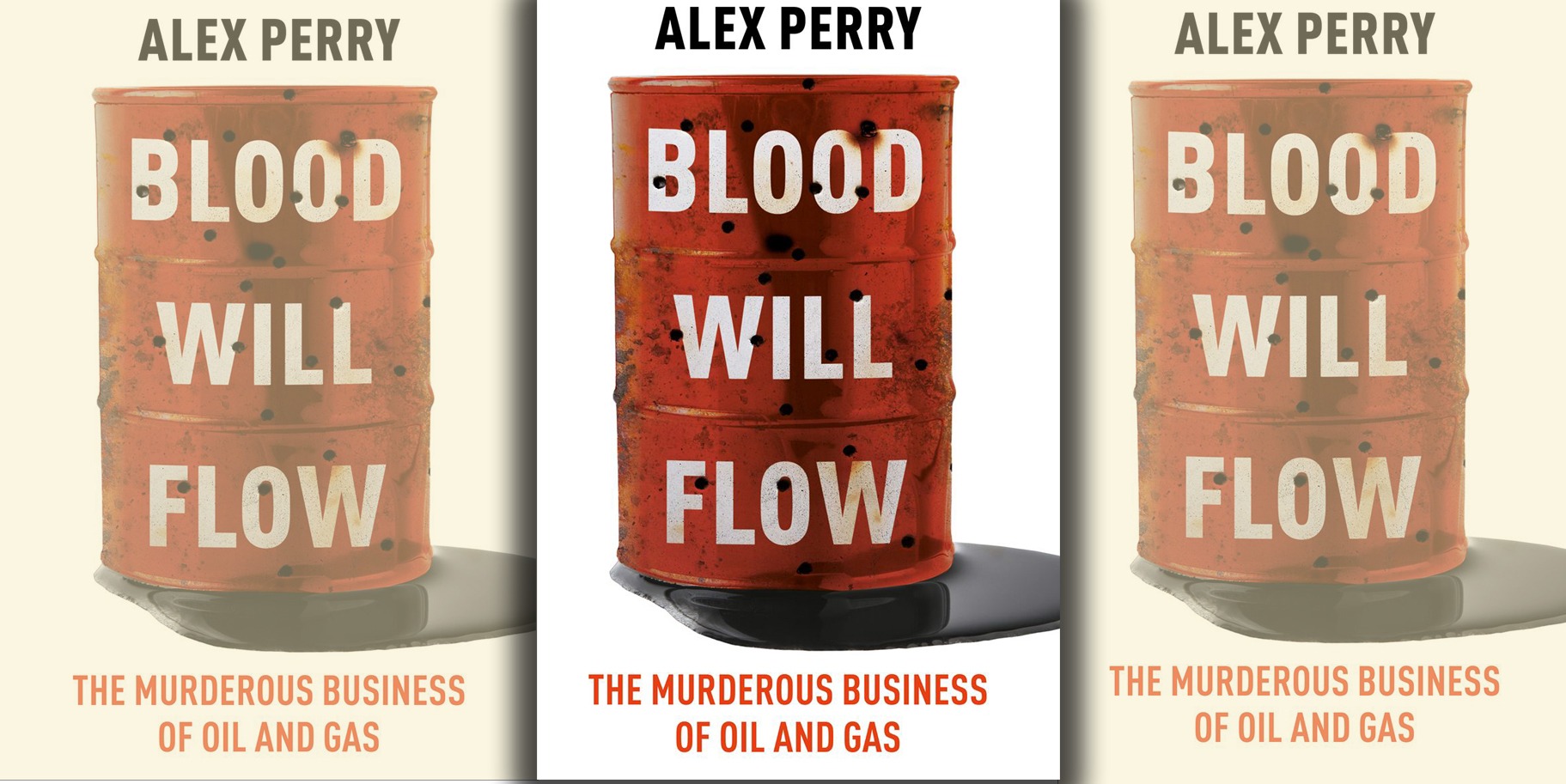
 In ‘Blood Will Flow’, Alex Perry details the horrific massacre of 1,355 people in Mozambique linked to Total’s gas plant. (Photo: Supplied)
 Between March and June 2021, 1,355 people were murdered and 209 abducted by Islamist insurgents outside the gates of French oil giant Total’s gas plant in Palma, an impoverished town in northern Mozambique.
This was the second deadliest terror attack in history, topped only by Osama bin Laden’s 9/11 atrocities in New York and Washington. Yet as the blood flowed and heads rolled, Total — scandalously unprepared for the scale of the assault — effectively abandoned the victims to their ghastly fate.
The anatomy of this massacre and Total’s callous response to it have been clinically dissected in Alex Perry’s new book “Blood Will Flow: The Murderous Business of Oil and Gas”. Daily Maverick obtained a copy in advance of its South African publication.
In this gripping page-turner, Perry has done a service to history and the victims by unearthing the buried details of this appalling crime and setting it firmly in the context of the hydrocarbon industry’s plundering past.
/file/attachments/orphans/RC20VP9QGLVU_941675.jpg "A soldier from the Rwandan security forces stands outside the Amarula Lodge hotel, in the Mozambican town of Palma on 22 September. (Photo: Baz Ratner / Reuters)")
Tracing the spoor of the massacre led Perry from the scene of the crime in northeastern Mozambique to northeastern Oklahoma — at first glance, an unusual detour but one that connected the dots of oil’s bloodstained history.
“In the months and years after the Palma massacre, when I went looking for answers to what happened there, I found myself one day in a cemetery in Pawhuska, northeast Oklahoma, just south of the Kansas state line,” writes Perry.
“In what became known as the ‘Reign of Terror’ in 1920s Pawhuska and nearby Fairfax, and Hominy, a group of white men married into the wealthy Osage tribe, assumed their riches and, in about sixty cases, killed them.”
The Osage murders have been the subject of several books and a 2023 movie, “Killers of the Flower Moon”. This Native American tribe had been uprooted several times from their ancestral land before being dumped by the US government in Kansas in 1825.
/file/dailymaverick/wp-content/uploads/2024/02/Killers_of_the_Flower_Moon_Photo_0128.jpg "Leonardo DiCaprio as Ernest Burkhart in 'Killers of the Flower Moon'. (Photo): Paramount Pictures")
The Osage eventually wound up in Oklahoma, which, for South African readers, effectively consisted of Native American Bantustans.
“Few Americans today would describe the mass removal of an indigenous people in the terms used by politicians, soldiers, journalists, and historians back then: as the necessary marginalization and extinction of a savage people by a superior one in the name of progress, Christian civilization, and the Manifest Destiny of a fledgling nation,” writes Perry.
The land the Osage eventually occupied turned out to be brimming with oil.
“In 1906, the tribe’s elders gave a single oil ‘head-right’ to each of the 2,229 individuals who could show they were at least one thirty-second Osage. By 1923, a collective annual income of $400-million from those rights made the Osage, per capita, the world’s wealthiest people,” notes Perry.
And that mana from heaven would trigger the Reign of Terror — a prelude to the “resource curse” that would haunt marginalised peoples around the world who happened to live in the vicinity of oil or other sources of resource wealth.
“If you consider that the curse is invoked by greed and routinely manifests as violent, acquisitive racism, you can spot its dark presence through history,” writes Perry.
“Before I arrived in Oklahoma, I’d wondered about the connection I was making between the Africa of today and the America of a hundred years ago. But when I described the Palma massacre to the Osage, they understood immediately. What happened in Africa had happened to them, they said.”
This is the thread that links a US Bantustan to an African gas project.
“Oilmen displaced Native Americans in Oklahoma, but also Alaska, Colorado, the Dakotas, Montana, Nebraska, New Mexico, Texas, Utah, and Wyoming. When the business expanded overseas, they did the same in South America (with Amazonian and Andean tribes in Venezuela, Colombia, Peru, Brazil, and Bolivia), Africa (with minorities in Nigeria, Gabon, Equatorial Guinea, Angola, Congo, and Tanzania), Europe (with Arctic peoples in Siberia, and Tartars in Urals-Volga), the Middle East (with the Kurds),” and on and on.
Unwanted disasters
Along the way, the industry has drawn unwanted attention to itself through disasters that occurred in developed Western countries, where it could not escape the spotlight of scrutiny.
There was the fireball that killed 167 workers on an oil rig off Scotland in 1988, the calamity of the Exxon Valdez and the 40 million litres of crude oil it spilled into pristine Alaskan waters, the Total tanker that fouled the beaches of Brtianny in 1999, and the 2010 Deepwater Horizon explosion in 2010 — the world’s worst oil spill, which this correspondent covered first-hand for Reuters.
“All four fiascos occurred in North America or Europe. All were accidents. And all led to sweeping corrective action: billion-dollar fines and clean-ups, and new laws and regulations,” Perry pointedly notes.
/file/dailymaverick/wp-content/uploads/BP-Oil-Spill-Court-Case.jpg "Fire boat response crews battle the blazing remnants of the offshore oil rig Deepwater Horizon off Louisiana on 21 April 2010. (Photo: US Coast Guard)")
But in 2021, when atrocities linked to a gas project swept northern Mozambique — with a human cost that dwarfed any of those incidents — it was dispatched down the memory hole. Occurring in a remote part of Africa, it was rendered invisible.
“Mozambique stood out not just for its scale, but what it said about the international energy business. It was not unexpected. Plant managers had predicted it for years. Nor was it accidental. The dead were all murdered. Yet this unprecedented, foreseeable calamity generated few headlines and led to no remedial measures, no new laws, and no fines. Even today, most people have never heard of it,” writes Perry.
This finely-crafted and deeply researched narrative takes Total to task for its shocking indifference to a tragedy it should have seen coming — and, as Perry’s detailed reporting shows, could have done much more to save those who were butchered in the mayhem.
Total’s press office did not respond to a request for comment from Daily Maverick.
‘The Bulldozer’
Patrick Pouyanné, Total’s CEO since 2014, is a central character. Nicknamed “The Bulldozer” for his hulking frame and matching temperament, his reputation was that of a classic micro-manager whose vision for the company was set in stone — in short, an autocratic corporate titan. Total’s press office has dismissed such a portrayal as “misplaced and baseless”, reports Perry.
One goal that long obsessed Pouyanné was reeling in a big gas find as he attempted to paint Total in a green sheen that was on board with the just energy transition — natural gas having a lower carbon footprint than the likes of oil and coal.
“One effect of the monocracy was to allow Pouyanné to impose his personal appetite for risk on Total,” writes Perry.
And so — allegedly over a dinner with Vicki Hollub, the CEO of Occidental — “Pouyanné took the decision to spend $3.9-billion on a giant undeveloped gas field in a war zone on the far side of the planet alone.”
/file/attachments/2989/2026-03-19_11-32-49_530311.png "Total CEO Patrick Pouyanné. (Photo: Wikipedia)")
The insurgency led by the ruthless al-Shabab commander Bonomade Machude Omar had already been in full swing for two years at that point in Mozambique’s Cabo Delgado province. It began on “October 5, 2017, with thirty fighters, three AK-47s, and a pile of machetes”.
And among the kindling that set Omar’s revolution alight was the sight of the smallholdings and farms where he had played as a child being swallowed up by a foreign hydrocarbon company.
But as Omar's insurgency spread like wildfire, Pouyanné appeared oblivious to the scale of the threat, confident in Total’s private security arrangements and a deal he had struck with the Mozambican government for the deployment of its ill-trained, corruption-prone and human rights-abusing army in the region for a pittance.
This brushed aside warnings from a consultancy that a financial relationship with Mozambique’s security forces made Total and its gas project a target in the war, as it had effectively taken sides.
‘Some security issues’
“We face clearly some security issues,” said Pouyanné in a live webcast to shareholders on 10 February 2021. “My highest priority is security, not only of our staff but also the staff of our partners who work onshore. But we have a clear plan, securing an area of at least 25 kilometres around the project.”
That would lead to the full resumption of operations. To much fanfare, Total on 24 March 2021 announced its return to Palma and said that the project was back on track — oblivious to advances that Omar was making, which were on the radar screens of others.
“Whether because of Pouyanné’s newly centralized security operation, poor intelligence from the Mozambican army, the halt to briefings from Western spy agencies, or a simple reluctance by Total or CCS managers to pass on bad news, the company’s executives were among the few not to know about Omar’s advance,” writes Perry.
Total issued its press release at 8am Paris time. At 10.30, Omar launched his attack.
/file/dailymaverick/wp-content/uploads/2022/12/9191655.jpg "Mozambican soldiers patrol the streets of Palma on 12 April 2021. (Photo: Joao Relvas / EPA-EFE)")
Perry painstakingly narrates the bloody events that unfolded in chilling detail, and the bottom line is that Total was caught off guard, then left thousands of people stranded.
One of Total’s most egregious actions — or inactions — was its refusal to provide aviation fuel for aircraft to fly in and bring people out of the killing zone.
“Total actually made the stuff,” Perry witheringly writes. “The company boasted that an aircraft filled up with Total avgas or jet fuel every thirty seconds.”
And yet, it refused to provide fuel to the Dyck Advisory Group (DAG), a South African private security outfit hired by the Mozambicans to train its police and which had the aircraft — and willing personal and capability — to effect such a rescue mission.
/file/attachments/orphans/AFP_20210331_97639B_v1_HighRes_MozambiqueUnrestJihadists_968070.jpg "People evacuated from the city of Palma arrive on a humanitarian flight at the airport in Pemba on 31 March 2021. (Photo: Alfredo Zuniga / AFP)")
“Total would later try to justify its action by claiming it was concerned that DAG’s rescuers were actually human rights abusers, citing a report by Amnesty International that was later found to be inaccurate,” says Perry.
“Once the attack began, Total flew its managers out, closed its gates to its own workers and fleeing civilians, and failed to assist DAG, the only organization actively rescuing people from Palma.”
Among those left behind were hundreds of subcontractors and other workers — but Total ignored their plight. And in its 2021 annual report, it reported only one fatality among its staff and contractors worldwide.
“In the months and years after the massacre, when I asked survivors to tell me their stories, I was surprised by how many fixated not on the rebels, from whom they expected barbarism, but Total, from whom they expected better,” writes Perry.
Will there be a reckoning?
For the odious Omar, his time came in August 2023 when he was killed — most likely by highly-trained Rwandan forces which swept in and took out hundreds of his fighters. One of the things that struck this reviewer was that Perry says his last stronghold in the forest was “fortified with landmines” — almost a decade after the country was declared landmine-free.
“TotalEnergies let Omar’s death pass unmarked. The company position was that the war had nothing to do with it. It was for the same reason, Palma’s survivors supposed, that in the years after the attack, Total never contacted its subcontractors, nor the families of those killed in Palma, nor the survivors of the gatehouse executions — no one, in fact, to express condolences, or ask what happened, or even find out who was dead and who alive,” writes Perry.
But Perry dug up those details, launching a survey involving a team of dedicated researchers who went door-to-door in Palma and surrounding villages that eventually cost $20,000. That money came from a $25,000 prize he won for his reporting on the massacres for the US magazine Outside.
“We designed a simple survey that would identify affected individuals (name, gender, age, address, and contact number for relatives) and categorize what happened to them (shot, beheaded, drowned, abducted, other cause of death, unknown cause of death, and missing),” he writes.
A morbid yet important task. But one in which Total had no interest in undertaking.
As for Total and its executives, a day of legal reckoning may be coming. In March last year, a French prosecutor announced a formal investigation into the company for involuntary manslaughter over the killing of 55 of its workers in Mozambique. The probe is also looking into allegations of failing to assist persons in danger.
“Perhaps most significant: of the fifty-five dead workers at the centre of the investigation, fifty-three were Black Africans. On their behalf, in pursuit of justice and retribution, a European state prosecutor would be interrogating a European oil and gas giant, whose riches had been built on European colonialism in the Middle East and Africa,” writes Perry.
This book is a powerful indictment of the oil industry, and essential reading for anyone interested in this sordid chapter of its history in Mozambique. DM