



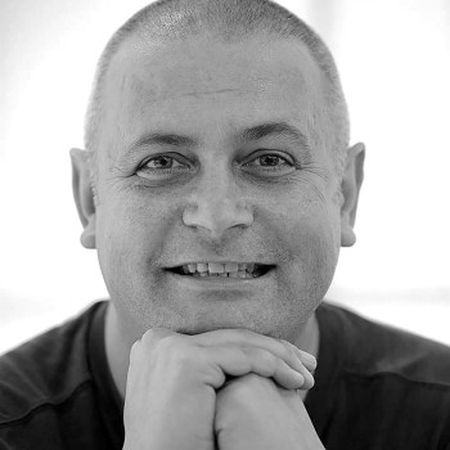
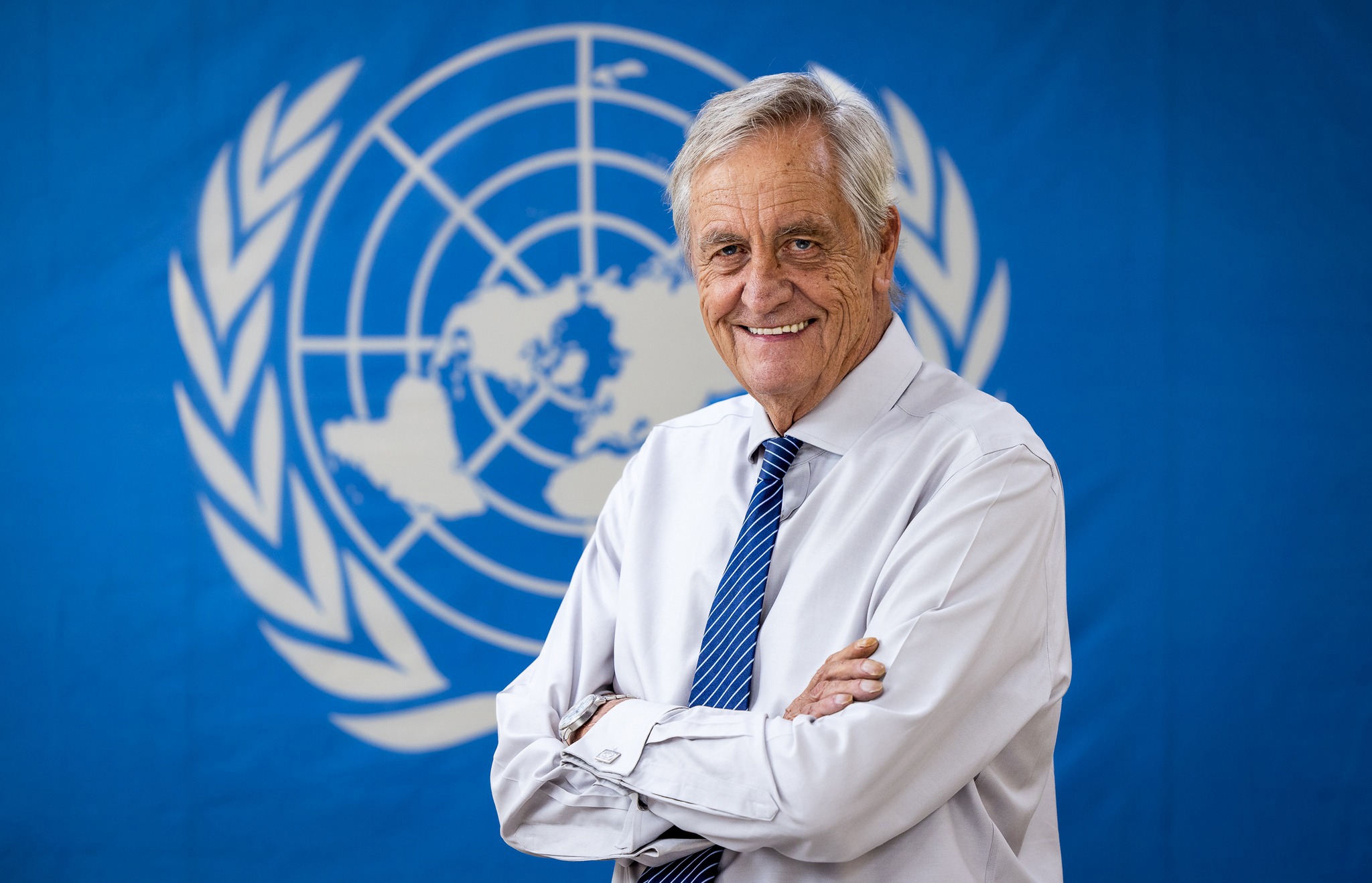
 The Special Representative of the Secretary-General and Head of the United Nations Mission in South Sudan, Nicholas (Fink) Haysom.
(Photo: British Embassy Juba / Fecebook)
The Special Representative of the Secretary-General and Head of the United Nations Mission in South Sudan, Nicholas (Fink) Haysom.
(Photo: British Embassy Juba / Fecebook) Nicholas “Fink” Roland Leybourne Haysom (1952–2026)
There is a story told at the University of Cape Town about how Nicholas Haysom came by his nickname. On 21 April 1952, the day he was born, a mix-up at the hospital led to him being briefly swapped with another baby, the infant of a Mrs Finkelstein, who noticed immediately that the blue-eyed, blond child brought to her was not hers.
After the error was corrected, the Haysom baby was returned to his mother still wearing the Finkelstein label. The name stuck. For the rest of his life, the world knew him not as Nicholas Roland Leybourne Haysom but as Fink: lawyer, human rights activist, constitutional architect, and one of the most trusted diplomats the United Nations deployed into the world’s most difficult places.
/file/attachments/orphans/652341117_1612210930914779_7813556696682116840_n_455657.jpg "The Special Representative of the Secretary-General and Head of the United Nations Mission in South Sudan, Nicholas (Fink) Haysom. (Photo: Eye Radio / Facebook)")
Nicholas “Fink” Haysom died on Wednesday, 18 March 2026, in New York City, following a short illness. The nature of his illness has not been disclosed. He was 73 and was serving as the United Nations special representative of the secretary-general for South Sudan and Head of the United Nations Mission in South Sudan. He is survived by his wife, Delphine, five children, and two sisters. He had previously been divorced.
Not much is known about his childhood, but he was educated at Michaelhouse in the KwaZulu-Natal Midlands, an Anglican boys’ school whose particular brand of liberal conservatism sat in some tension with the radical trajectory of one of its most distinguished alumni.
/file/attachments/orphans/654462073_10161865637915633_6653864780499852320_n_997610.jpg "A young Fink Haysom at home during a hot summer in Bidston Road, Durban, December 1979. (Photo: Andrew Boraine / Facebook)")
From there, he studied law at the University of Natal before moving to the University of Cape Town, where he was elected president of the Students’ Representative Council. The late 1970s were not an easy time to be a student activist in South Africa. For the right kind of person, they were clarifying.
In 1976, the year of the Soweto uprising, with many of its leaders detained and the organisation in disarray, Haysom became president of the National Union of South African Students (Nusas). The regime took note. He was detained without trial on several occasions, the last time for several months, part of it in solitary confinement. Later, he was served with a banning order that effectively placed him under house arrest for two years. Such experiences either break people or define them. In Haysom’s case, he showed the establishment the middle finger.
Jay Naidoo, the anti-apartheid activist, trade unionist and former Cabinet minister, first encountered Haysom and his colleague Mary Ann Cullinan in 1979, in what he describes as a South Africa “burning with repression and possibility.”
Naidoo had been shaped by the aftermath of the Soweto uprising and the murder of Steve Biko. He was 25, operating underground, in a world where many were detained and many others had gone into exile. He describes Haysom and Cullinan as among the first white comrades who treated him as an equal in both the Struggle and life. “Through them, and through the emerging union movement,” he says, “I began to understand organisation, discipline, and the deeper meaning of working-class solidarity.”
When his banning order was lifted, Haysom turned his energies to the law as a weapon. He helped found Cheadle Thompson & Haysom, a human rights law firm in Johannesburg, with Halton Cheadle and Clive Thompson. He later served as associate professor of law and deputy director at the Centre for Applied Legal Studies at Wits, litigating high-profile human rights cases and producing rigorous academic work on vigilante violence, labour law, forced removals and the legal architecture of apartheid.
But his life was not all about law. He won the South Africa Playwright of the Year award in 1987 for The Native Who Caused All the Trouble, a detail that sits unexpectedly among his other credentials, and which those who knew him well find entirely in character.
/file/dailymaverick/wp-content/uploads/peterfab-fink.jpg "Archive photo of Fink Haysom following a United Nations Security Council session regarding renewal of the mandate for the UN Assistance Mission in Afghanistan at which he offered a report. (Photo: Albin Lohr-Jones / Pacific Press /LightRocket via Getty Images)")
The artist Kevin Collins says: “My memories are from the 1970s when he managed to get me out of a police cell after being bitten by a police dog for protesting outside St George’s Cathedral in Cape Town, and I’m not sure I thanked him properly for this brave gesture. He was always the most decent guy. What amused Fink most was that I was able to swear at the cops in Afrikaans.”
As apartheid began its long unravelling, Haysom moved into what he called “the low-trust world of mediation”. In Thokoza on the East Rand, he negotiated a truce between warring hostel dwellers and ANC-aligned township residents. It was dangerous, unglamorous work, and exactly the kind that would prepare him for what followed. He then played a quiet but significant role in negotiations for South Africa’s interim and final Constitutions.
When Nelson Mandela became president, Haysom was appointed his chief legal and constitutional adviser. He was, by all accounts, indispensable, present for the legal mechanics of the new democracy and available for matters of both high policy and personal judgment.
Zelda la Grange, Mandela’s private secretary and confidante for nearly two decades, recalls the easy trust Mandela placed in him. “Whenever Madiba didn’t have the appetite for long-winded process, he would leave it to Fink to resolve.”
David Coltart, the Zimbabwean human rights lawyer, former minister of education, sport, arts and culture, and current mayor of Bulawayo, first became aware of Haysom’s reputation as a student at UCT through his role in Nusas and the anti-apartheid movement.
He came to know him personally during the years when the Movement for Democratic Change challenged Robert Mugabe’s rule. “He assisted us generally and me personally in a variety of ways,” says Coltart, “giving us advice and also communicating with senior figures in the ANC, including Nelson Mandela.
“He was absolutely steadfast in support of our struggle to promote democracy and respect for the rule of law in Zimbabwe.” Haysom later wrote the foreword to Coltart’s memoir, The Struggle Continues: 50 Years of Tyranny in Zimbabwe.
“He managed to strike a balance,” says Coltart, “between being a profoundly significant and courageous fighter for justice and someone who had a remarkable personal touch and genuine humility.”
Coltart remembers a brilliant lawyer who also had a wonderful sense of humour, a sparkle in his eyes, and a sincere concern for the plight of others. “He was a benchmark for younger lawyers like me.”
/file/attachments/orphans/652328194_10162974014917613_6521144151957067885_n_873268.jpg "‘A brilliant lawyer with a wonderful sense of humour.’ (Photo: David Coltart / Facebook)")
After leaving the Presidency, Haysom took South Africa’s lessons into a fractured world. He worked on the Burundi peace talks, chaired constitutional negotiations, helped Iraq draft its transitional constitution, and served in Timor-Leste, Sri Lanka, Colombia, Myanmar and Indonesia. He became the UN’s go-to constitutional lawyer for broken states.
/file/attachments/orphans/GettyImages-83827523_410503.jpg "Fink Haysom speaking at a conference sponsored by the UN and the Centre for Conflict Resolution in Cape Town on 17 October 2007. (Photo: Jonathan C Katzenellenbogen / Getty Images)")
Nono Dihemo, senior gender adviser to the United Nations Assistance Mission in Afghanistan and a South African lawyer based in Kabul, recalled working alongside Haysom in Iraq during the constitutional reform process. “In moments when negotiations seemed endless,” she said, “you would smile and say, ‘talks about talks about talks’, a reminder that peacebuilding is never linear, but always worth the patience, the discipline, and the belief.”
Humility and humanity
She described him as an intellectual force who carried his brilliance with humility and humanity. “Whenever I reached out for advice, no matter where in the world he was, he responded with clarity, wisdom and kindness. He was present, thoughtful, and deeply committed to the work and to the people behind it.”
Haysom served with the United Nations Assistance Mission for Iraq. His involvement in world politics was endless. He moved to Afghanistan as deputy special representative, eventually becoming head of mission, before being appointed special envoy for Sudan and South Sudan.
Abdul Mohammed, senior African diplomat, mediator and political analyst, first encountered Haysom during the negotiations for the Sudan Comprehensive Peace Agreement. Writing in Amani Africa Media and Research Services, he describes a man who belonged to a fading breed: those who approached diplomacy not as a profession but as a vocation.
“He did not dominate the room; he stabilised it. He did not rush to solutions; he cultivated them patiently.” His defining quality, Mohammed says, was the discipline of listening: “Not as a formality, but as a moral act.”
The secretary-general of the United Nations, António Guterres, said he was “saddened” by Haysom’s death. In a formal statement, he said that Haysom had devoted his life to justice, dialogue and reconciliation, and that in every task he had combined deep legal insight with sound political judgment and an unwavering dedication to improving the lives of people.
Sarah Crowe (former spokesperson for UNICEF Executive Director) worked with Nicholas Fink Haysom in 1984 in the Vaal Triangle on an investigation into the conduct of the police in the township violence, detailing the abuse, rape and torture, on behalf of the Southern Africa Catholic Bishops (headed by Archbishop Denis Hurley and Smangaliso Mkhatshwa).
"Fink was a quiet colossus on the UN stage,” she says. “It was as if South Africa became too small for him after the Mandela era – driven to apply the lessons he learnt here globally.
"I was immensely proud to witness not only his impact globally – very often behind the scenes – on the Horn of Africa, in Kabul, South Sudan and in New York, commanding deeply contentious negotiations with an eloquence, compassion and always great humour, great laugh, but also how pertinent and powerful his South African history was for the world then. He was the best of us," she says.
/file/attachments/2988/13776314_776799.jpg "UN Secretary-General António Guterres. (Photo: Valentin Flauraud / EPA)")
There is an unspoken rule among obituarists: don’t just focus on the triumphs. Find the dark side. Admittedly, it wasn’t easy in this case; this obituarist has a nose for tittle-tattle and couldn’t find anything.
However, there are those who recall another side; alas, not a shady side. Haysom was a gourmand and an ardent lover of food. Erica Platter, a journalist and food and wine writer, knew him through his sister. “Fink, brother of my school, university, journo friend Cheetah, enjoyed food and cooking, and was the most exotic contributor to two books which I researched and edited: Durban Curry — So Much of Flavour and Durban Curry Up2Date. Durban boys do not have to braai. But they should know their curries, which Fink did,” she says.
It is the kind of detail that resists the flattening tendency of public eulogies: the man who helped negotiate the end of apartheid and the separation of two African nations also knew his way around a curry pot.
/file/attachments/orphans/OneofFinksCurryRecipes_542968.jpg "One of Fink Haysom’s curry recipes. (Source: Erica Platter)")
Mohammed, who ends his tribute with the word “Farewell, Comrade,” perhaps captured him best: “Fink did not simply practise diplomacy. He dignified it.” DM