




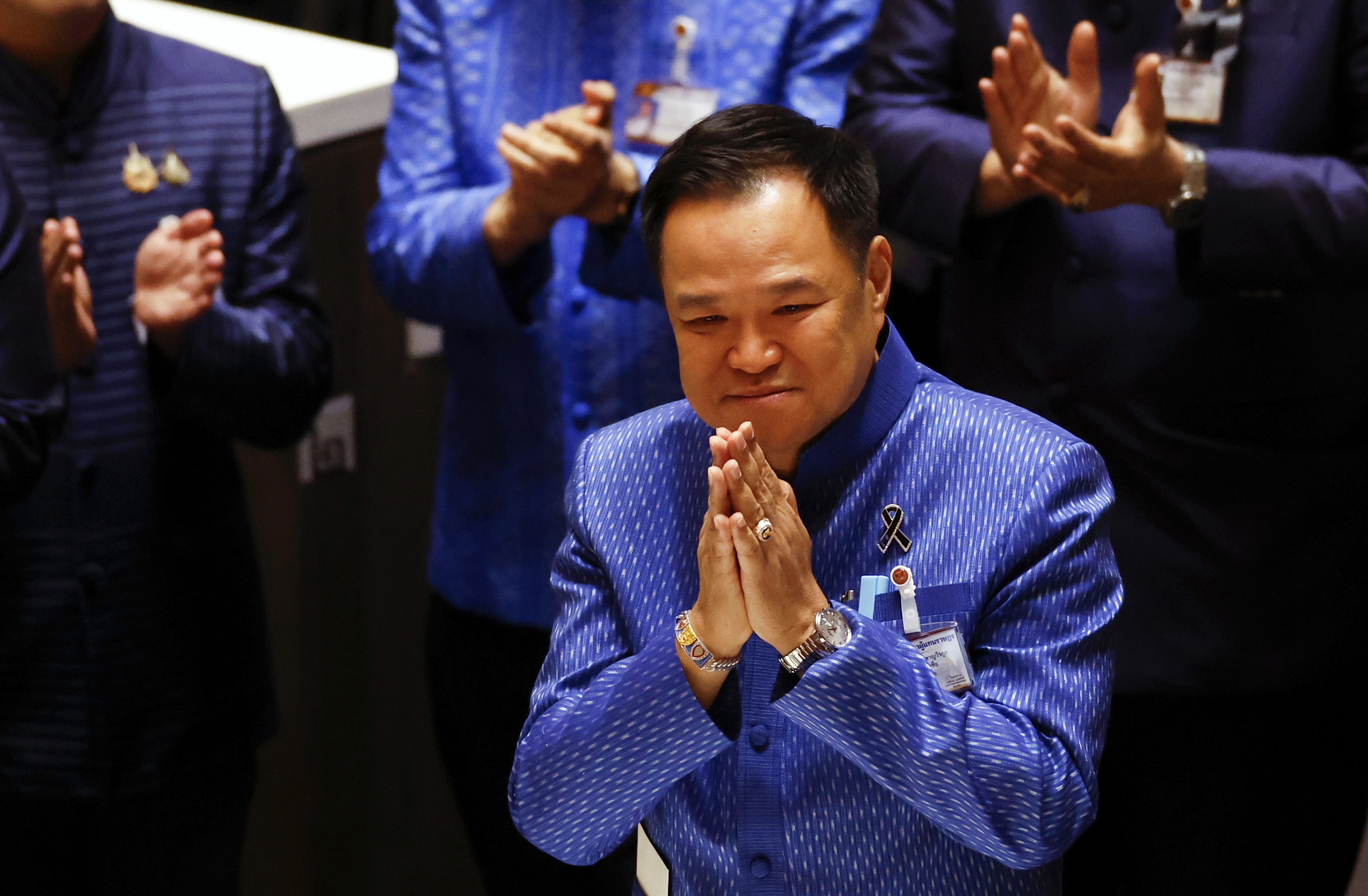
 Bhumjaithai Party's leader Anutin Charnvirakul (C) greets lawmakers to thank them after being re-elected as prime minister during a House of Representatives meeting session to vote for a new prime minister at Parliament in Bangkok, Thailand, 19 March 2026. Anutin Charnvirakul, the Bhumjaithai Party leader and current caretaker premier, was re-elected as prime minister after leading his party to win the 08 February general election. EPA/RUNGROJ YONGRIT
 The Bhumjaithai Party's Anutin led from the start in rout of his biggest rival, Natthaphong Ruengpanyawut, leader of the progressive People's Party and the surprise runner-up last month in an election it had been widely expected to win.
Anutin won the backing of 293 of parliament's 499 members on Thursday, more than twice the 119 votes Natthaphong secured.
He offered no immediate comment on his victory, but headed into a meeting on energy security.
"Thailand has no issues and is able to still buy oil," Anutin said after the meeting. "We will ensure public confidence."
Earlier, dressed in Thai traditional attire in his party's hue of blue, a beaming Anutin had greeted a succession of allies in parliament, shaking hands and posing for photographs.
OPPORTUNITY SEIZED
In a stunning turnaround for a party that had struggled to make its mark in Thai politics, Bhumjaithai decisively won last month's election, riding on a wave of nationalism unleashed by military clashes with neighbouring Cambodia last year.
Much of Anutin's success comes from his opportunism in seizing on the decline of the once dominant Pheu Thai party, first by abandoning its coalition government and then manoeuvring swiftly to form his own after a court sacked a second prime minister in the space of just over a year.
Bhumjaithai's coalition pact with the politically bruised Pheu Thai and a crew of small parties stood firm in Thursday's vote, as Anutin comfortably reached the necessary threshold of 51%.
Earlier, Anutin, 59, had pledged to immediately start forming a cabinet and resolving Thailand's problems.
"Your voices are equally heard," he told lawmakers from outside his alliance. "I'm ready to accept suggestions ... We all have the same goals - the wellbeing of the people."
Staunch royalist Anutin weathered two decades of upheaval in tumultuous Thai politics by strategically positioning his party between elites warring in an intractable power struggle to ensure its role in successive coalition governments.
PROSPECT OF STABILITY
He now has his first clear mandate to lead a country with a long-stuttering economy shackled by massive household debt and facing headwinds from trade uncertainty and the fallout of the U.S.-Israeli war on Iran.
A political veteran and son of a former cabinet minister who once ran his family's construction firm, Anutin is a former deputy premier, interior minister and health minister who served as Thailand's COVID-19 tsar.
Although seen as a conservative, Anutin gained notoriety for leading a successful campaign to legalise cannabis, which led to an unregulated surge of thousands of marijuana retailers.
His survival instincts and ability to straddle political divides could prove his biggest asset, some analysts say, as Bhumjaithai escaped the wrath of Thailand's powerful military and judiciary, the engineers of the downfall of multiple governments and parties.
Prospects for medium-term stability were good, with Bhumjaithai holding sway in both houses of parliament and Thailand's axes of institutional power appearing to be behind Anutin, said political scientist Napon Jatusripitak.
"It's the first time in a long while that the referee and the players are on the same side," added Napon, of the ISEAS–Yusof Ishak Institute in Singapore.
"There's control," he said. "And we have a highly fragmented opposition."
(Reporting by Panu Wongcha-um, Chayut Setboonsarng, Kitiphong Thaicharoen, Panarat Thepgumpanat and Devjyot Ghoshal; Writing by Martin Petty; Editing by Raju Gopalakrishnan)