




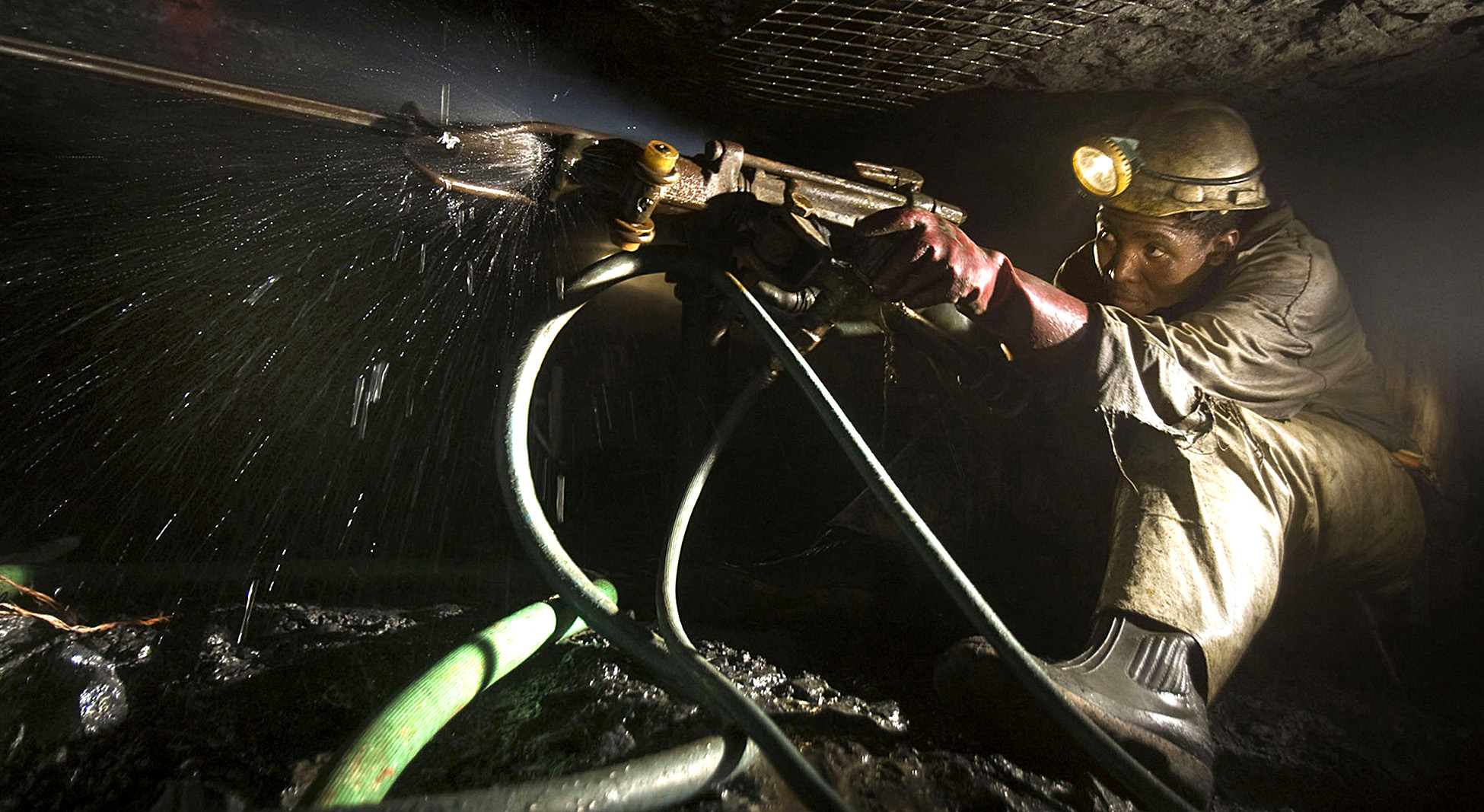
 Mineworkers deep underground at the Impala Platinum mine in Rustenburg. (Photo: Nadine Hutton / Bloomberg via Getty Images News)
 Hydrogen is the future of the platinum industry and always will be.
That, at least, has long been the narrative: lots of hype about the “hydrogen economy” and its implications for platinum, which is a critical catalyst for fuel cell technology and the green energy it heralds. Hydrogen fuel cell adoption in vehicles is seen as a potentially huge driver for platinum demand to counterbalance the uptake of electric vehicles, which don’t require the precious metal.
But the talk has always run way ahead of concrete action.
It is now back on the radar screen of platinum group metals (PGM) producers – not least because under the radar, commercialisation has been taking place in China. And this comes against the backdrop of a little-reported push by South Africa's Department of Mineral and Petroleum Resources (DMPR) to open a vast swathe of the Bushveld to natural hydrogen exploration.
“Our view before was that there had been an overpromise regarding hydrogen ... we now believe the world is potentially underestimating hydrogen,” Northam Platinum CEO Paul Dunne told a PGM conference in Johannesburg on Thursday, organised by Resources For Africa.
The pessimism that had set in regarding the potential of hydrogen as a catalyst for platinum demand was based on the fact that the hype had long been just that – hype.
“We expected hydrogen in the 90s to go commercial in 10 years, and in the noughties in 10 years, and in the 2010s in 10 years. There was a persistent over-expectation in terms of timing,” Dunne told Daily Maverick in an interview on the sidelines of the conference.
“We always knew there was a possibility for fuel cells; it was not an unknown technology. But on the rate of adoption and commercialisation, I think we overestimated the timelines. So we got disillusioned.”
Chinese adoption
The renewed sense of optimism Dunne spoke of at the conference sprang from previously opaque developments in China.
“We picked up that there was adoption technology emerging there from one of our big Japanese customers, Mitsubishi. They mentioned that they are now supplying a Chinese company [with] catalysts for fuel cells. Our ears pricked up,” Dunne said.
On a visit by Northam executives to China to verify what was going on there, what they discovered was “very, very surprising in terms of the commercialised status of fuel cells”.
/file/dailymaverick/wp-content/uploads/2022/05/fdhaultruck1-1.jpg "Anglo American unveils a prototype of the world’s largest hydrogen-powered mine haul truck at the Magalakwena mine in Limpopo on 6 May 2022. (Photo: Felix Dlangamandla / Daily Maverick)")
“The company the guys visited had over 20,000 trucks running on fuel cells. Now that’s a big number. And each truck has 100 grams of platinum inside that fuel cell. And this company has a plan to go to over 200,000 trucks,” Dunne said.
“This is fully commercial. It’s not in an R&D programme. This is a fully fledged fleet of hydrogen trucks.”
Northam has not disclosed the name of the company, which produces coking coal. But Northam and other PGM companies in recent years have flagged platinum flows into China which had unknown uses and destinations. This is one piece of that puzzle.
Among other matters, this highlights one of the unexpected ways in which coal is inserting itself into the green-energy transition. Like windmills, which typically require 60 tonnes of coking coal in their construction, the energy unlocked by a hydrogen fuel cell is ultimately clean – but there is a carbon trail behind it.
Natural or white hydrogen, by contrast, is low-carbon from the get-go and “... offers a stable and renewable energy resource stored within the Earth’s crust”, according to a recent scientific paper on the issue.
SA exploration
South Africa’s Department of Mineral and Petroleum Resources has been accepting applications for natural hydrogen exploration – a little-reported fact that a senior official in the department recently confirmed to Daily Maverick.
In January this year, H2Au Ltd – a privately owned UK company that focuses on natural hydrogen – announced that its “... two applications had been accepted for exclusive exploration rights totalling over three million acres, subject to final granting by the Minister.”
“The applications cover approximately 3.4 million acres of South Africa’s Bushveld region, where H2Au’s previous TCP studies have revealed promising results. These areas ... lie within a major industrial and mining corridor where H2Au is engaging with potential hydrogen off-takers for reliable clean power, heat and fertiliser production.”
So there is movement on this front, and the Chinese unsurprisingly are leading the way with green hydrogen embedded in the Asian giant’s most recent five-year plan.
“The energy transition will happen, and the outlook for platinum demand from hydrogen fuel cells is promising. If anyone can do it, it’s the Chinese,” Valterra Platinum CEO Craig Miller told Daily Maverick at the conference.
After decades of talk, the hydrogen economy – and the promise it holds for increased platinum demand and by extension the South African economy – seems to finally be getting some real traction. DM