




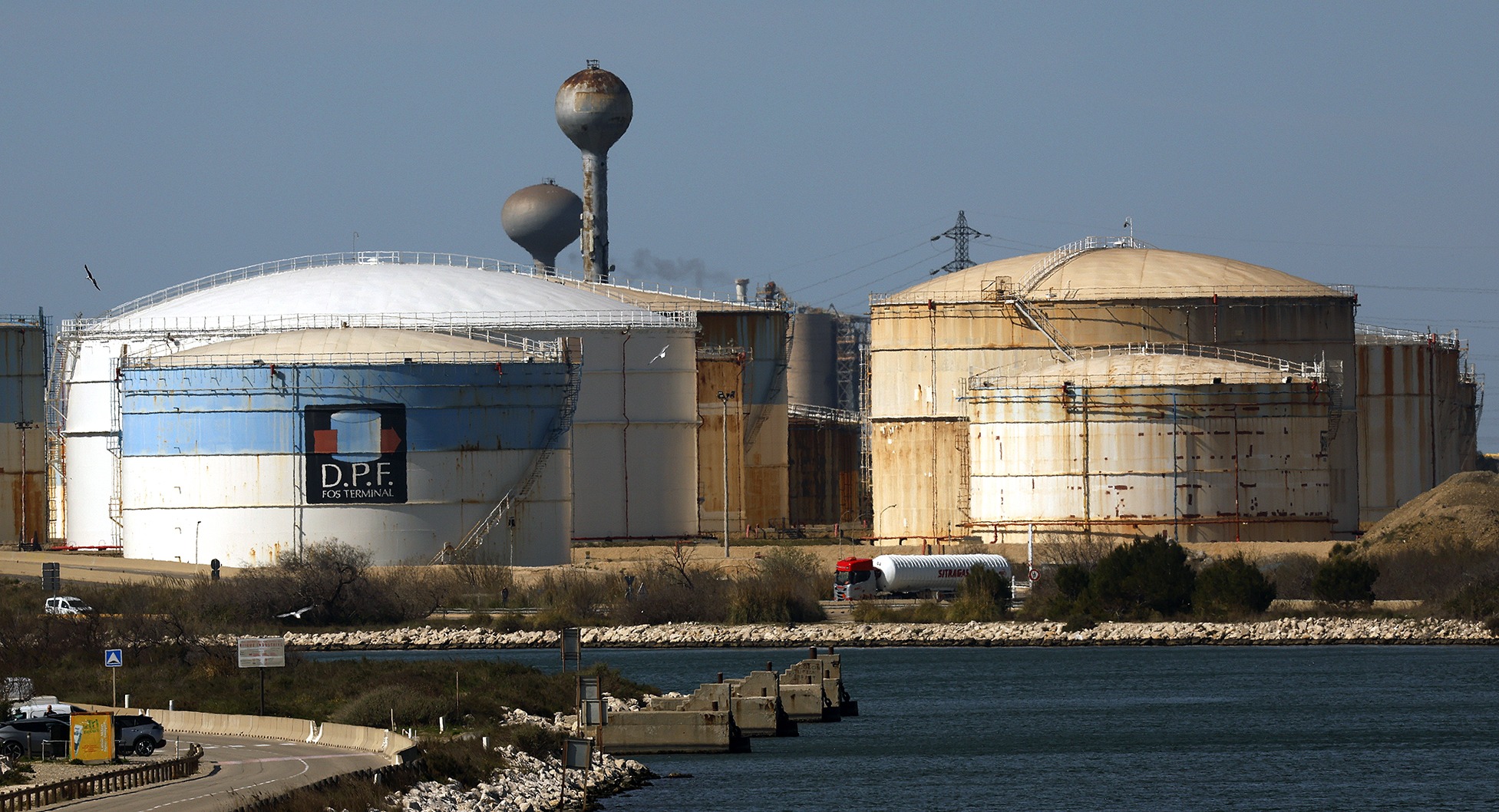
 A truck leaves the Depots Petroliers de Fos fuel depot and oil hub in Fos-sur-Mer, France, on 12 March. On 11 March, the members of the International Energy Agency unlocked 400 million barrels of oil from their reserves in response to rising oil prices brought on by the Iran conflict. (Photo: Guillame Horcajuelo / EPA)
 Note: This story has been updated to include a statement by DMPR released on Friday morning.
There is no government shutdown of petrol stations. There is no QR-code rationing system. The Fuel Pricing Mechanism director at the Department of Mineral and Petroleum Resources (DMPR), Robert Maake, was open with John Perlman on the radio show 702 Drive: “There’s no need to [panic over] anything as far as fuel supply is concerned at the moment.”
That is the official position. It is also, to a meaningful extent, accurate.
South Africa is experiencing an acute fuel supply shock triggered by escalating conflict in the Middle East and the effective closure of the Strait of Hormuz. The immediate shortages are real. The price shock heading for consumers in April is significant. But the scenario circulating on social media is not.
The contingency plan
While social media claims are exaggerated, the closure of the Strait has nonetheless exposed a very real vulnerability in our supply chain. But Maake says the DMPR anticipated that a pivot would be necessary:
“We have developed a sort of a contingency plan where, at the moment, I can tell you … we are expecting around … six vessels, six shipments that are coming from different parts of the world (India, West Africa) that are bringing products of different source to the country.”
Those six vessels are real, confirmed and en route. Supply chains have aggressively pivoted: crude oil is now being sourced primarily from Nigeria, Angola and Ghana to feed South Africa’s inland Natref refinery, while finished refined product, the petrol and diesel that goes straight to the forecourt, is coming in volume from India.
/file/dailymaverick/wp-content/uploads/2025/10/GettyImages-1247623140.jpg "The Natref crude oil refinery in Sasolburg. (Photo: Waldo Swiegers / Bloomberg via Getty Images)")
March and early April consignments were secured before the geopolitical escalation locked in higher freight costs.
The supply line is stretched, rerouted and considerably more expensive.
Why your forecourt is running dry anyway
DMPR and the Fuels Industry Association of South Africa issued a joint statement on Friday morning reiterating that the country’s fuel supply “remains stable in the immediate term” and calling on the public to continue purchasing fuel normally.
The statement seemingly took aim at coverage (like this article) linking the dry pumps to the Hormuz closure, stating that it was “incorrect and misleading” and that connecting “isolated domestic logistical matters to broader geopolitical developments” was wrong – which is a characterisation that sits awkwardly alongside the department’s own daily high-intensity logistics sessions and its confirmed pivot to supply chains that are far away from the conflict region.
Government is encouraging members of the public who experience fuel-related challenges are directed to report these to fuel.complaints@dmpr.gov.za.
Despite the government’s assurances of adequate supply, motorists in the Western Cape, Gauteng, Free State, North West and Northern Cape have watched 50ppm diesel signs go dark.
What is driving the localised shortages is industry-level controlled allocation measures.
Wholesale fuel companies are throttling deliveries downstream and have instituted blanket bans on ad hoc bulk purchases. The stated goal is to prevent speculative hoarding and market manipulation, the kind of panic-buying behaviour that turns a manageable logistics stutter into a genuine crisis. The unintended consequence is that your local forecourt runs dry faster than usual.
/file/attachments/orphans/GettyImages-1239465918_672686.jpg "The unintended consequence of the fuel industry’s controlled allocation measures is that your local forecourt runs dry faster than usual. (Photo: Dwayne Senior / Bloomberg via Getty Images)")
Liquid Fuels Wholesalers Association CEO Peter Morgan has been sharper in his assessment of the government’s response pace, arguing the industry “should have been talking about this three weeks ago” and that the country does not appear to be “in crisis mode”.
His concern points to a broader structural friction: coordination between state and industry is happening, but not at the tempo this disruption demands.
The Saldanha problem
The obvious question is: what about the Strategic Petroleum Reserve? South Africa maintains a stockpile at Saldanha Bay managed by the Strategic Fuel Fund. Its theoretical maximum capacity is 45 million barrels. The answer, unfortunately, is a logistical irony.
The facility currently holds an estimated 7.7 million barrels (about 17% of capacity).
But that crude oil at Saldanha relies on a pipeline to the Astron Energy refinery in Cape Town to be converted into the petrol and diesel the market actually needs. The Astron refinery, a 100,000-barrel-per-day facility, is currently offline for its planned annual maintenance shutdown.
As Morgan explained, with the Cape Town refinery on shutdown, the crude at Saldanha “is really not strategic stock”. The raw barrels exist. The mechanism to turn them into usable fuel does not, right now. Releasing the reserve today would be operationally useless.
The harvest is bleeding
While passenger car owners are experiencing inconvenience, the agricultural sector is facing something more serious. The supply shock has arrived directly at the start of the maize and fruit harvest season.
A single combine harvester consumes between 30 and 60 litres of diesel per hour of operation. Major agricultural cooperatives have implemented emergency purchase limits, in some cases capping farmers at 80 litres per day. That ceiling shuts down a combine harvester in under 90 minutes. Machinery is sitting idle in the fields. Yields are at risk. Downstream food inflation is no longer a forecast — it is already locked in.
This is the part of the fuel story that deserves more attention than the WhatsApp voice notes are giving it. The pump drama is temporary. The hit to agricultural output will reverberate through food prices for quarters.
April’s bill is already written
The physical supply picture will stabilise as the six confirmed vessels arrive and the pivoted procurement channels bed in. Minister Gwede Mantashe has been a less reassuring voice from the DMPR, acknowledging that “substantial fuel price increases are increasingly unavoidable”. He is correct.
With global Brent crude futures having surged past $115 per barrel in mid-March, and maritime freight costs spiking to bypass Middle East routes, current projections indicate retail price pain in April.
The government has, for now, bought time on supply. It has not, and cannot, buy time on price. DM